Facts
The petitioners constituted a consortium under a Consortium Agreement dated 27 July 2026, with LC Infra Projects Private Limited as the Lead Member and Radhika Opto Electronics Limited and Esmart Energy Solutions Limited as consortium members.
Source reference: p.2The MCD issued an RFP/NIT for replacement and comprehensive operation and maintenance of public lights across six zones for ten years, requiring an EMD comprising an online payment of ₹20 lakh and the balance through a bank guarantee/e-bank guarantee in favour of the Commissioner, MCD.
Source reference: p.3The consortium submitted its bid on 5 August 2026 and furnished the balance EMD through a bank guarantee issued by Union Bank of India on the application of Esmart Energy Solutions Limited, consortium member no. 2.
Source reference: p.4The bank guarantee was uploaded with the bid and its original was deposited in the tender box on 7 August 2026.
Source reference: p.4The MCD rejected the bid as “not admitted” on the ground that the EMD/bank guarantee was “not in confirmation of RFP”.
Source reference: p.1; para. 26The respondents contended that the covering letter identified the Lead Member, whereas the bank guarantee identified Esmart Energy Solutions Limited as the applicant/“Contractor”, without expressly connecting the guarantee to the consortium or the Lead Member.
Source reference: pp.6–11The petitioners challenged the rejection, contending that neither the RFP nor the Corrigendum required the bank guarantee to be furnished exclusively by the Lead Member.
Source reference: para. 27Issues
1. Whether the MCD could reject the consortium’s bid on the ground that the bank guarantee was furnished by a consortium member rather than the Lead Member, when the RFP and Corrigendum did not expressly impose such a requirement?
Source reference: pp.13–18, paras. 26–352. Whether the bank guarantee furnished by Esmart Energy Solutions Limited was non-conforming with the RFP merely because the covering letter named the Lead Member and the guarantee named another consortium member as applicant/Contractor?
Source reference: pp.6–11; pp.17–18, paras. 34–353. Whether the Court should interfere under Article 226 with the tendering authority’s interpretation and rejection of the bid?
Source reference: pp.18–21, paras. 35–36Law Applied
The Court applied Clause H.2(i) of the RFP, which required the balance EMD to be furnished through a bank guarantee/e-bank guarantee in favour of the Commissioner, MCD, valid for at least 180 days from the last date of bid submission.
Source reference: p.14, para. 29The Corrigendum specifically allocated certain eligibility requirements to any one consortium member, the Lead Member, or all members individually, and amended Clause J(D) to provide that the Lead Member would be “solely responsible and liable for meeting all obligations in relation to the agreement”.
Source reference: pp.15–16, para. 30Clause K permitted disqualification where the bid security did not conform to the RFP.
Source reference: p.9, para. 16The Court recognised the general principle that judicial review does not ordinarily involve appellate scrutiny of tender decisions and that the tendering authority is normally the best judge of its requirements, as stated in Tata Cellular v. Union of India, Afcons Infrastructure Ltd. v. Nagpur Metro Rail Corporation Ltd., Silppi Constructions Contractors v. Union of India, Jagdish Mandal v. State of Orissa, Michigan Rubber (India) Ltd. v. State of Karnataka and National High Speed Rail Corporation Ltd. v. Montecarlo Ltd.
Source reference: pp.10–12, paras. 18–22However, tender conditions must be clear and unambiguous; a bid cannot be rejected on an unstated or implied condition. Relying particularly on Kimberly Club Pvt. Ltd. v. Krishi Utpadan Mandi Parishad, 2025 INSC 1276, the Court held that where the tender intended a particular form or issuing authority, it was required to say so expressly.
Source reference: pp.18–21, para. 36Reasoning
The Court held that Clause H.2(i) specified the beneficiary, amount and validity of the bank guarantee but did not require the guarantee to be furnished by the Lead Member.
Source reference: p.17, paras. 29–32Although the Corrigendum expressly distinguished obligations applicable to the Lead Member and other consortium members, it contained no corresponding stipulation that the Lead Member alone must arrange or submit the EMD bank guarantee.
Source reference: pp.15–17, paras. 30–32Clause J(D), requiring the Lead Member to be responsible for obligations “in relation to the agreement”, was interpreted as concerning the future agreement to be executed after award of the contract, not as imposing an additional bid-stage requirement absent from Clause H.2(i).
Source reference: p.17, para. 33The respondents’ concern that the guarantee identified Esmart as the applicant/Contractor could have been addressed through an express tender condition requiring the Lead Member or consortium to be named as the secured party. Since no such condition existed, the MCD could not retrospectively introduce it as a ground of rejection.
Source reference: pp.17–18, paras. 34–35The Court also noted that the RFP permitted consortium bids and required submission of the Consortium Agreement and Power of Attorney; therefore, whether the consortium satisfied the remaining technical requirements could only be determined through proper technical evaluation, which had been prematurely prevented by the rejection.
Source reference: p.21, para. 37Holding
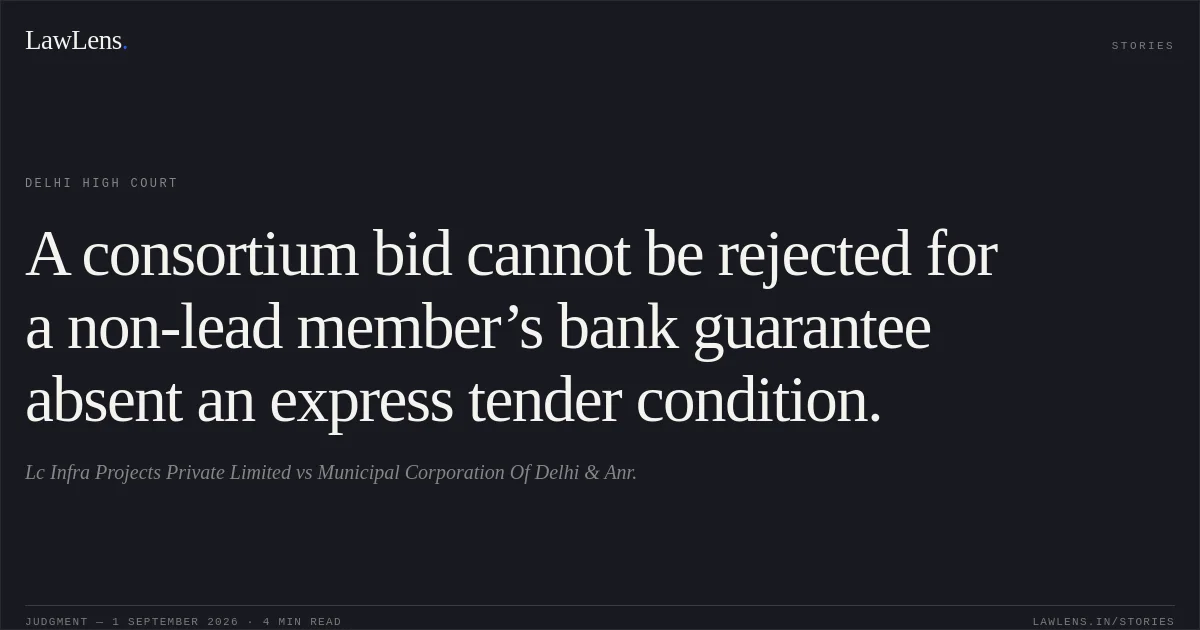
The Court held that rejection of the petitioners’ bid on the ground that the bank guarantee was not in conformity with the RFP was unsustainable because the RFP and Corrigendum did not require the EMD bank guarantee to be furnished exclusively by the Lead Member.
The respondents were directed to admit the bid, technically evaluate it, and proceed in accordance with the tender conditions.
Source reference: p.21, para. 38The Court clarified that it had examined only the stated objection concerning the bank guarantee and had not decided whether the consortium satisfied the other requirements of the RFP; those matters were left to the respondents for consideration during technical evaluation.
Source reference: p.22, para. 40The writ petition and pending application were accordingly disposed of.
Source reference: p.22, para. 41Original Court PDF
Lc Infra Projects Private LimitedvsMunicipal Corporation Of Delhi & Anr.
Click to open original judgment
Original judgment, available to read, download and summarize on LawLens.in