Facts
Sujata Kumari alleged that she married Petitioner No. 1, Pappu Kumar, on 17 March 2013 according to Hindu rites and thereafter resided at her matrimonial home in Village Sithauta, District Vaishali.
Source reference: pp. 2–3, paras. 2–3She alleged dowry-related cruelty and harassment by her husband and relatives, including demands for jewellery, television, refrigerator, furniture and other articles.
Source reference: pp. 2–3, paras. 2–3She further alleged that the accused persons assaulted her, sprinkled kerosene on her and attempted to set her on fire, compelling her to leave the matrimonial home and take shelter with her parents.
Source reference: pp. 2–3, paras. 2–3The complainant instituted Complaint Case No. 3735 of 2014 before the competent court at Saran.
Source reference: pp. 3–4, para. 4After recording her solemn affirmation and the statements of three inquiry witnesses, the Judicial Magistrate, Saran, found a prima facie case under Sections 323, 498A and 494 of the Indian Penal Code and issued process against the petitioners.
Source reference: pp. 3–4, para. 4The accused, who were the husband and his relatives, invoked Section 482 Cr.P.C. seeking quashing of the order dated 26 May 2015, principally contending that the alleged acts occurred in Vaishali and that the Saran court lacked territorial jurisdiction.
Source reference: pp. 3–6, paras. 5–8, 13Issues
Whether the Judicial Magistrate at Saran had territorial jurisdiction to entertain the complaint and issue process for offences under Sections 323, 498A and 494 IPC, when the principal acts of alleged cruelty occurred at the matrimonial home in Vaishali?
Source reference: pp. 6–9, paras. 13–16Whether the alleged cruelty under Section 498A IPC constituted a continuing offence or produced consequences within the jurisdiction of Saran so as to attract Sections 178 and 179 Cr.P.C.?
Source reference: pp. 7–12, paras. 14–22Whether the order dated 26 May 2015 issuing process against the petitioners warranted interference under Section 482 Cr.P.C.?
Source reference: pp. 6–7, 12–13, paras. 13, 23–24Law Applied
The Court applied Section 177 Cr.P.C., which prescribes that an offence ordinarily be inquired into and tried by the court within whose jurisdiction it was committed; Sections 178 and 179 Cr.P.C., which permit trial in any of several jurisdictions where an offence is partly committed, is continuing, consists of acts in different places, or where the consequence of an act ensues in another jurisdiction.
Source reference: pp. 7–8, para. 14Relying on State of Bihar v. Deokaran Nenshi, (1972) 2 SCC 890, the Court stated that a continuing offence is one involving a continuing breach or omission, with the offence recurring so long as the disobedience continues.
Source reference: p. 8, para. 16Section 498A IPC criminalises cruelty by a husband or his relative, including dowry-related harassment and wilful conduct causing grave injury or danger to the woman’s physical or mental health.
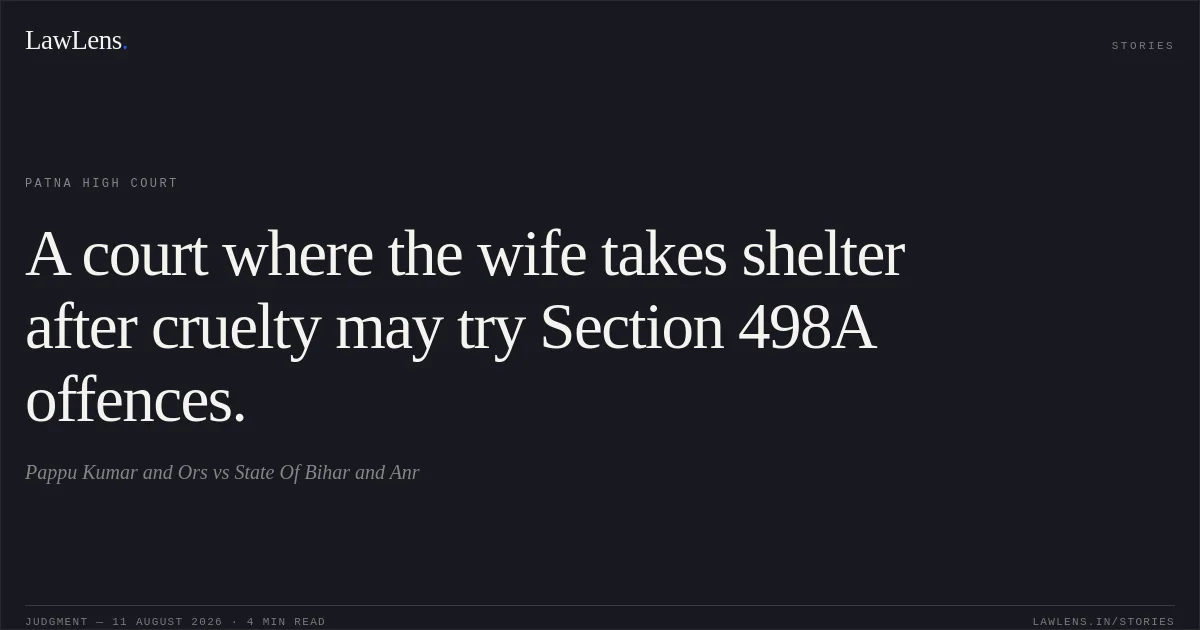
Source reference: pp. 9–10, para. 17The Court relied principally on Rupali Devi v. State of Uttar Pradesh, (2019) 5 SCC 384, which held that a court at the place where a wife takes shelter after leaving or being driven away from the matrimonial home may, depending on the facts, have jurisdiction to entertain a complaint under Section 498A IPC.
Source reference: p. 11, para. 20The Court also considered Amarendu Jyoti v. State of Chhattisgarh, (2014) 12 SCC 362, relied upon by the petitioners, but applied the later principle in Rupali Devi.
Source reference: pp. 4–5, 10–11, paras. 7, 20Reasoning
The Court held that the petitioners’ reliance on the ordinary rule in Section 177 Cr.P.C. was insufficient because Sections 178 and 179 create jurisdictional exceptions where the offence is continuing or its consequences ensue elsewhere.
Source reference: p. 8, para. 15On the complaint’s allegations, the complainant was subjected not merely to isolated acts of assault but to sustained physical and mental cruelty, including an alleged attempt to set her on fire, which compelled her to flee and take shelter with her parents.
Source reference: pp. 11–12, paras. 21–22The Court treated the continuing emotional distress and psychological consequences of the alleged matrimonial cruelty as consequences occurring at the place where the complainant took shelter.
Source reference: pp. 11–12, paras. 20–22Accordingly, the Saran court was held to possess concurrent jurisdiction under Section 179 Cr.P.C., notwithstanding that the matrimonial home and several alleged acts were situated in Vaishali.
Source reference: pp. 11–12, paras. 20–22Since the Magistrate had considered the complaint, the complainant’s solemn affirmation and the inquiry witnesses’ statements and had found a prima facie case, the High Court found no ground to exercise its inherent jurisdiction under Section 482 Cr.P.C.
Source reference: pp. 3–4, 12–13, paras. 4, 23Holding
The High Court answered the jurisdictional issue against the petitioners and held that the Saran court had jurisdiction to entertain the complaint and issue process, because the alleged cruelty and its continuing psychological consequences extended to the place where the complainant took shelter.
The application under Section 482 Cr.P.C. was therefore dismissed, and the order dated 26 May 2015 issuing process under Sections 323, 498A and 494 IPC was upheld.
Source reference: pp. 12–13, paras. 23–24The trial court was directed to proceed with the case and conclude the trial expeditiously without unnecessary delay.
Source reference: p. 13, para. 25No order as to costs was made.
Source reference: p. 13, para. 27Acts & Sections Cited
9 provisions across 2 statutes referred to in this judgment. Each provision opens on LawLens.
Code of Criminal Procedure, 19737
Indian Penal Code, 18602
Original Court PDF
Pappu Kumar and OrsvsState Of Bihar and Anr
Click to open original judgment
Original judgment, available to read, download and summarize on LawLens.in