Facts
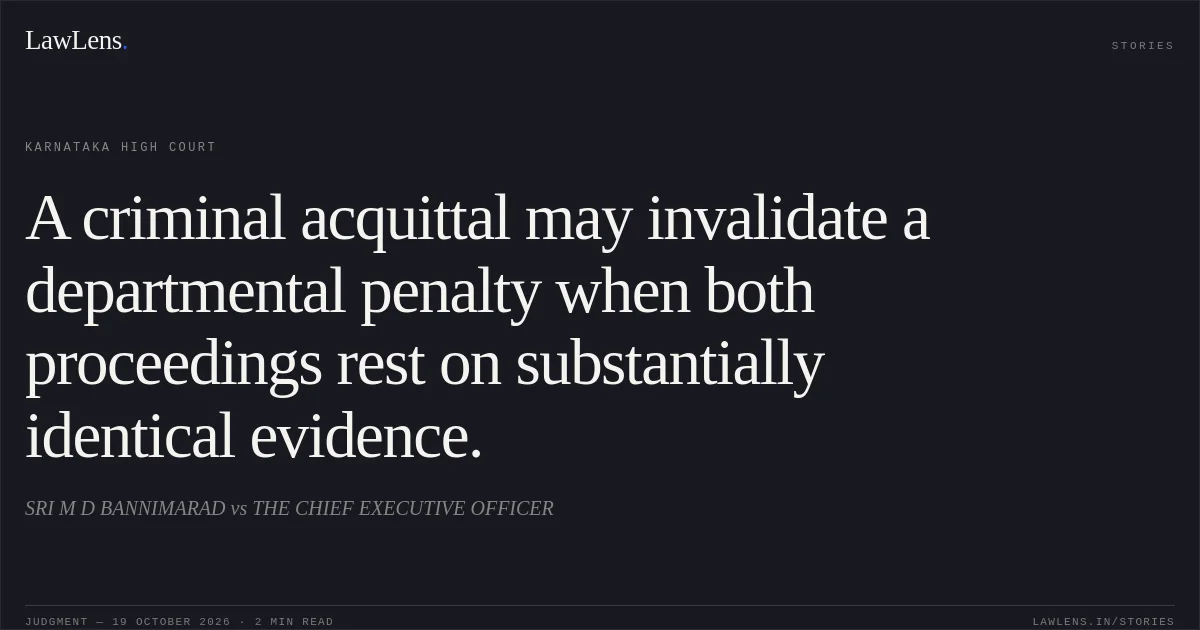
M.D. Bannimarad, then a District Officer with the Karnataka State Khadi and Village Industries Board, faced departmental and criminal proceedings arising from allegations concerning margin-money subsidies between 1998 and 2002.
Source reference: paras. 3.1–3.2, pp. 3–4The criminal court acquitted him and other accused, finding the evidence insufficient to establish, among other things, fraud, misappropriation, or financial loss.
Source reference: paras. 12–15, pp. 8–12The departmental authority ordered recovery of ₹8,85,000 from Bannimarad’s retirement benefits or as arrears of land revenue; the compulsory-retirement penalty mentioned in the Single Judge’s order applied to another accused.
Source reference: paras. 16–20, pp. 13–15Bannimarad’s writ petition challenging the recovery order was dismissed.
Source reference: paras. 18–21, pp. 14–15He died while the petition was pending, and his legal representatives appealed.
Source reference: paras. 18–21, pp. 14–15Issues
Whether the Single Judge’s decision could stand when it proceeded on the mistaken premise that Bannimarad had been compulsorily retired, rather than subjected to recovery of ₹8,85,000.
Source reference: paras. 17–20, pp. 13–15Whether the departmental recovery penalty should be set aside in light of Bannimarad’s criminal acquittal, where the proceedings arose from the same allegations and the criminal court found no proof of loss, fraud, or tampering.
Source reference: paras. 22–26, pp. 15–16, 51–52Law Applied
Criminal acquittal does not automatically invalidate a departmental penalty: criminal and disciplinary proceedings have different purposes, procedures, and standards of proof, and departmental misconduct is generally assessed on a preponderance of probabilities (*Karnataka Power Transmission Corporation Ltd. v. C. Nagaraju*; *State of Karnataka v. Umesh*).
Source reference: paras. 23, 11.1–11.2, pp. 16–19However, under *G.M. Tank v. State of Gujarat* and *Ram Lal v. State of Rajasthan*, where the charges, evidence, witnesses, and circumstances in the criminal and departmental proceedings are identical or substantially similar, and the criminal court has considered the evidence and found the prosecution case to have failed on its merits, a departmental finding may be set aside if allowing it to stand would be unjust, unfair, or oppressive.
Source reference: para. 23, pp. 20–28, 47–51The substance of the criminal judgment, rather than labels such as “benefit of doubt” or “honourable acquittal,” is determinative.
Source reference: para. 23, pp. 27–28, 48–51Reasoning
The Division Bench found that the Single Judge had proceeded on an incorrect factual premise: Bannimarad had not been compulsorily retired; the penalty against him was recovery of ₹8,85,000.
Source reference: paras. 19–20, pp. 14–15Applying the exception to the general rule of independence between criminal and disciplinary proceedings, the Bench considered that both arose from the same subsidy-related allegations and that the criminal court, after assessing the evidence, found no proof of financial loss, fraud, tampering, or conspiracy.
Source reference: paras. 10–15, 24–26, pp. 7–12, 51–52It concluded that, in these circumstances, sustaining the recovery penalty would not be justified.
Source reference: paras. 24–26, pp. 51–52Holding
The appeal was allowed and the Single Judge’s order dated 25 February 2022 was set aside.
The recovery penalty of ₹8,85,000 was obliterated, and the deceased employee’s family became entitled to his terminal benefits, to be settled within twelve weeks of receipt of the order.
Source reference: para. 28(iii)–(iv), pp. 52–53Acts & Sections Cited
9 provisions across 4 statutes referred to in this judgment. Each provision opens on LawLens.
KARNATAKA HIGH COURT ACT, 19611
Prevention of Corruption Act, 19881
Code of Criminal Procedure, 19731
Indian Penal Code, 18606
Original Court PDF
SRI M D BANNIMARADvsTHE CHIEF EXECUTIVE OFFICER
Click to open original judgment
Original judgment, available to read, download and summarize on LawLens.in