Facts
The petitioners were engaged by BESCOM as Micro Feeder Franchisees, later redesignated as Grama Vidyut Prathinidhis, under memoranda of understanding.
Source reference: no citationTheir services were terminated, and a coordinate Bench, by order dated 31 August 2020, quashed the termination orders and directed the respondents to hold disciplinary enquiries within eight weeks; if the petitioners were not found guilty, they were to be reinstated without consequential benefits.
Source reference: p. 10–13The Division Bench dismissed BESCOM’s appeals and directed compliance with the Single Judge’s directions.
Source reference: p. 10–13The respondents later issued notices, considered the petitioners’ replies and passed orders affirming the terminations.
Source reference: p. 8–9, 13–16The petitioners challenged those orders, contending that the directed enquiries had not been held.
Source reference: p. 8–9, 13–16Issues
1. Whether issuing notices, considering the petitioners’ replies and affirming the earlier termination orders amounted to the disciplinary enquiry directed in the earlier writ proceedings
Source reference: p. 13–162. Whether the impugned termination orders should be set aside and the matter remitted for disciplinary enquiries in accordance with the earlier directions
Source reference: p. 16–17Law Applied
The Court applied the binding directions in the earlier writ proceedings, as affirmed by the Division Bench: the respondents were required to conduct disciplinary enquiries, and petitioners not found guilty were to be reinstated without consequential benefits.
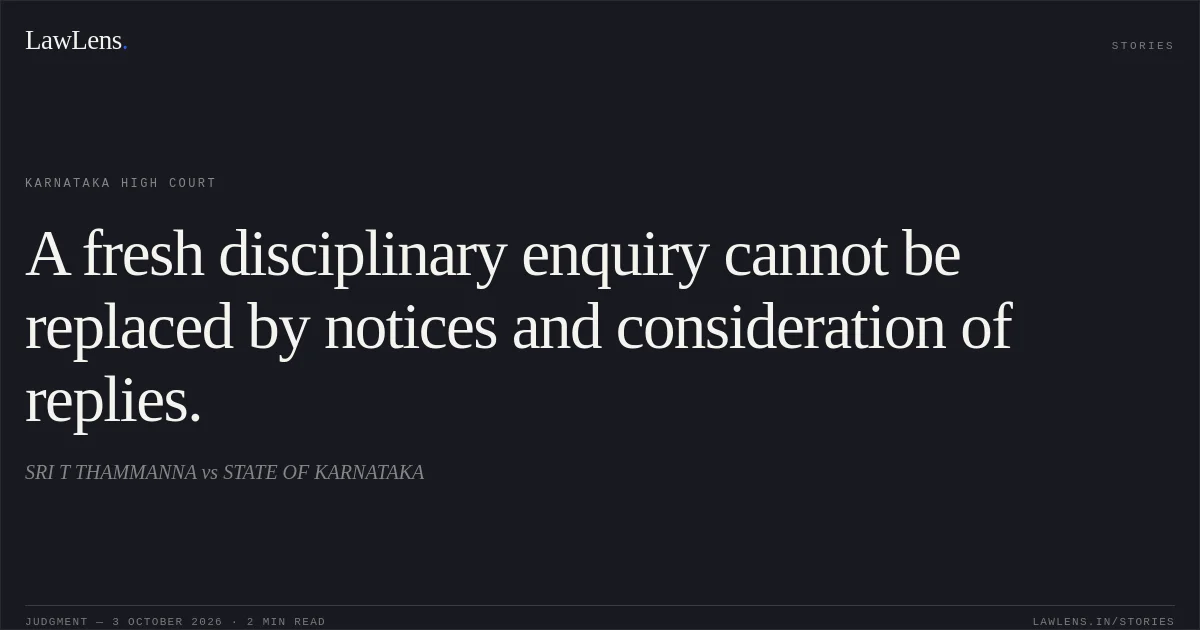
Source reference: p. 10–13A notice-and-reply procedure followed by reaffirmation of an earlier termination does not, by itself, satisfy a direction to conduct a disciplinary enquiry.
Source reference: p. 15–16The Court also referred to the earlier order’s recognition of the principles of natural justice and Article 21 in the context of termination from livelihood, citing Olga Tellis v. Bombay Municipal Corporation, (1985) 3 SCC 545.
Source reference: p. 10–11Reasoning
The Court compared the procedure actually followed with the prior judicial directions.
Source reference: p. 13–17Although notices were issued and replies considered, the respondents’ orders substantially reiterated the earlier terminations rather than conducting the fresh disciplinary enquiry required by the Court.
Source reference: p. 13–17The Court therefore held that the prior directions had not been complied with and that the termination orders could not stand.
Source reference: p. 13–17Holding
The petition was allowed in part.
The impugned orders were set aside, and the matter was remitted to the respondents to conduct disciplinary enquiries in accordance with the directions in the earlier writ proceedings.
Source reference: p. 17Given the protracted history, the respondents were directed to conclude the enquiries within three months of receiving a copy of the order.
Source reference: p. 17The judgment identifies the challenged orders as dated 2 May 2025, while the operative order states 2 May 2026.
Source reference: p. 1, 17Original Court PDF
SRI T THAMMANNAvsSTATE OF KARNATAKA
Click to open original judgment
Original judgment, available to read, download and summarize on LawLens.in