01Facts
The petitioners challenged the Sub-Divisional Officer’s order dated 24 September 2026 reserving the office of Sarpanch, Gram Panchayat Manchi, for OBC (Woman).
¶ 1–4They contended that the same office had been reserved for SC (Woman) in the 2020 election and that reserving it again for a woman violated rotation under Article 243D and the Rajasthan Panchayati Raj Act and Rules.
¶ 1–4They also alleged that the lottery was conducted without disclosure of the roster, eligible pool or proceedings, and sought either an unreserved seat or a fresh, transparent lottery.
¶ 1–4The State argued that Sarpanch offices are governed separately from seats and that an earlier SC (Woman) reservation did not bar a subsequent OBC (Woman) reservation.
¶ 8–1002Issues
i.Whether reserving the Sarpanch office for OBC (Woman) in 2026, after it had been reserved for SC (Woman) in 2020, violated the applicable constitutional and statutory rotation scheme
¶ 2, 5–7, 19–21ii.Whether the impugned reservation was unlawful because the lottery and its underlying roster or eligible pool were not adequately disclosed
¶ 3, 7, 1003Law Applied
Article 243D provides for category-based reservation and reservation for women, including rotation of reserved offices of Chairpersons among Panchayats; Article 243D(6) permits reservation for Backward Classes.
¶ 12Sections 15 and 16 of the Rajasthan Panchayati Raj Act, 1994 govern reservation of seats and offices of Chairpersons respectively; Section 16 requires offices to be allotted by rotation in the prescribed manner.
¶ 12Rules 7 and 9 of the Rajasthan Panchayati Raj (Election) Rules, 1994 provide the mechanisms for reservation of seats and Sarpanch offices respectively; Rule 7(13)’s exclusion of certain wards or constituencies from subsequent lotteries cannot automatically be extended to Sarpanch offices governed by Rule 9.
¶ 8–10, 12The Court held that category-wise reservation is vertical, while women’s reservation operates horizontally within the relevant categories and the overall quota.
¶ 14, 17–19Rotation must be assessed by reference to the applicable category-wise sequence and prescribed cycle; a prior women’s reservation, by itself, does not make a Panchayat ineligible for a subsequent women’s reservation.
¶ 14, 17–19Provisions in the judgment · 3 · Linked ones open on LawLens
Rajasthan Panchayati Raj Act, 1994 Section 15Section 16
Maharashtra Inferior Village Watans Abolition Act. Section 30
04Reasoning
The Court treated reservation of Sarpanch offices as distinct from reservation of seats and applied the office-specific scheme under Section 16 and Rule 9.
¶ 14, 18–19It reasoned that a prior SC (Woman) reservation did not, without more, bar a later OBC (Woman) reservation: the legality depended on whether the authorities correctly determined category-wise reservations, accommodated the women’s quota and followed the applicable rotational cycle.
¶ 14, 18–19The petitioners’ reliance on Rule 7(13) could not establish a restriction on Sarpanch-office allocation, and the Bombay High Court decision they cited arose under different Maharashtra provisions and was not controlling.
¶ 10, 20The Court concluded that the impugned order complied with the constitutional and statutory scheme.
¶ 2105Holding
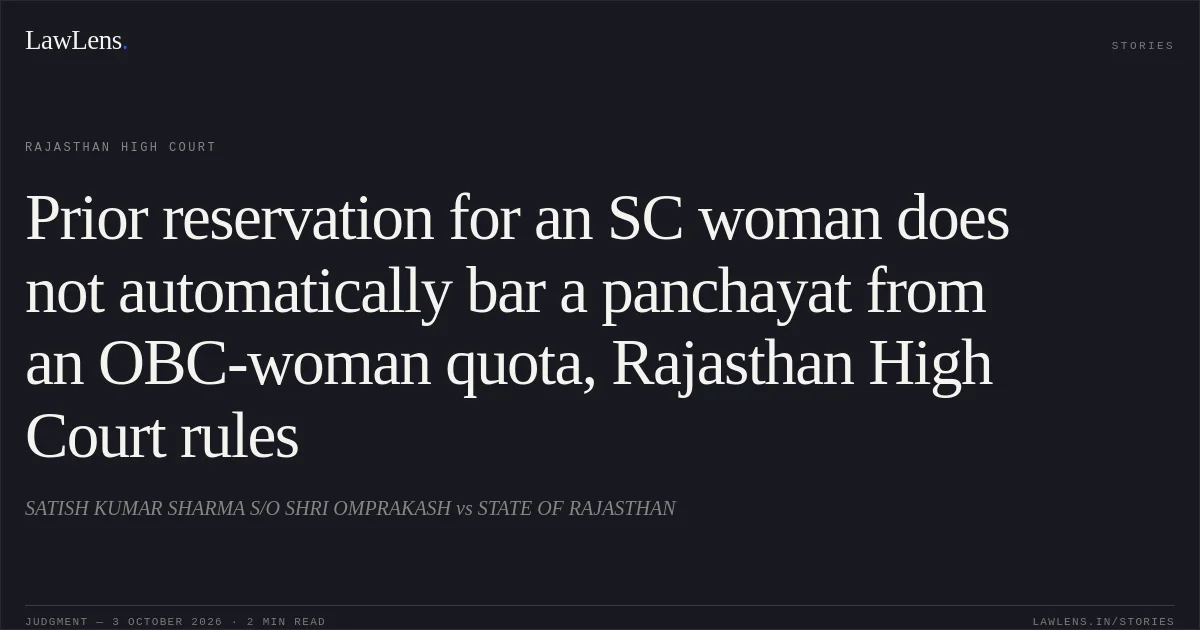
The Court held that the 2026 reservation of the Sarpanch office of Gram Panchayat Manchi for OBC (Woman) was not invalid merely because the office had been reserved for SC (Woman) in 2020, and found no jurisdictional infirmity or illegality warranting interference.
¶ 21The writ petition was dismissed; pending applications, if any, were disposed of.
¶ 22–23Original Court PDF
SATISH KUMAR SHARMA S/O SHRI OMPRAKASHvsSTATE OF RAJASTHAN
Click to open original judgment
Original judgment, available to read, download and summarize on LawLens.in