Facts
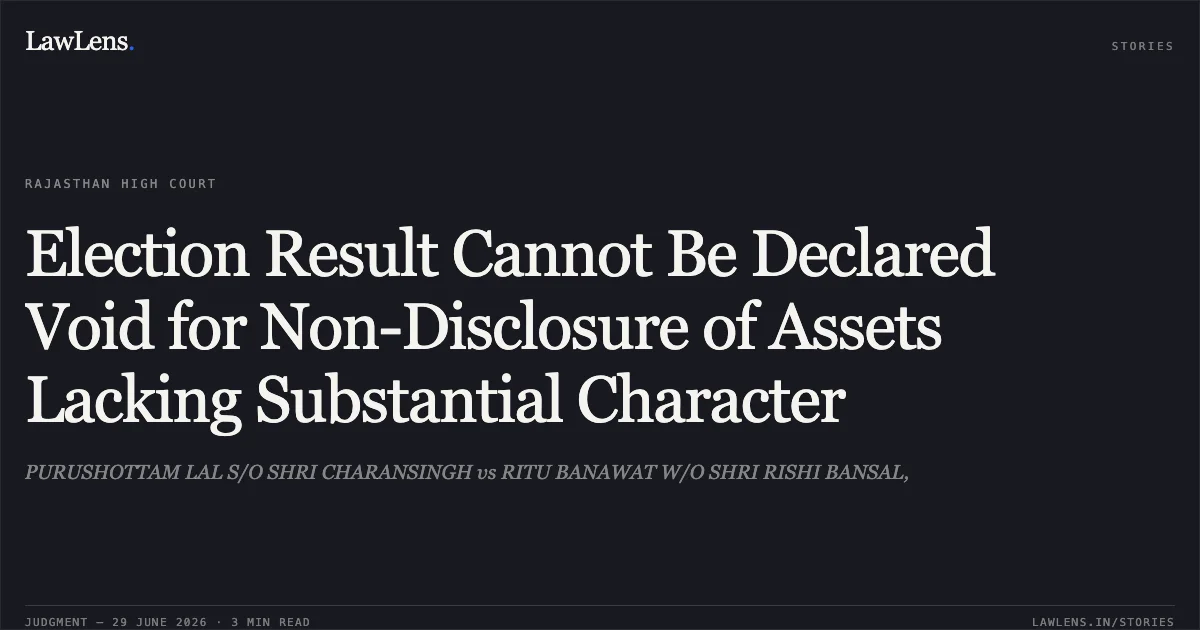
The Petitioner, a contesting candidate who secured 689 votes in the 2023 Rajasthan State Assembly Elections for the Bayana Constituency (No. 076), challenged the election of Respondent No. 1 (the returned candidate with 105,749 votes).
Source reference: para 2The challenge was primarily based on alleged non-disclosure and concealment of assets, liabilities, social media accounts, and sources of income in the Form-26 affidavit, asserting that such omissions constituted "corrupt practices" under Section 100(1)(b) and (d) of the Representation of People Act (RP Act), 1951.
Source reference: para 3The Petitioner further sought to disqualify Respondents No. 2 to 10 to be declared the only surviving candidate.
Source reference: para 5Issues
1. Whether the alleged non-disclosures in Form-26 attract grounds under Section 100(1)(b) or 100(1)(d) of the RP Act, 1951, to declare the election of Respondent No. 1 void.
Source reference: para 72. Whether the nomination forms of Respondents No. 2 to 10 were improperly accepted and are liable to be rejected.
Source reference: para 73. Whether the Petitioner is entitled to be declared as an unopposed elected member if the other nominations are cancelled.
Source reference: para 7Law Applied
The Court applied Section 33A and Rule 4A of the Conduct of Election Rules, 1961, regarding the mandatory filing of Form-26 affidavits.
Source reference: para 11-12It relied on the principle from Resurgence India v. Election Commission of India [(2014) 14 SCC 189], holding that filing an affidavit with blank particulars renders it nugatory if the candidate fails to fill them after a reminder.
Source reference: para 13The Court further applied Section 36(4) of the RP Act, which mandates that a nomination shall not be rejected for defects not of a "substantial character".
Source reference: para 19It integrated the doctrine from Karikho Kri v. Nuney Tayang [(2024) 15 SCC 112] and Ajmera Shyam v. Kova Laxmi [(2026) 3 SCC 373], establishing that the "right to know" is not absolute and only non-disclosure of "substantial issues" (as opposed to technical or trivial ones) warrants voidance of an election.
Source reference: para 25-26charges of "corrupt practice" under Section 123 must be proved "to the hilt" beyond reasonable doubt.
Source reference: para 34-35Reasoning
Social media accounts: Non-disclosure was deemed non-substantial as name/email were provided, making accounts easily traceable.
Source reference: para 28.1Bank Accounts: The SBI and Canara bank accounts contained trivial amounts (Rs. 1,458 and Rs. 83), and their omission did not constitute a material defect.
Source reference: para 28.2Vehicle Valuation: The Petitioner’s claim of undervalued vehicles failed because he did not factor in depreciation or provide market evidence.
Source reference: para 28.3Real Estate: The Court accepted the explanation that a plot was sold via agreement-to-sale prior to nomination and a residential house belonged to the mother-in-law, not the candidate.
Source reference: para 28.4Blank Columns: The Court found that the unfilled columns were either technical omissions or implied a "Nil" value, lacking the substantiality required to influence the electorate.
Source reference: para 28.6The Court reasoned that the Petitioner failed to prove that these minor discrepancies materially affected the election result or infringed upon the voters' "right to know" in a meaningful way.
Source reference: para 31, 39Holding
The Court answered Issue No. 1 in the negative, holding that the defects in Respondent No. 1’s affidavit were not of a substantial character.
Issues No. 2 and 3 were rendered redundant as the election of the returned candidate remained valid.
Source reference: para 42The Court dismissed the election petition.
Source reference: para 46Consequently, the Court saddled Respondent No. 1 with a cost of Rs. 1,00,000 payable to the Petitioner.
Source reference: para 47Acts & Sections Cited
34 provisions across 2 statutes referred to in this judgment. Each provision opens on LawLens.
Representation of the People Act, 1951
Bharatiya Sakshya Adhiniyam, 20231
Original Court PDF
PURUSHOTTAM LAL S/O SHRI CHARANSINGHvsRITU BANAWAT W/O SHRI RISHI BANSAL,
Click to open original judgment
Original judgment, available to read, download and summarize on LawLens.in