01Facts
The petitioner contested the 2023 election to the 175 Bommanahalli Assembly Constituency. Results were declared on 13.05.2023.
¶ 8The petitioner filed the election petition (EP) on 27.06.2023, the 45th day, seeking a declaration that the first respondent's election was void under Section 100(1)(d)(iv) of the Representation of the People Act, 1951 (RoPA).
¶ 1 · ¶ 8 · ¶ 14The EP was presented at 3:55 pm before the officiating Registrar (Protocol), as the Registrar (Judicial) was on leave.
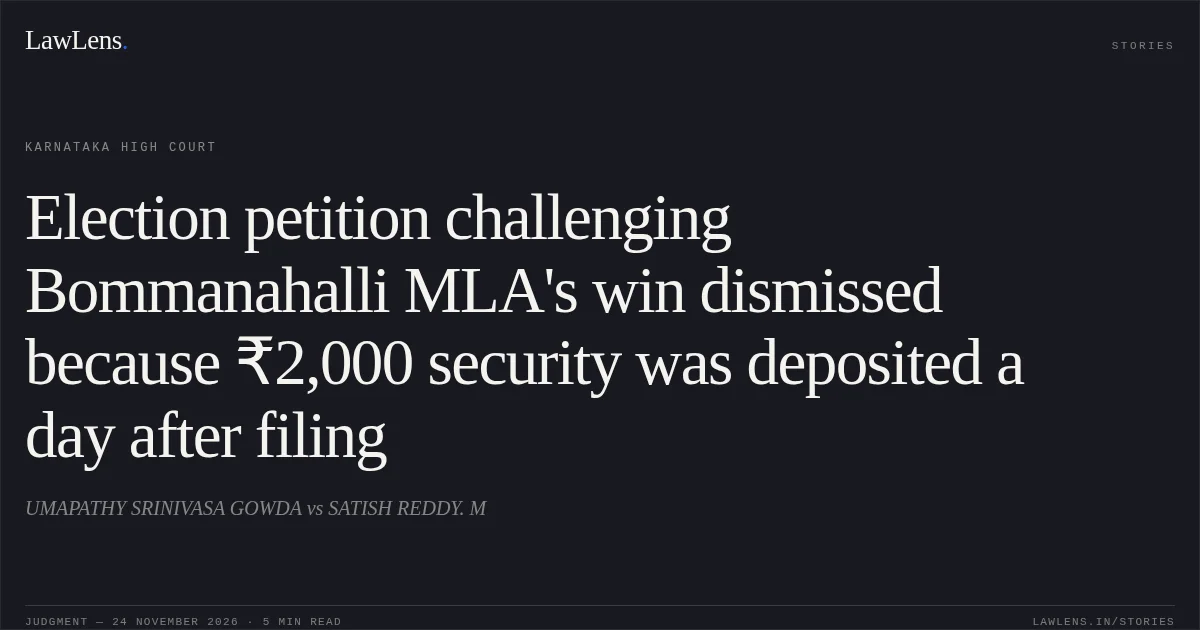
¶ 14 · ¶ 30The Rs. 2,000 security for costs under Section 117 RoPA was deposited on 28.06.2023, and the certificate was dated 28.06.2023.
¶ 6 · ¶ 52The petitioner's case is that the Accounts Branch had closed for the day before he presented the EP, making earlier deposit impossible.
¶ 15The Registry raised an office objection regarding the non-affixed certificate.
¶ 44 · ¶ 39The first respondent's earlier application under Order VII Rule 11 CPC was dismissed on 09.05.2024.
¶ 5The Supreme Court declined to interfere but held certain observations were obiter and directed that the question whether the Accounts Branch was closed at 3:55 pm, and whether the petitioner was prevented by circumstances beyond his control, be determined after evidence.
¶ 5 · ¶ 16A preliminary issue was framed on 07.03.2025.
¶ 6In evidence, the petitioner (PW-1) admitted non-deposit before filing and deposit on 28.06.2023.
¶ 6 · ¶ 7In cross-examination, the petitioner stated that he was told to deposit the next day.
¶ 36The Deputy Registrar (Accounts-I), summoned as an official witness, did not produce records.
¶ 2902Issues
i.1. Whether the Accounts Branch of the High Court was closed at 3:55 pm on 27.06.2023, and whether the petitioner could not deposit security for costs for reasons beyond his control.
¶ 15(i) · ¶ 16ii.2. Whether depositing security for costs one day after presentation of the EP violates the mandatory requirement of Section 117 RoPA and Rule 22 of the Karnataka Election Petition Rules, 1967.
¶ 15(ii) · ¶ 43iii.3. If there is non-compliance, whether the defect is fatal or curable under Rules 8 to 10 of the EP Rules.
¶ 15(iii) · ¶ 25, 33–35iv.4. Whether the EP can be rejected under Order XII Rule 6 and/or Order VII Rule 11 CPC on the basis of the petitioner's admissions.
¶ 42 · ¶ 5703Law Applied
Section 117(1) RoPA requires security of Rs. 2,000 to be deposited at the time of presenting an EP.
¶ 3 · ¶ 20Section 86(1) RoPA mandates dismissal of an EP that does not comply with Sections 81, 82 or 117.
¶ 3 · ¶ 20Rule 22 of the Karnataka Election Petition Rules, 1967 requires the EP to be accompanied by an Accounts Branch certificate of deposit.
¶ 20 · ¶ 43In Sitaram v. Radhey Shyam Vishnav (2018) 4 SCC 507, the Supreme Court held that "accompanied" means co-existing, so that deposit cannot be separated from presentation.
¶ 2 · ¶ 43In Charan Lal Sahu v. Nandkishore Bhatt (1973) 2 SCC 530 and Aeltemesh Rein (1981) 2 SCC 689, the principle that non-deposit leaves the court no option but dismissal, and that the court has no power to condone it.
¶ 4 · ¶ 56In M. Karunanidhi (1983) 2 SCC 473 and M.Y. Ghorpade (2002) 7 SCC 289, the mandatory nature of the deposit requirement.
¶ 56Rule 5, Chapter XII of the Rules of the High Court, Rule 4 of the Karnataka High Court Accounts Rules, 1965 (including the Registrar's power to permit transactions beyond closing hours), and Rule 18(a) of the Treasury Code fix working hours and govern deposits.
¶ 19–22 · ¶ 53A plea of impossibility must be pleaded, and a party must exhaust all available modes of performance.
¶ 54Rules 8 to 10 of the Karnataka Election Petition Rules, 1967 govern the curability of defects in an EP.
¶ 25Order XII Rule 6 and Order VII Rule 11 CPC govern summary disposal, and Bhim Rao Baswanth Rao Patil (2023) 18 SCC 231 and Karam Kapahi (2010) 4 SCC 753 hold that these powers must be used sparingly.
¶ 32, 48, 50–51Provisions in the judgment · 8 · Linked ones open on LawLens
Representation of the People Act, 1951 Section 81Section 82Section 86Section 100Section 101Section 117
Code of Civil Procedure, 1908 Section 148Section 151
04Reasoning
The court accepted that the deposit was not made with the EP, so the statutory requirement of Section 117 RoPA was not met.
¶ 43, 57The plea of impossibility failed for lack of pleading. Paragraph 15 of the EP pleaded only the deposit on 28.06.2023 and did not plead that the petitioner was prevented from depositing earlier or that he sought the Registrar's permission under the proviso to Rule 4 of the Accounts Rules.
¶ 52 · ¶ 53Because the Treasury Code and Accounts Rules contemplate deposit beyond normal hours on the Registrar's permission, a party claiming impossibility must show that he availed or exhausted every available mode.
¶ 54–55The court found no such pleading or evidence.
¶ 55The court relied on the petitioner's admissions: he did not pay before filing, he was told to pay the next day, and he admitted he did not know the Accounts Branch's closing time.
¶ 7, 36–37The court did not expressly decide whether the Accounts Branch closed before 3:55 pm, and it did not record a finding on the curability argument under Rules 8 to 10 of the EP Rules.
see paras. 25, 33–35, 47 · no express findingInstead, the court held that the admitted non-compliance made continuation of trial futile.
¶ 57The threshold for Order XII Rule 6 was met because the admission was clear and unequivocal, and the mandatory nature of the deposit was not disputed.
¶ 56–5705Holding
The petitioner's admissions of non-deposit before presentation and deposit on the following day constitute clear, unequivocal admissions of non-compliance with Section 117 RoPA.
¶ 57The plea of impossibility was not pleaded and was not supported by evidence that the petitioner exhausted the available modes of deposit, including seeking the Registrar's permission.
¶ 53–55The threshold for judgment on admissions under Order XII Rule 6 CPC was met, so no trial was required.
¶ 57The judgment does not expressly decide the curability question under Rules 8 to 10 of the EP Rules or record a finding on whether the Accounts Branch was closed at 3:55 pm.
The Election Petition is dismissed with no order as to costs.
¶ 58Original Court PDF
UMAPATHY SRINIVASA GOWDAvsSATISH REDDY. M
Click to open original judgment
Original judgment, available to read, download and summarize on LawLens.in