Facts
The petitioner, Accused No. 2 in a case arising from Crime No. 20/2021, was charged under Sections 504, 326, 307, 506, 120(B) and 212 read with Section 34 of the IPC.
Source reference: pp. 2–5After the charge sheet was filed, he was granted regular bail by the Sessions Court on 9 September 2021.
Source reference: pp. 2–5He appeared in the original sessions case until his arrest in a separate NDPS case in 2023; his absence thereafter led to a split-up case and coercive steps.
Source reference: pp. 2–5He was secured before the trial court on 19 March 2026, remanded to custody, and his bail application was rejected on 27 June 2026.
Source reference: pp. 2–5He then sought regular bail from the High Court.
Source reference: pp. 2–5The State opposed release, citing his criminal antecedents and concerns about securing his attendance and preventing further offences.
Source reference: p. 4Issues
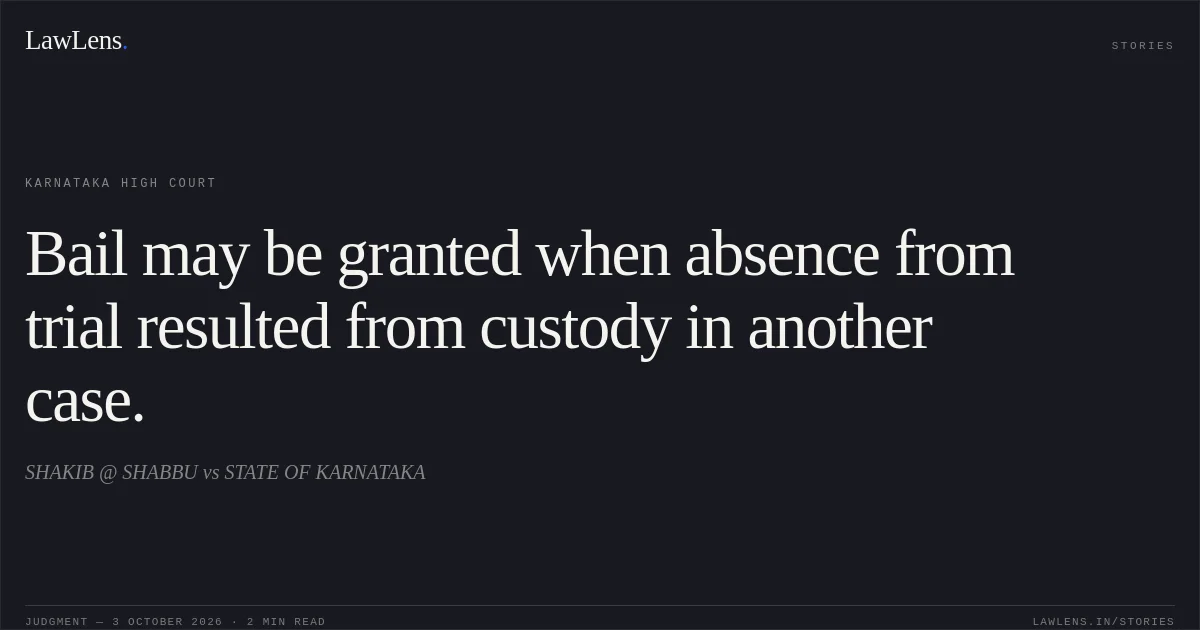
Whether the petitioner should be granted regular bail in the split-up case, notwithstanding his prior non-appearance before the trial court.
Source reference: pp. 3–6Whether appropriate conditions could address the concerns about the petitioner’s attendance and risk of further offences.
Source reference: pp. 4, 6–8Law Applied
The petition was considered under Section 483 of the Bharatiya Nagarik Suraksha Sanhita, 2023, which provides the basis for the High Court’s consideration of regular bail.
Source reference: pp. 2, 6The Court applied its discretionary bail jurisdiction to the circumstances of the case, including the petitioner’s prior grant of bail on the merits, the explanation for his subsequent absence, and the need to secure his future attendance.
Source reference: no citationReasoning
The Court noted that the petitioner had previously been granted bail after the charge sheet was filed and had attended the original proceedings until he was arrested in the separate NDPS case.
Source reference: pp. 4–5In light of that explanation, the Court treated the split-up proceedings as arising from his inability to attend after that arrest, rather than disregarding the prior bail order or his earlier attendance.
Source reference: pp. 4–5Although the State raised concerns about antecedents, attendance, and possible further offending, the Court considered the petitioner’s custody of approximately six months for his absence sufficient punishment and accepted his undertaking to cooperate with the trial.
Source reference: pp. 4, 6–7It addressed the remaining concerns through conditions governing attendance, conduct, travel, and reporting to the police.
Source reference: pp. 7–8Holding
The High Court allowed the petition and directed that the petitioner be released on regular bail in S.C. No. 79/2026, subject to a personal bond of ₹1,00,000 with two sureties, one of whom must be local.
Conditions include regular court attendance, no threatening or tampering with prosecution witnesses, no involvement in similar offences, no departure from the trial court’s jurisdiction without permission, and attendance at Surathkal Police Station on the second and fourth Sundays of each month until disposal of the case.
Source reference: pp. 6–8Acts & Sections Cited
8 provisions across 3 statutes referred to in this judgment. Each provision opens on LawLens.
Code of Criminal Procedure, 19731
Bharatiya Nagarik Suraksha Sanhita, 20231
Indian Penal Code, 18606
Original Court PDF
SHAKIB @ SHABBUvsSTATE OF KARNATAKA
Click to open original judgment
Original judgment, available to read, download and summarize on LawLens.in