Facts
The Respondent instituted CS(COMM) No. 260/2020 against the Appellant for injunction and allied reliefs concerning the Appellant’s use of the trademark “T-MAX”.
Source reference: p.2, para. 2.2The Appellant was served with summons on 27.08.2022 and engaged counsel, who appeared on 04.11.2022. Although the Trial Court granted time to file the written statement and affidavit of admission/denial, the Appellant failed to file them within the prescribed period and also failed to pay imposed costs.
Source reference: p.7, para. 6(i)–(iii)On 22.02.2023, the Trial Court noted that a copy of the written statement had been shared with the Respondent’s counsel through WhatsApp but had not been filed in Court. The matter was adjourned to 20.04.2023 for filing the written statement, affidavit and costs.
Source reference: p.7–8, para. 6(iv)On 20.04.2023, no one appeared for the Appellant. The Trial Court closed his right to file the written statement and proceeded ex parte.
Source reference: p.8, para. 6(v)The Appellant’s counsel appeared through video conferencing on 01.04.2025 and 23.05.2025, but no application was filed to recall the ex-parte order. The Respondent thereafter led ex-parte evidence, and the Trial Court pronounced an ex-parte judgment on 07.07.2025, granting permanent injunction and awarding damages and costs of Rs. 9,00,000/-.
Source reference: p.8–9, para. 6(vi)–(vii)After receiving a legal notice on 12.08.2025, the Appellant filed an application under Order IX Rule 13 CPC, together with an application for condonation of delay, contending that his counsel had negligently failed to file the written statement and had falsely represented that settlement talks were continuing.
Source reference: p.4, paras. 2.8–2.10Issues
Whether the Appellant was prevented by sufficient cause from appearing before the Trial Court on 20.04.2023, or on any subsequent date, so as to warrant setting aside of the ex-parte order and judgment under Order IX Rule 13 CPC?
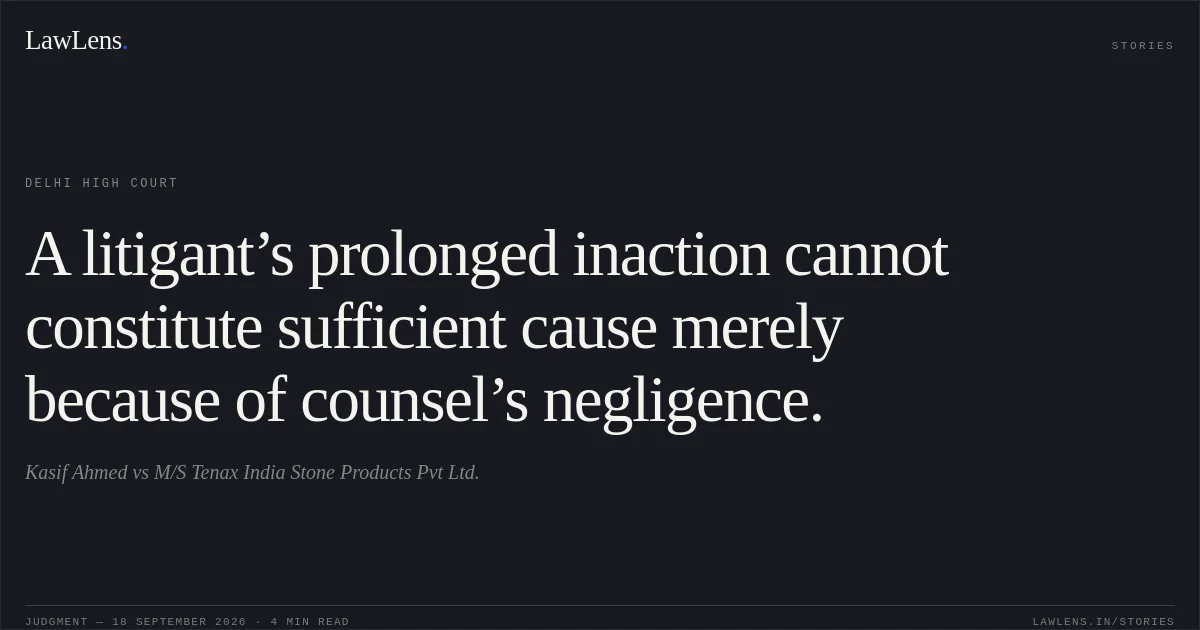
Source reference: p.6, para. 8Whether the Appellant could avoid the consequences of his prolonged inaction by attributing the non-appearance and failure to defend the suit entirely to the negligence of his counsel?
Source reference: p.9–12, paras. 9–13Whether the Appellant’s alleged lack of digital literacy and belief in ongoing settlement negotiations constituted sufficient cause for not monitoring the proceedings until the ex-parte judgment was passed?
Source reference: p.13–14, paras. 14–16Law Applied
The Court applied Order IX Rule 13 CPC, under which an ex-parte decree may be set aside only if summons were not duly served or if the defendant establishes that he was prevented by sufficient cause from appearing when the suit was called for hearing.
Source reference: p.10, para. 11The appeal was considered under Section 104 read with Order XLIII Rule 1(d) and Section 151 CPC, read with Section 13(1) of the Commercial Courts Act, 2015.
Source reference: p.1, para. 1The Court also applied the statutory time-bound procedure governing commercial suits, including the 120-day outer limit for filing a written statement, relying on M/s SCG Contracts India Pvt. Ltd. v. K.S. Chamankar Infrastructure Pvt. Ltd., (2019) 12 SCC 210.
Source reference: p.8, para. 6(v)Relying on Rajneesh Kumar v. Ved Prakash, 2024 SCC OnLine SC 3380, and Salil Dutta v. T.M. & M.C. Private Ltd., (1993) 2 SCC 185, the Court held that a litigant must remain vigilant and cannot ordinarily shift the entire responsibility for prolonged inaction onto counsel; although relief may exceptionally be granted where the client is an innocent litigant, there is no absolute immunity from the consequences of an advocate’s conduct.
Source reference: p.11–12, para. 13The liberal approach to “sufficient cause” recognised in A. Murugesan v. Jamuna Rani, (2019) 20 SCC 803, applies where specific circumstances explain the non-appearance and the application is made promptly, but does not assist a litigant guilty of prolonged and unexplained inaction.
Source reference: p.15, para. 18Reasoning
The Court found that the Appellant had due notice of the suit, had received the plaint and documents, and had been granted repeated opportunities to file his written statement and affidavit of admission/denial.
Source reference: p.7–8, para. 6(i)–(iv)His failure to file those documents, failure to pay costs, and non-appearance on 20.04.2023 demonstrated his own lack of diligence. More significantly, after being proceeded ex parte, he took no steps for approximately two years, although the suit remained pending and his counsel appeared in 2025.
Source reference: p.8–9, para. 6(v)–(vii)The alleged oral assurances regarding settlement were unsupported by correspondence, call records or other documentary evidence, and could not justify complete disengagement from the proceedings.
Source reference: p.13, para. 14The Court held that the Appellant had several available means of monitoring the case, including inspecting the physical court record, attending hearings, using video conferencing, or obtaining assistance to access online case-status facilities. His asserted lack of digital literacy therefore did not constitute sufficient cause, particularly when he was a businessman and had produced no material substantiating the assertion.
Source reference: p.13–14, paras. 15–16Accepting such an explanation would undermine the time-bound framework of the Commercial Courts Act and reward prolonged negligence in commercial litigation.
Source reference: p.14–15, para. 17The Court distinguished A. Murugesan because that case involved a single unexplained absence supported by specific circumstances and an immediate application, unlike the Appellant’s prolonged inaction over two years.
Source reference: p.15, para. 18Holding
The Court held that the Appellant failed to establish any sufficient cause under Order IX Rule 13 CPC for his non-appearance on 20.04.2023 or for his continued failure to participate in the suit thereafter.
His reliance on counsel’s alleged negligence, settlement discussions and lack of digital literacy was rejected as insufficient and inconsistent with his duty to remain vigilant.
Source reference: p.12–14, paras. 14–16The Trial Court’s order dismissing the Order IX Rule 13 application was upheld, and the appeal was dismissed. The pending applications were also disposed of.
Source reference: p.15, para. 19Acts & Sections Cited
3 provisions across 2 statutes referred to in this judgment. Each provision opens on LawLens.
Code of Civil Procedure, 19082
Commercial Courts Act, 20151
Original Court PDF
Kasif AhmedvsM/S Tenax India Stone Products Pvt Ltd.
Click to open original judgment
Original judgment, available to read, download and summarize on LawLens.in