Facts
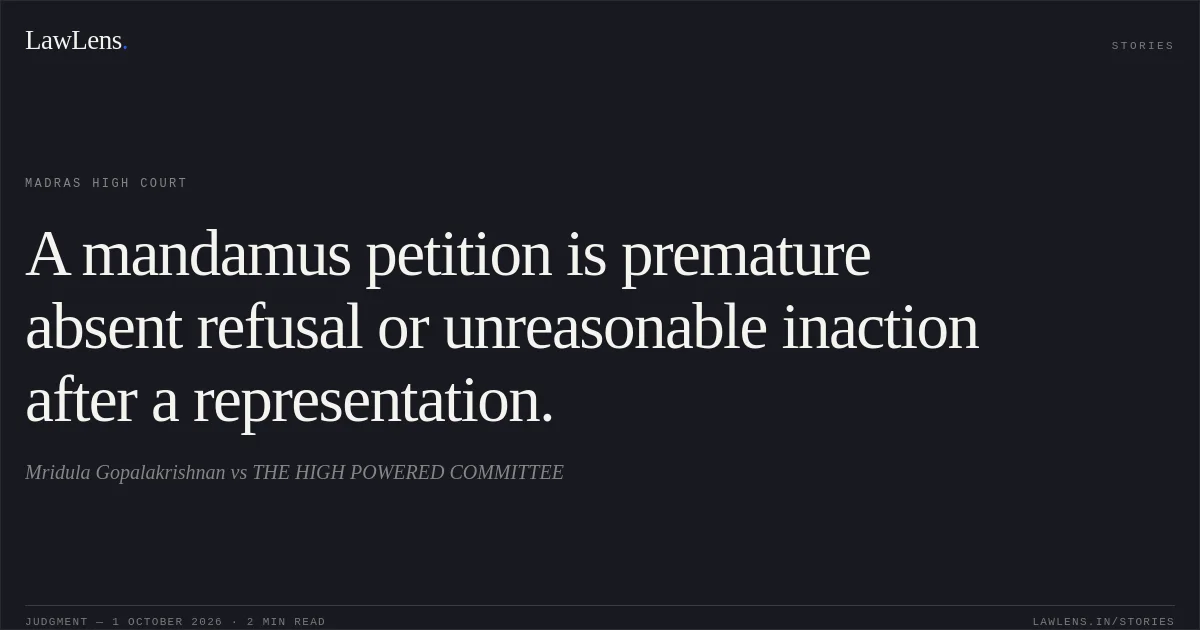
The petitioner submitted a representation on 16 September 2026 asking the first respondent to examine the legality and provenance of the transfer of five juvenile elephants from Assam to Tamil Nadu, including their captive-birth status and ownership.
Source reference: pp. 2–3She filed this writ petition the following day, seeking a direction to consider the representation and related relief.
Source reference: pp. 2–3The Court dismissed the petition as premature without examining the merits of the representation.
Source reference: pp. 5–6Issues
1. Whether the petitioner had established a prior demand and refusal, or unreasonable inaction, sufficient to maintain a writ of mandamus under Article 226.
Source reference: pp. 3–42. Whether filing the petition one day after submitting the representation gave rise to a cause of action for mandamus.
Source reference: pp. 4–6Law Applied
Under Article 226, mandamus is available to enforce a public duty where the authority has refused to perform it or has failed to act for an unreasonable period after being called upon to do so; a prior demand and an actual or implied refusal are prerequisites.
Source reference: pp. 3–4The Court relied on Saraswati Industrial Syndicate Ltd. v. Union of India, (1974) 2 SCC 630, and State of Haryana v. Chanan Mal, (1977) 1 SCC 340, for the requirement of a distinct demand and refusal or unreasonable inaction.
Source reference: p. 4A cause of action does not arise merely from sending a representation; it arises upon breach of the authority’s legal duty.
Source reference: p. 6Reasoning
The petitioner approached the Court less than 24 hours after submitting her representation, leaving the authorities no reasonable opportunity to consider it.
Source reference: pp. 3, 5The requested inquiry involved technical and factual matters—including provenance, genetic profiling, and ownership—which required administrative assessment.
Source reference: pp. 4–6In the absence of a refusal or unreasonable inaction, the Court found no breach of public duty and no subsisting cause of action for mandamus.
Source reference: pp. 4–6Holding
The Court held that the petition was premature because the representation had not been afforded reasonable time for consideration and no cause of action for mandamus had accrued.
It dismissed the writ petition without expressing any opinion on the merits of the representation and made no order as to costs; the connected miscellaneous petitions were closed.
Source reference: p. 6Original Court PDF
Mridula GopalakrishnanvsTHE HIGH POWERED COMMITTEE
Click to open original judgment
Original judgment, available to read, download and summarize on LawLens.in