Facts
The petitioner’s father, an Assistant Teacher, died in harness on 14 May 2015.
Source reference: para. 3–5She applied for compassionate appointment on 17 May 2016.
Source reference: para. 3–5Her claim was initially rejected, including on the ground that she was a married daughter.
Source reference: para. 3–5In an earlier writ petition, the High Court quashed the rejection and remitted the matter for fresh consideration in light of the applicable law.
Source reference: para. 3–5The District Basic Education Officer again rejected her claim; the petitioner challenged that decision in this petition.
Source reference: para. 3–5The impugned order relied on her marital status and alleged delay, while the respondents also raised her qualifications as an issue.
Source reference: para. 14–16, 19–22Issues
Whether the petitioner’s claim could be rejected because she was a married daughter, notwithstanding the declaration in Vimla Srivastava and the subsequent amendment to the Rules.
Source reference: para. 23–27Whether the petitioner’s application could be treated as delayed when she had applied within the relevant period and the claim had been rejected on substantive grounds.
Source reference: para. 28–30Law Applied
Rule 2(c) of the Uttar Pradesh Recruitment of Dependants of Government Servants Dying in Harness Rules, 1974, defines the relevant class of family members.
Source reference: para. 7In Vimla Srivastava v. State of U.P., the Division Bench held the exclusion of married daughters unconstitutional and struck down “unmarried” in Rule 2(c)(iii).
Source reference: para. 24The State subsequently omitted that word by notification dated 12 November 2021.
Source reference: para. 9, 25The Court also relied on the principle that a declaration of law ordinarily operates retrospectively unless expressly limited to prospective operation, referring to Government of India v. Sri Devaraj Urs Medical College, and on Sayara Khatoon concerning the impermissibility of excluding a daughter solely on marital status.
Source reference: para. 26Compassionate-appointment eligibility, however, remains subject to other applicable statutory requirements.
Source reference: para. 8, 33–34Reasoning
The Court held that the petitioner’s marital status could not sustain rejection because Vimla Srivastava had already invalidated that exclusion; the later amendment aligned the Rules with that declared constitutional position rather than creating the relevant protection for the first time.
Source reference: para. 24–27Nor could the authority attribute delay to the petitioner: she applied on 17 May 2016, and her claim was rejected on substantive grounds.
Source reference: para. 28–30The time taken in processing and rejecting the claim could not be converted into a disqualification against her.
Source reference: para. 28–30The Court did not determine that she was otherwise eligible, leaving qualifications, dependency, family finances, suitable-post availability and other lawful requirements for fresh consideration.
Source reference: para. 33Holding
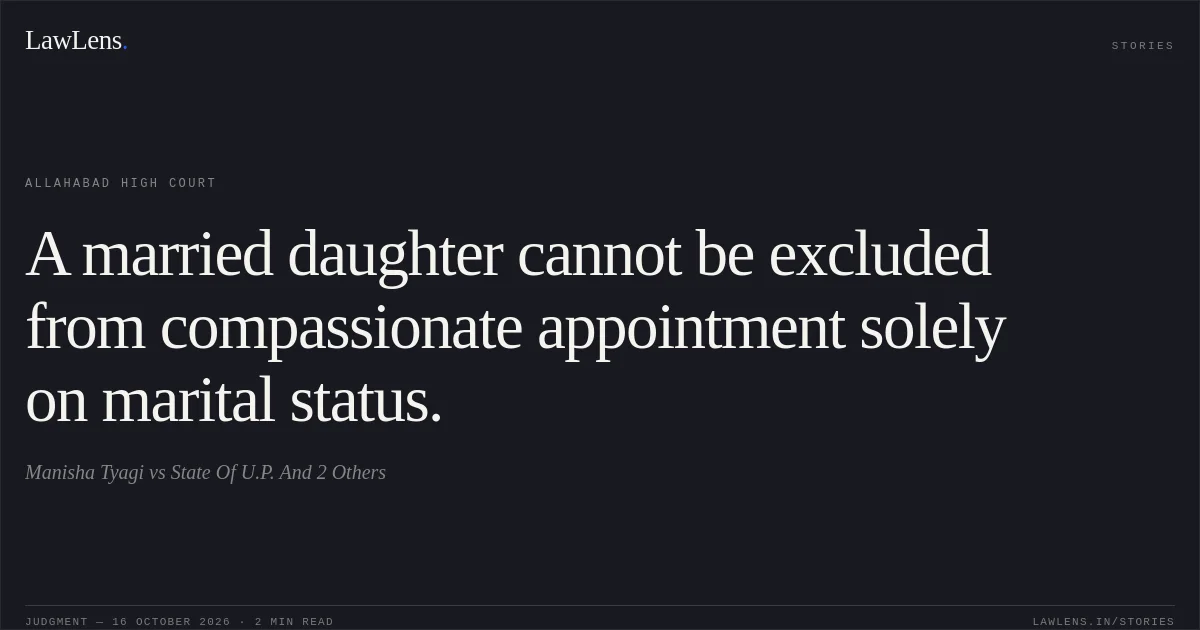
The High Court allowed the petition to the stated extent and quashed the impugned order insofar as it rejected the petitioner’s claim on the ground that she was a married daughter.
It remitted the matter to the District Basic Education Officer for reconsideration under the 1974 Rules, without being influenced by marital status, and directed a reasoned order within eight weeks.
Source reference: para. 33–35The Court clarified that its judgment did not confer an automatic right to appointment.
Source reference: para. 33–35Original Court PDF
Manisha TyagivsState Of U.P. And 2 Others
Click to open original judgment
Original judgment, available to read, download and summarize on LawLens.in