Facts
The parties’ minor son had lived with the mother since October 2020; the elder son had been living with the father since May 2021.
Source reference: paras. 2–3, pp. 2–3In pending guardianship proceedings, the Family Court granted the father overnight visitation and eight days’ interim custody during the summer vacation, despite recording that the child was reluctant to stay overnight with him.
Source reference: paras. 4–5, pp. 2–3On appeal, the High Court modified the arrangement to permit one overnight stay at a hotel so the brothers could spend time together. The child left the father’s company before the overnight stay was completed.
Source reference: paras. 6–8, pp. 3–5The High Court subsequently interacted with the child, who said he did not wish to stay overnight with his father but was not opposed to visitation.
Source reference: para. 17, p. 8Issues
1. Whether the father’s overnight visitation could continue when the child repeatedly expressed unwillingness to stay overnight and the attempted overnight visit had not been completed.
Source reference: paras. 12, 16–18, pp. 6–82. What visitation arrangement would best serve the child’s welfare while preserving the relationship with his father.
Source reference: paras. 12, 19–22, pp. 6, 8–9Law Applied
Section 17(3) of the Guardians and Wards Act, 1890 requires the court, when considering a minor’s welfare, to have regard to the child’s wishes if the child is old enough to form an intelligent preference.
Source reference: para. 13, p. 6The controlling consideration in custody and visitation matters is the child’s welfare, not either parent’s superior right; the child’s wishes, the suitability of the environment, and the parent’s ability to care for the child are relevant factors, relying on Gayatri Bajaj v. Jiten Bhalla, (2012) 12 SCC 471.
Source reference: para. 13, p. 6Nil Ratan Kundu v. Abhijit Kundu, (2008) 9 SCC 413, was also cited for the principle that a child capable of forming an intelligent preference should have their wishes ascertained and considered in determining custody.
Source reference: para. 14, p. 7Reasoning
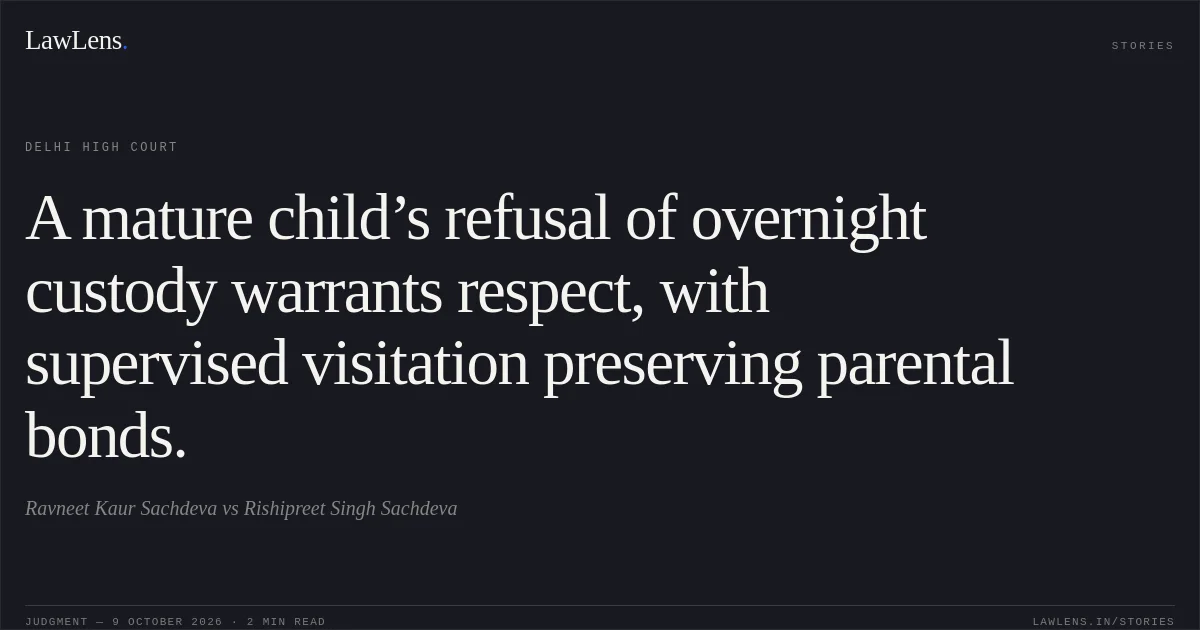
The Court found the child intelligent and mature enough to understand the proceedings, and considered his consistent preference against overnight stays, expressed both to the Family Court and to the High Court.
Source reference: paras. 4, 17, pp. 2, 8The attempted overnight arrangement had caused evident distress and had not achieved its intended purpose of strengthening the father-child bond.
Source reference: paras. 16–18, pp. 7–8Applying the welfare principle, the Court concluded that overnight custody should not continue, but that denying the father all contact would also not serve the child’s welfare. It therefore substituted structured, supervised visitation in a familiar setting.
Source reference: paras. 18–20, pp. 8–9The original summer-custody order had expired and been overtaken by subsequent orders, so its merits were not further examined.
Source reference: para. 15, p. 7Holding
The Court set aside the direction for overnight stays and directed visitation on the first and third Saturdays of each month, from 12:00 p.m. to 2:00 p.m., before the concerned Family Court in the presence of a child counsellor; the mother was not to remain in the room.
A missed visit, with prior notice by WhatsApp or email, was to be substituted by the following Sunday. The existing video-calling arrangement was to continue, and the Family Court could consider expanding visitation after assessing the child’s response.
Source reference: paras. 18–22, pp. 8–9The appeal and pending applications were disposed of, and the parties were directed to appear before the Family Court on 12 October 2026.
Source reference: paras. 23–25, pp. 9–10Acts & Sections Cited
7 provisions across 3 statutes referred to in this judgment. Each provision opens on LawLens.
Family Courts Act, 19841
Guardians and Wards Act, 18905
Code of Civil Procedure, 19081
Original Court PDF
Ravneet Kaur SachdevavsRishipreet Singh Sachdeva
Click to open original judgment
Original judgment, available to read, download and summarize on LawLens.in