01Facts
The appellant, Reji, was the sole accused in S.C. No. 280 of 2016 before the Special Court for POCSO cases, Alappuzha.
¶ 3 · pp. 2–3The prosecution alleged that on 17.11.2014, when the victim was 17 years old, the accused took her to the courtyard of her house, tied her hands to a jack-fruit tree, and forcibly had sexual intercourse with her.
¶ 3 · pp. 2–3The prosecution further alleged repeated sexual assaults thereafter.
¶ 9 · pp. 6–8The victim’s date of birth was proved as 08.12.1998 through school records and oral evidence, establishing that she was below 18 years on the date of the occurrence.
¶ 8 · pp. 5–6The First Information Statement was recorded on 25.12.2015, approximately one year after the alleged first incident.
¶ 5, 19 · pp. 3–4, 12–13The Special Court convicted the accused under Sections 376, 376(2)(n), and 376(2)(f) of the IPC and Section 4(1) read with Section 3(a) of the POCSO Act, sentencing him to ten years’ simple imprisonment and a fine of ₹50,000, with six months’ simple imprisonment in default.
¶ 4 · p. 302Issues
i.Whether the prosecution proved beyond reasonable doubt that the accused committed penetrative sexual assault punishable under Section 4(1) read with Section 3(a) of the POCSO Act against the victim, who was below 18 years of age?
¶ 7(i) · p. 5ii.Whether the alleged delay in reporting, the subsequent assault case involving the victim’s father, the alleged love relationship, and the absence of a jack-fruit tree in the scene mahazar rendered the prosecution case unreliable or established false implication?
¶ 5, 18–20 · pp. 3–4, 12–14iii.Whether the conviction and sentence imposed by the Special Court required interference in appeal?
¶ 7(ii) · p. 503Law Applied
The Court applied Section 2(1)(d) of the POCSO Act, under which a person below 18 years is a “child,” and Sections 3(a) and 4(1) of the POCSO Act, which criminalise and prescribe punishment for penetrative sexual assault involving penile penetration of the vagina.
¶ 3, 8 · pp. 2–3, 5–6It also considered Sections 342, 376, 376(2)(n), and 376(2)(f) of the IPC, as invoked and applied by the Special Court.
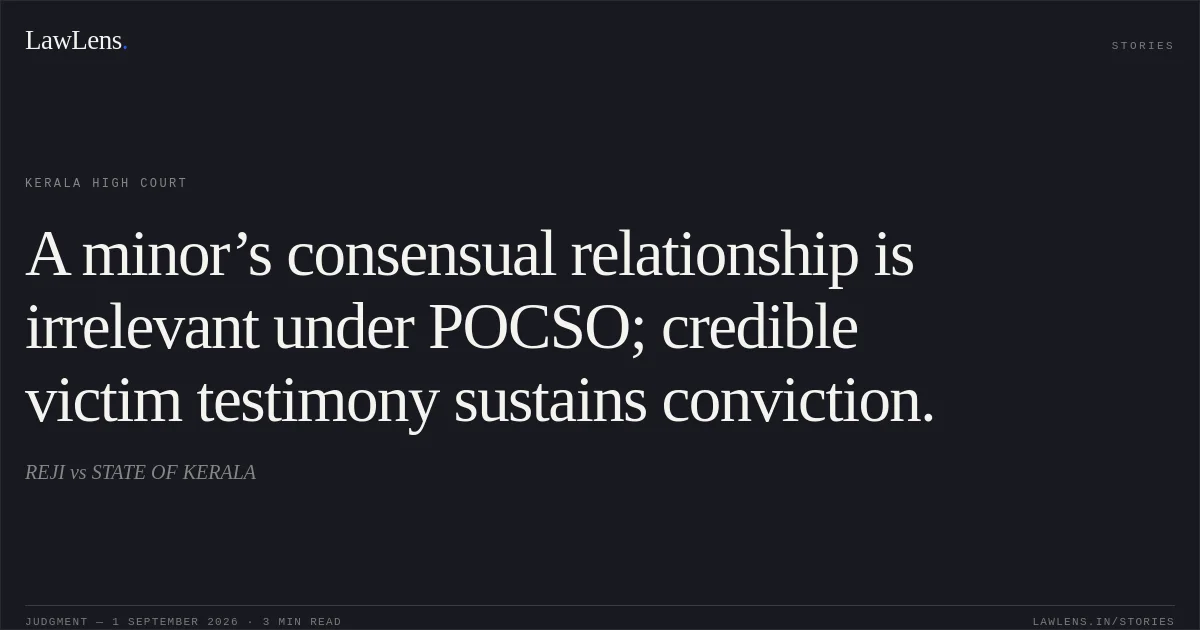
¶ 4 · p. 3The Court applied the principle that the credible and reliable testimony of a victim of sexual assault can, by itself, sustain a conviction, and that a minor’s consent or a prior love relationship has no legal relevance to exonerate the accused under the POCSO Act.
¶ 20–21 · pp. 14–15Provisions in the judgment · 6 · Linked ones open on LawLens
Indian Penal Code, 1860 Section 342Section 376
Protection of Children from Sexual Offences Act, 2012 Section 2Section 3Section 4
Code of Criminal Procedure, 1973 Section 164
04Reasoning
The Court found the victim’s testimony to be consistent, reliable, and of “sterling quality.”
¶ 9 · pp. 6–8 · ¶ 21 · p. 15Her evidence described the accused’s identity, the forcible taking of her to the courtyard, tying of her hands, penile-vaginal penetration, and subsequent repeated assaults.
¶ 9 · pp. 6–8 · ¶ 21 · p. 15Her account was materially corroborated by her aunt’s evidence regarding the disclosure, the medical evidence recording the history of forceful intercourse and finding that sexual intercourse was possible, and the accused’s medical potency examination.
¶ 11–13 · pp. 8–10The Court rejected the false-implication argument, holding that the assault case involving the victim’s father arose when he questioned the accused about the sexual assault; the later compromise in that case did not itself discredit the present prosecution.
¶ 19 · pp. 12–13The absence of a jack-fruit tree from the scene mahazar was also not considered material because the victim stated that trees had subsequently been cut and removed, while the mahazar referred to a projecting root at the relevant location.
¶ 19 · pp. 13–14The reporting delay was assessed in the context of the victim’s stated fear and her delayed disclosure, and was not treated as fatal to the prosecution.
Finally, the Court held that the alleged love relationship could not assist the accused because the victim was a minor and consensual sexual activity with a child has no exculpatory effect under POCSO.
¶ 20 · p. 1405Holding
The Kerala High Court held that the prosecution had established the victim’s minority and proved the penetrative sexual assault through reliable victim testimony supported by surrounding and medical evidence.
¶ 19–21 · pp. 12–15The Court found no merit in the grounds of delay, alleged false implication, the subsequent compromise case, or the discrepancy concerning the jack-fruit tree.
¶ 19–21 · pp. 12–15The appeal was dismissed, and the conviction and sentence imposed by the Special Court—ten years’ simple imprisonment and a fine of ₹50,000, with six months’ simple imprisonment in default—were confirmed.
¶ 22–23 · p. 15The order suspending the sentence and granting bail was cancelled, and the bail bond stood cancelled.
¶ 23 · p. 15Original Court PDF
REJIvsSTATE OF KERALA
Click to open original judgment
Original judgment, available to read, download and summarize on LawLens.in