Facts
The petitioner held a granite-mining lease over part of Khasra No. 28/1 in Village Silpatpura. It relied on a 2016 Panchnama, prepared following a demarcation arranged by the Director of Geology and Mining, and contended that earlier demarcations established encroachment on its leased land.
Source reference: paras. 1–5After proceedings concerning fresh demarcation—including an earlier writ petition and a remand to the Commissioner—the petitioner challenged orders directing fresh demarcation, arguing that the earlier demarcation had attained finality and that it had not been afforded a reasonable hearing. The State and respondents disputed that the Panchnama constituted a demarcation under Section 129 of the Madhya Pradesh Land Revenue Code, 1959 (MPLRC), and stated that a later demarcation had been confirmed by the Tehsildar on 15 July 2026.
Source reference: paras. 1–7Issues
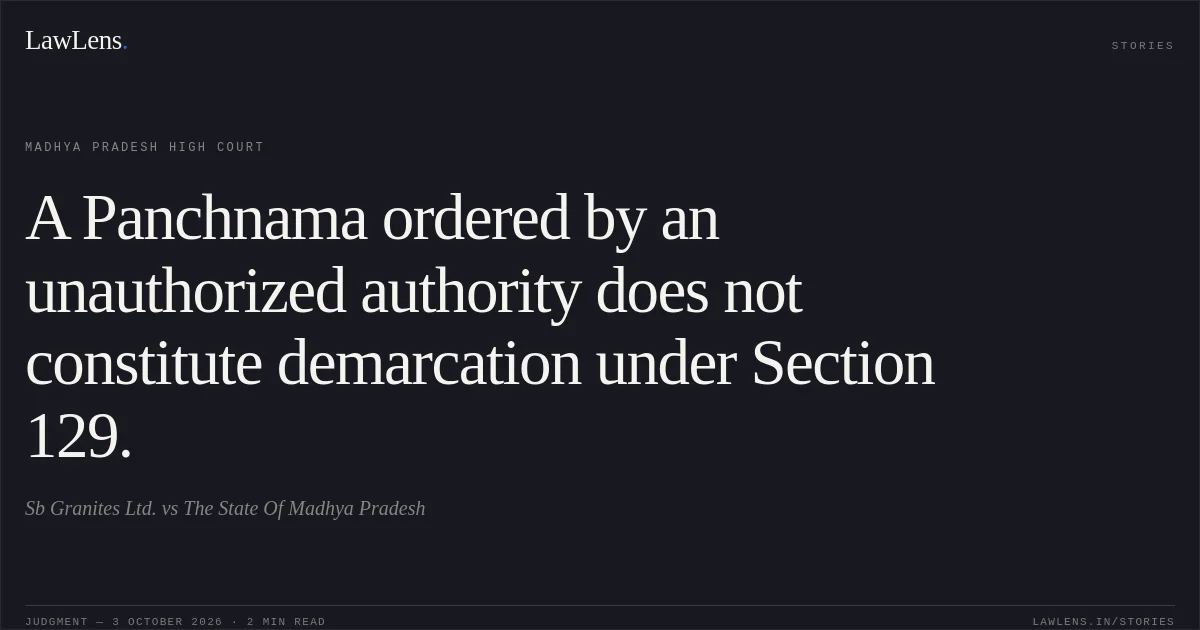
Whether the 2016 Panchnama constituted a demarcation under Section 129 of the MPLRC, such that a fresh demarcation was impermissible
Source reference: paras. 3, 6, 8–9Whether the petitioner could challenge the later demarcation through the present writ petition, or should pursue the remedy under Section 129(5) of the MPLRC
Source reference: paras. 7, 10–11Law Applied
Section 129 of the MPLRC governs demarcation of land. The Court held that a Panchnama prepared by a team acting on the direction of the Director of Geology and Mining—an authority not empowered to order demarcation under Section 129—did not amount to a statutory demarcation.
Source reference: paras. 8–9The Court further held that the petitioner could challenge the Tehsildar’s confirmation of the subsequent demarcation by invoking the remedy under Section 129(5) of the MPLRC.
Source reference: paras. 8–10Reasoning
The Panchnama relied on by the petitioner arose from a demarcation initiated on the Director of Geology and Mining’s direction, rather than through the process contemplated by Section 129. It was also undisputedly not signed by the Tehsildar.
Source reference: paras. 8–9The Court therefore concluded that it was not a valid demarcation under either the amended or unamended provision, and that the petitioner’s claim that an earlier statutory demarcation barred a fresh one was misconceived. Because the subsequent demarcation had been confirmed by the Tehsildar, the appropriate course was to challenge that confirmation under Section 129(5), rather than obtain relief in the writ petition.
Source reference: paras. 8–10Holding
The Court dismissed the writ petition, finding no basis to interfere with the impugned orders in light of the absence of an earlier demarcation under Section 129 and the completion and confirmation of a later demarcation.
It granted the petitioner liberty to challenge the Tehsildar’s confirmation dated 15 July 2026 under Section 129(5) of the MPLRC.
Source reference: paras. 10–11Acts & Sections Cited
2 provisions across 1 statute referred to in this judgment. Each provision opens on LawLens.
MP Land Revenue Code 19592
Original Court PDF
Sb Granites Ltd.vsThe State Of Madhya Pradesh
Click to open original judgment
Original judgment, available to read, download and summarize on LawLens.in