Facts
The petitioner invoked Section 528 of the Bharatiya Nagarik Suraksha Sanhita, 2023 (“BNSS”) seeking quashing of FIR Crime No. 119/2024, registered at Police Station Itarsi, District Narmadapuram, for an offence under Section 420 IPC and all consequential proceedings.
Source reference: p.1The parties had entered into agreements, including one dated 28 January 2021 containing an arbitration clause.
Source reference: p.1The petitioner contended that the dispute concerned contractual monetary transactions and was purely civil in nature, and that the ingredients of cheating were absent.
Source reference: p.1Respondent No. 2 alleged that the petitioner failed to make payments for work performed, failed to open a bank account in the name of Apex Technology, did not deposit sale proceeds from Water Vending Machines, and failed to return ₹52,00,000 as stipulated under the agreement.
Source reference: pp.2–3The FIR was registered pursuant to respondent No. 2’s complaint to the Superintendent of Police.
Source reference: p.2The petitioner had obtained anticipatory bail subject to cooperating with the investigation, but the State and respondent No. 2 submitted that he had not cooperated and that investigation remained incomplete.
Source reference: p.3The petitioner had sought only quashing of the FIR and had not placed any charge-sheet or order taking cognizance on record.
Source reference: pp.10–11Issues
Whether the FIR should be quashed under Section 528 BNSS on the ground that the dispute arose from a contractual agreement, contained an arbitration clause, and was essentially civil in nature.
Source reference: pp.1, 3–5, 10–11Whether the allegations in the FIR, taken at face value, disclosed the ingredients of a cognizable offence under Section 420 IPC so as to justify continuation of the investigation.
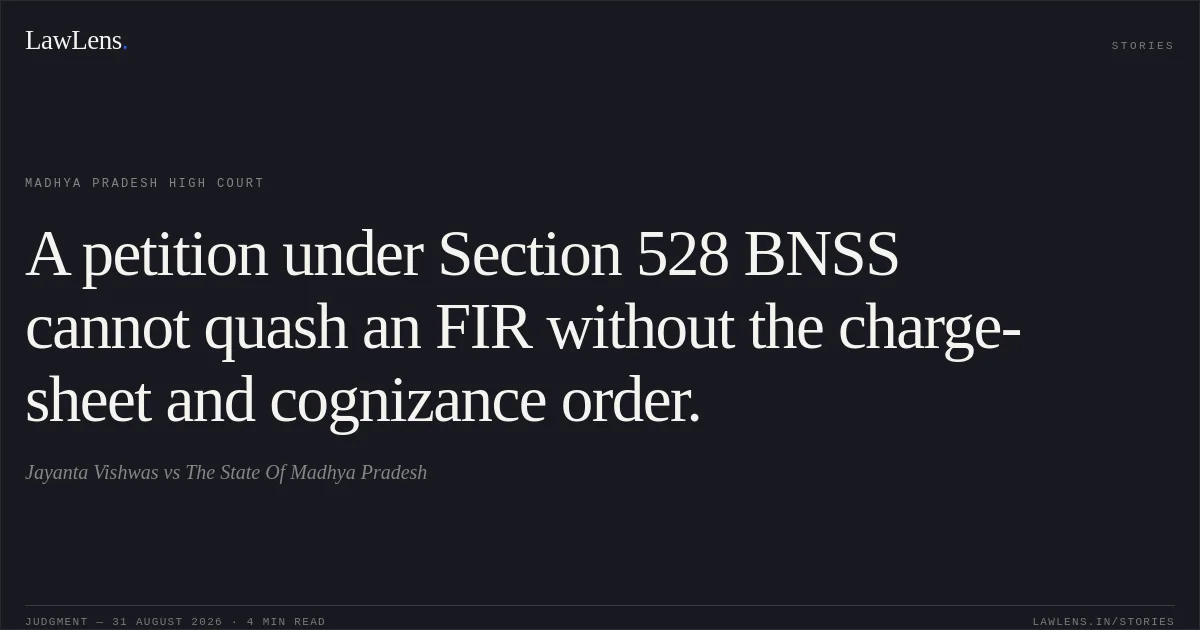
Source reference: pp.3–5, 7–9Whether a petition under Section 528 BNSS seeking only quashing of an FIR is maintainable when no charge-sheet or order taking cognizance has been placed on record.
Source reference: pp.10–11, paras 13–15Law Applied
Section 528 BNSS, corresponding to Section 482 CrPC, confers inherent power on the High Court to prevent abuse of process and secure the ends of justice, but the power must be exercised sparingly.
Source reference: no citationUnder Kamaladevi Agrawal v. State of W.B., proceedings should not be quashed where the allegations, taken at face value, prima facie disclose an offence, and disputed facts cannot ordinarily be adjudicated at the quashing stage.
Source reference: para. 7R. Kalyani v. Janak C. Mehta and Mahesh Chaudhary v. State of Rajasthan establish that the Court ordinarily should not examine defence documents, determine mens rea or actus reus conclusively, or quash merely because the dispute also has a civil character.
Source reference: paras. 8–9The principles in Amit Kapoor v. Ramesh Chander, as reiterated in State of M.P. v. Deepak, require the Court to assess whether uncontroverted allegations prima facie establish the offence without conducting a meticulous evidentiary examination.
Source reference: para. 10The Neeharika Infrastructure guidelines, reproduced in Directorate of Enforcement v. Niraj Tyagi, state that investigation into a cognizable offence should not ordinarily be thwarted and that the reliability or genuineness of FIR allegations should not be examined at the threshold.
Source reference: para. 11In Pradnya Pranjal Kulkarni v. State of Maharashtra, the Supreme Court held that, where only quashing of an FIR is sought, the relevant constitutional jurisdiction is Article 226; Section 528 BNSS may be invoked to quash the FIR, charge-sheet and cognizance order where the charge-sheet and cognizance order are placed on record and a strong case is made out.
Source reference: paras. 13–14Reasoning
The High Court found that the allegations regarding non-payment, failure to open the agreed bank account, non-deposit of sale proceeds, and non-return of ₹52,00,000 could not be rejected at the threshold as merely contractual or inherently improbable.
Source reference: pp.2–3The existence of an arbitration clause and the possibility of civil remedies did not, by themselves, extinguish the criminal dimension of allegations which prima facie suggested dishonest conduct; whether the petitioner possessed the requisite intention and whether the allegations could ultimately be proved were matters for investigation and trial.
Source reference: paras. 7–12Since the investigation was still pending, the Court declined to assess the reliability of the competing contractual versions or to determine the petitioner’s defence based on disputed facts.
Source reference: paras. 7–11Independently, the petition was held not maintainable in its present form because the petitioner sought only quashing of the FIR and had not produced either the charge-sheet or the order taking cognizance, as required by the principle stated in Pradnya Pranjal Kulkarni.
Source reference: paras. 13–15Holding
The Court answered the issues against the petitioner.
It held that the contractual and civil aspects of the dispute did not warrant quashing where the FIR disclosed allegations requiring investigation, and that the petition under Section 528 BNSS was also not maintainable because no charge-sheet or cognizance order had been placed on record.
Source reference: paras. 15–16The petition was accordingly dismissed as devoid of merit, and the consequential criminal proceedings were permitted to continue.
Source reference: para. 16The trial Court was directed not to be influenced by the observations made in the order, and a copy of the order was directed to be sent to the trial Court for information and compliance.
Source reference: paras. 17–18Acts & Sections Cited
6 provisions across 3 statutes referred to in this judgment. Each provision opens on LawLens.
Bharatiya Nagarik Suraksha Sanhita, 20231
Indian Penal Code, 18601
Code of Criminal Procedure, 19734
Original Court PDF
Jayanta VishwasvsThe State Of Madhya Pradesh
Click to open original judgment
Original judgment, available to read, download and summarize on LawLens.in