Facts
The minor plaintiff, represented by his mother as next friend, instituted a suit for partition alleging that Defendant No. 1, his paternal grandfather, was the Karta of a Hindu Undivided Family (“HUF”) governed by Mitakshara law. The plaintiff claimed that Defendant No. 1 had blended his self-acquired properties, bank accounts, jewellery, shares and other assets into the joint-family hotchpot and that the plaintiff, as a grandson within three degrees of the common male ancestor, had a coparcenary interest in them. The suit also included several companies promoted or allegedly controlled by Defendant No. 1 as defendants, and sought relief concerning properties and assets held by those companies
Source reference: pp. 2–5, 13–15Defendant No. 1 applied under Order VII Rule 11 of the Code of Civil Procedure, 1908 (“CPC”), contending that the plaint disclosed no cause of action because the properties were his self-acquired assets, no coparcenary or ancestral nucleus existed, and no valid HUF or blending had been established. The corporate defendants separately sought rejection of the plaint, asserting that they were distinct juristic entities and that their corporate assets could not be partitioned as HUF property
Source reference: pp. 2–7The plaintiff opposed the applications, arguing that the plaint specifically pleaded the existence of the HUF, the blending of Defendant No. 1’s assets, and the acquisition or holding of corporate shares from alleged joint-family funds. It was submitted that these questions involved disputed facts and could not be determined at the Order VII Rule 11 stage
Source reference: pp. 7–10Issues
1. Whether the plaint disclosed a cause of action and a right in the minor plaintiff to seek partition of the alleged HUF and coparcenary properties?
Source reference: p. 11; pp. 12–202. Whether the suit was barred by law insofar as it sought partition of properties owned by separate corporate entities?
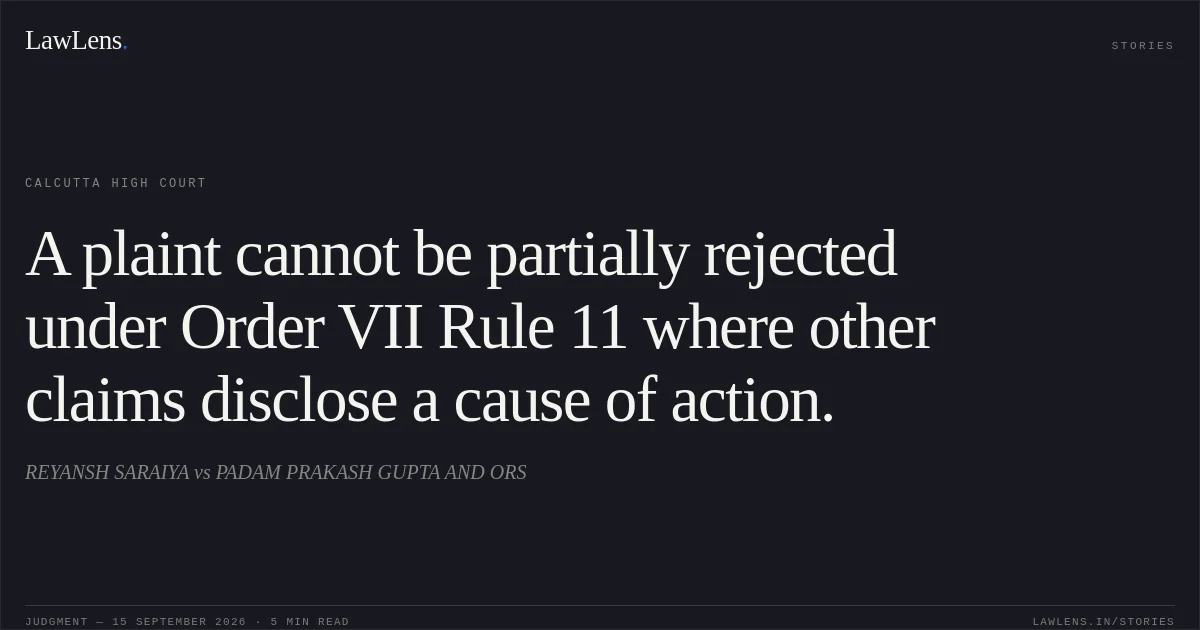
Source reference: p. 11; pp. 19–213. Whether the plaint could be rejected partially under Order VII Rule 11 CPC in respect of the corporate defendants or corporate assets?
Source reference: p. 11; pp. 20–214. Whether the leave granted under Clause 12 of the Letters Patent, 1865, ought to be revoked for want of jurisdiction?
Source reference: pp. 5, 21Law Applied
The Court applied Order VII Rule 11(a) and (d) CPC, under which a plaint may be rejected where it discloses no cause of action or where the suit appears from the plaint to be barred by law. At this stage, the plaint must be read as a whole, its averments and annexed documents must be treated as substantially true, and the Court must not examine the defence or conduct a mini-trial: Mayar (H.K.) Ltd. v. Owners & Parties, Vessel M.V. Fortune Express and Liverpool & London S.P. & I Association Ltd. v. M.V. Sea Success I
Source reference: pp. 12–13The Court also relied on Manjula v. D.A. Srinivas, 2026 SCC OnLine SC 831, concerning the scope of scrutiny under Order VII Rule 11
Source reference: p. 13Under Mitakshara law, a coparcenary consists of descendants within the prescribed degrees from the common ancestor, and a grandson may claim a birth interest where a coparcenary exists
Source reference: pp. 14–17The Court recognised that self-acquired property may allegedly be blended with HUF property, but whether such blending actually occurred is ordinarily a fact-intensive matter requiring evidence
Source reference: pp. 8–9, 17–20It further applied the principle of separate corporate personality under Bacha F. Guzdar v. CIT, holding that shareholders do not own the underlying assets of a company; however, shares held with joint-family funds may themselves form part of the partitionable family estate, as recognised in Pesticides and Brewers Ltd. v. Narendra Kumar Berlia
Source reference: pp. 19–20Finally, relying on Sejal Glass Ltd. v. Navilan Merchants Pvt. Ltd., the Court held that a plaint cannot ordinarily be rejected in part under Order VII Rule 11; it must be rejected as a whole or not at all
Source reference: p. 20Reasoning
The Court held that the plaint contained specific, though arguably insufficient or scanty, pleadings alleging the existence of an HUF, Defendant No. 1’s position as Karta, the blending of his self-acquired assets into the common hotchpot, and the plaintiff’s status as a direct male descendant within three degrees
Source reference: pp. 13–18These allegations were not so inherently impossible or ex facie sham that they could be rejected without evidence. The defendants’ contentions that no coparcenary existed, that no valid HUF had been created, and that blending was legally impermissible in the absence of a pre-existing nucleus were treated as matters of defence and disputed questions requiring trial
Source reference: pp. 12–18As regards the corporate defendants, the Court accepted the legal distinction between corporate assets and shares. The physical assets of a company could not ordinarily be treated as HUF property merely because the company was promoted or controlled by a family member. Nevertheless, shares allegedly acquired with joint-family funds could be examined in the partition proceedings
Source reference: pp. 19–20Since the plaint also contained claims concerning non-corporate assets such as bank accounts, jewellery and allegedly blended properties, partial rejection was impermissible under Sejal Glass
Source reference: pp. 20–21The question whether the corporate structure justified any relief, including whether the corporate veil could be lifted or whether the relevant shares formed part of the HUF estate, was left for trial. The issue concerning Clause 12 jurisdiction was likewise not conclusively determined at the interlocutory stage
Source reference: p. 21Holding
The Court rejected both applications, GA/2/2021 and GA/3/2021, and declined to reject the plaint under Order VII Rule 11 CPC
It held that the plaint disclosed a triable cause of action concerning the alleged HUF, blended non-corporate assets and possible HUF-held shares. Although the underlying assets of the corporate defendants could not ordinarily be partitioned as HUF property, that finding did not justify partial rejection of the plaint because the claims were interconnected and included other potentially partitionable assets
Source reference: pp. 19–21The defendants were permitted to raise their substantive objections in their written statements and at trial, including objections concerning the alleged HUF, blending, corporate assets and jurisdiction under Clause 12 of the Letters Patent
Source reference: p. 22Acts & Sections Cited
3 provisions across 1 statute referred to in this judgment. Each provision opens on LawLens.
Hindu Succession Act, 19563
Original Court PDF
REYANSH SARAIYAvsPADAM PRAKASH GUPTA AND ORS
Click to open original judgment
Original judgment, available to read, download and summarize on LawLens.in