Facts
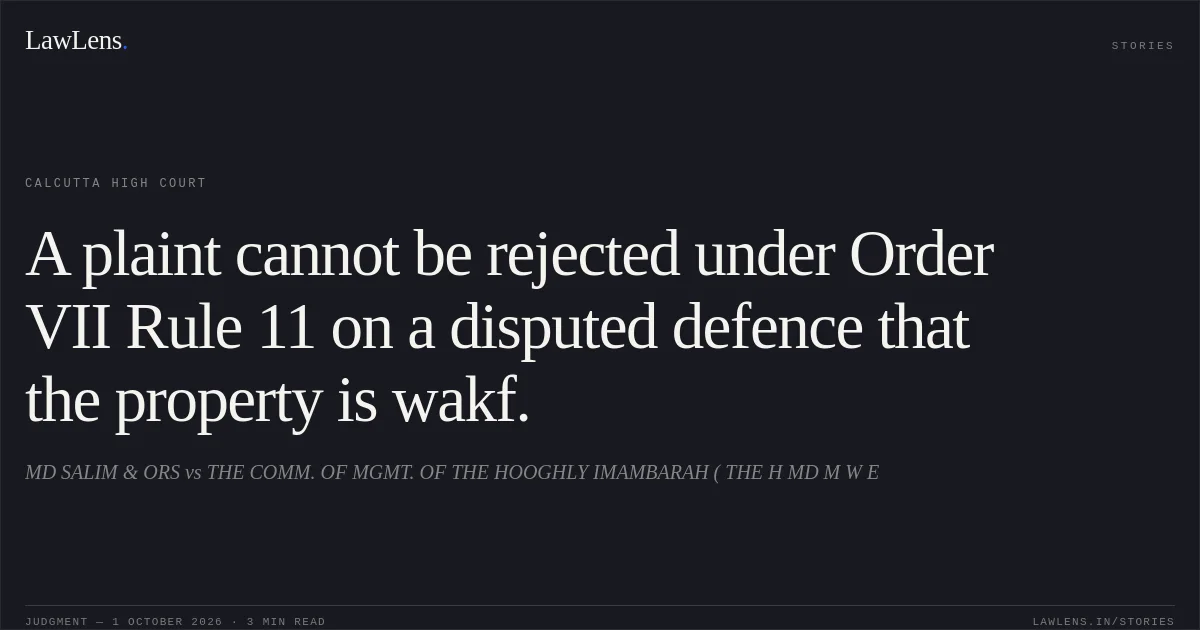
The petitioners, defendants in a suit for recovery of possession and permanent injunction, challenged the trial court’s dismissal of their application under Order VII Rule 11 of the Code of Civil Procedure, 1908 (CPC). They contended that the suit was barred by limitation, disclosed no cause of action, and was barred before a civil court under Sections 84 and 85 of the Bengal Wakf Amendment Act, 1995, because the property was Wakf property.
Source reference: p.2The plaintiffs disputed that characterisation, pleading that the property was outside the Wakf and was a “Kharij Tauliat property” governed by the Act XV of 1895.
Source reference: p.3The trial court dismissed the application, reasoning that the dispute involved mixed questions of law and fact requiring evidence.
Source reference: p.3–4The defendants then invoked the High Court’s supervisory jurisdiction under Article 227 of the Constitution.
Source reference: p.4Issues
1. Whether, on the plaint’s averments alone, the suit was barred by Sections 84 and 85 of the Bengal Wakf Amendment Act, 1995, and therefore liable to rejection under Order VII Rule 11 CPC.
Source reference: p.5–62. Whether the trial court committed an error warranting supervisory interference under Article 227 by dismissing the defendants’ application under Order VII Rule 11 CPC.
Source reference: p.6Law Applied
Under Order VII Rule 11 CPC, the court must determine whether the plaint is liable to rejection by considering the plaint’s averments; the inquiry is confined to the plaint and does not ordinarily turn on the defendant’s allegations or evidence.
Source reference: p.5–6The petitioners invoked Sections 84 and 85 of the Bengal Wakf Amendment Act, 1995, concerning civil-court jurisdiction in Wakf matters, and cited T. Arivandandam v. T.V. Satyapal, Prem Kishore v. Brahm Prakash, Sk. Abdur Rauf Wakf Estate v. State of West Bengal, Garib Das v. Munshi Abdul Hamid, and Shannugam v. Tamil Nadu Wakf Board. The judgment does not state a separate rule drawn from those authorities.
Source reference: p.4–5Article 227 permits supervisory intervention where the case warrants it, including where an error or abuse of process is shown.
Source reference: p.6Reasoning
The plaint specifically pleaded that the suit property was not Wakf property. On a plaint-only inquiry under Order VII Rule 11 CPC, the defendants could not establish that the suit was barred merely by asserting the contrary—that the property was Wakf property and the civil court therefore lacked jurisdiction under Sections 84 and 85.
Source reference: p.5–6That contention required the defendants to file a written statement and prove their case at trial, rather than seek rejection of the plaint.
Source reference: p.6As the defendants failed to show from the plaint that the suit was barred by law, or that the trial court’s order involved an error or abuse of process, the High Court found no basis for Article 227 intervention.
Source reference: p.6Holding
The High Court held that the plaint did not establish that the suit was barred by Sections 84 and 85 of the Bengal Wakf Amendment Act, 1995, and that the trial court had not erred in dismissing the Order VII Rule 11 application.
The Article 227 application was dismissed. The Court expressly left the merits of the suit and all other points open for determination by the trial court.
Source reference: p.6–7Acts & Sections Cited
2 provisions across 1 statute referred to in this judgment. Each provision opens on LawLens.
Unified Waqf Management, Empowerment, Efficiency and Development Act, 19952
Original Court PDF
MD SALIM & ORSvsTHE COMM. OF MGMT. OF THE HOOGHLY IMAMBARAH ( THE H MD M W E
Click to open original judgment
Original judgment, available to read, download and summarize on LawLens.in