Facts
The plaintiff sued for, among other reliefs, partition of three properties allegedly belonging to her father, Late Chaman Lal, and declarations concerning two relinquishment deeds dated 21 July 1999 and a Will dated 11 July 1994.
Source reference: para. 2She pleaded that she was one of five legal heirs, entitled to a one-fifth share, and in joint and constructive possession; she also pleaded that she learned of the relinquishment deeds in August 2014.
Source reference: para. 2, 10–11The appellant, Defendant No. 2, sought rejection of the plaint under Order VII Rule 11 CPC on grounds including limitation, the effect of the 2005 amendment to Section 6 of the Hindu Succession Act, the Delhi Land Reforms Act, and deficient court fee.
Source reference: para. 3–5The Single Judge dismissed the application, and the appellant appealed.
Source reference: para. 1, 3–5Issues
Whether the plaint, on its own averments, disclosed that the claims concerning the relinquishment deeds, Will, and partition were barred by limitation.
Source reference: para. 8–14Whether the plaintiff’s claim was barred because Chaman Lal died in 1995, before the 2005 amendment to Section 6 of the Hindu Succession Act.
Source reference: para. 15Whether the plaint disclosed that partition of the properties was barred by the Delhi Land Reforms Act.
Source reference: para. 16–17Whether the plaint was liable to rejection for insufficient court fee.
Source reference: para. 18Law Applied
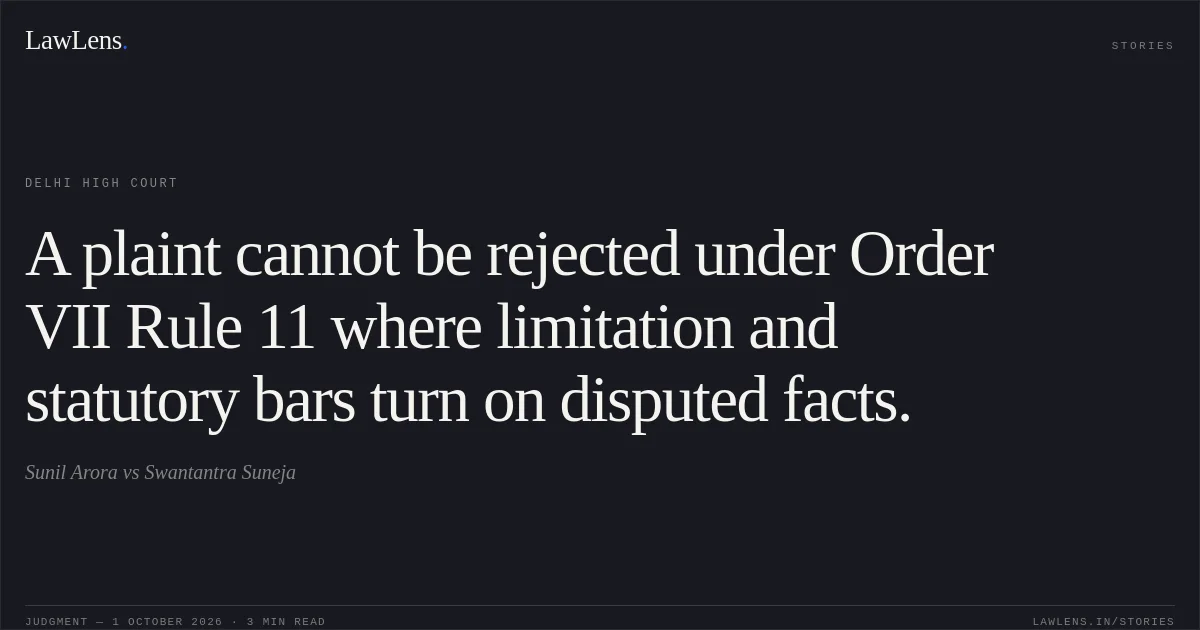
Order VII Rule 11 CPC requires the court to assess the plaint as a whole, taking its averments as true and not importing the defendant’s defence; the plaint may be rejected where it itself discloses no cause of action or a statutory bar.
Source reference: para. 7–8Under Popat and Kotecha Property v. State Bank of India Staff Assn., (2005) 7 SCC 510, pleadings must be read meaningfully and as a whole, without isolating or dissecting passages.
Source reference: para. 7–8A limitation objection may be decided under Rule 11(d) where the bar is apparent from the plaint, but not ordinarily where it depends on disputed facts.
Source reference: para. 12–13Articles 58 and 59 of the Limitation Act, 1963 may respectively govern declaratory relief and relief in substance seeking cancellation or setting aside of an instrument; the applicable provision and accrual of the right to sue depend on the nature of the claim and pleaded facts.
Source reference: para. 12–13The court also considered the pleaded claim under the Hindu Succession Act, the asserted applicability of the Delhi Land Reforms Act, and the possession-based court-fee objection.
Source reference: para. 15–18Reasoning
The plaint pleaded both joint and constructive possession and discovery of the relinquishment deeds in August 2014.
Source reference: para. 11–14Whether the plaintiff knew of the deeds earlier, was in possession, or was entitled to the relief sought—and which limitation article applied—could not be resolved merely from the dates of the instruments.
Source reference: para. 11–14The plaint claimed inheritance as a legal heir, while the effect of the 1995 death, the character of the properties, and the consequences of the 2005 amendment required consideration of the applicable law and facts.
Source reference: para. 15The properties’ legal character and any bar under the Delhi Land Reforms Act were likewise not apparent from the plaint alone.
Source reference: para. 16–17Because the plaintiff pleaded joint and constructive possession, the disputed assertion that she was not in possession did not establish deficient court fee at the threshold; an issue on court fee had also been framed.
Source reference: para. 18The objections therefore raised matters requiring factual determination, not rejection of the plaint under Order VII Rule 11.
Source reference: para. 19–20Holding
The Court held that the appellant had not established, on the plaint’s averments alone, that the suit was barred by limitation, the Hindu Succession Act, the Delhi Land Reforms Act, or deficient court fee.
It found no infirmity in the Single Judge’s dismissal of the Order VII Rule 11 application and dismissed the appeal and any pending applications.
Source reference: para. 20–23The appellant was left at liberty to apply to the Single Judge for the objections to be considered as preliminary issues, to be decided in accordance with law.
Source reference: para. 20–23Acts & Sections Cited
4 provisions across 3 statutes referred to in this judgment. Each provision opens on LawLens.
Hindu Succession Act, 19561
Limitation Act, 19632
Code of Criminal Procedure, 19731
Original Court PDF
Sunil AroravsSwantantra Suneja
Click to open original judgment
Original judgment, available to read, download and summarize on LawLens.in