01Facts
M/s Atlantic Engineering Services Pvt. Ltd., whose directors included the respondents, was awarded an NTPC contract for ventilation and air-conditioning work.
¶ 1–3, 7–8, 12The prosecution alleged that, between January and November 1982, the respondents conspired to obtain approximately ₹19.95 lakh under a letter of credit by submitting bills for goods not supplied.
¶ 1–3, 7–8, 12The trial court convicted them under Sections 120-B and 420 of the IPC; the Special Judge allowed their appeal and acquitted them.
¶ 1–3, 7–8, 12The Union of India, through the CBI, appealed against that acquittal under Section 378(2) CrPC.
¶ 1–3, 7–8, 1202Issues
i.Whether the acquittal rested on a reasonable and plausible view of the evidence, or was perverse or legally unsustainable so as to warrant interference in an appeal against acquittal.
¶ 38–42, 46, 50ii.Whether the evidence established that the respondents dishonestly induced NTPC to make payments, with the requisite intention to cheat, and agreed to commit an illegal act so as to prove offences under Sections 420 and 120-B IPC.
¶ 12, 45, 47–4803Law Applied
Sections 120-B and 420 IPC require proof, respectively, of an agreement to commit an illegal act (or a lawful act by illegal means) and of deception accompanied by fraudulent or dishonest inducement; for cheating, dishonest intention must exist when the representation or promise is made, and cannot be inferred merely from a later breach or irregularity (V.Y. Jose v. State of Gujarat, (2009) 3 SCC 78).
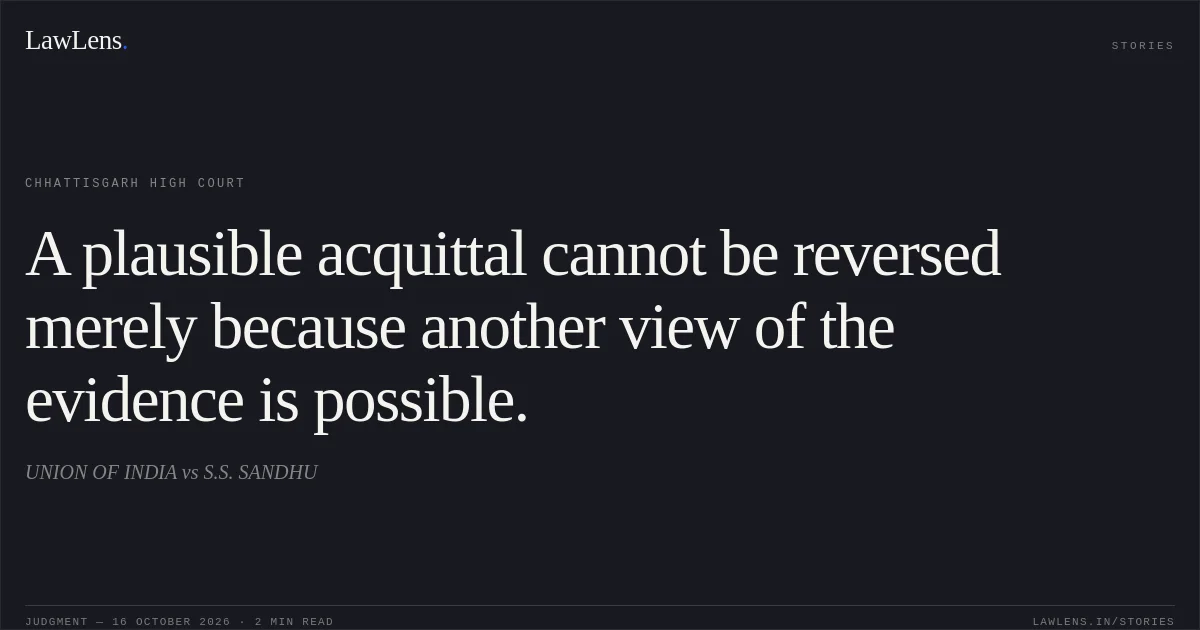
¶ 47–48In an appeal against acquittal under Section 378 CrPC, the appellate court may reappreciate the evidence, but should not reverse a plausible view merely because another view is possible; interference is justified where the acquittal is perverse, rests on a material misreading or omission, or the evidence permits no reasonable conclusion other than guilt.
¶ 38–42The Court relied on State of Rajasthan v. Kistoora Ram, 2022 SCC OnLine SC 984; Jafarudheen v. State of Kerala, (2022) 8 SCC 440; CBI v. Shyam Bihari, (2023) 8 SCC 197; and Tulasareddi @ Mudakappa v. State of Karnataka, 2026 SCC OnLine SC 89.
¶ 38–42Provisions in the judgment · 5 · Linked ones open on LawLens
Code of Criminal Procedure, 1973 Section 378Section 313
Indian Penal Code, 1860 Section 420Section 468Section 471
04Reasoning
The Court considered the evidence insufficient to displace the acquittal.
¶ 13–17, 20–26, 36, 43–46, 48, 50The witnesses concerning the disputed vehicle movements lacked reliable records or personal knowledge, while NTPC and bank witnesses described payments made against dispatch certificates and subsequent meetings, adjustments, recovery of excess payments and later supply of goods.
¶ 13–17, 20–26, 36, 43–46, 48, 50The investigating officer also acknowledged the reconciliation and subsequent supply.
¶ 13–17, 20–26, 36, 43–46, 48, 50Taken together, these circumstances supported a plausible view that the discrepancies arose during contractual performance and reconciliation, rather than proving dishonest intent at the outset.
¶ 13–17, 20–26, 36, 43–46, 48, 50The evidence likewise did not establish an agreement or meeting of minds constituting conspiracy.
¶ 13–17, 20–26, 36, 43–46, 48, 50The acquittal therefore disclosed no perversity or material misappreciation warranting appellate interference.
¶ 13–17, 20–26, 36, 43–46, 48, 5005Holding
The Court held that the prosecution had not proved beyond reasonable doubt either dishonest inducement under Section 420 IPC or conspiracy under Section 120-B IPC, and that the acquittal was a permissible view of the evidence.
¶ 50–52It dismissed the CBI’s appeal and affirmed the judgment of acquittal dated 13 September 2019.
¶ 50–52Original Court PDF
UNION OF INDIAvsS.S. SANDHU
Click to open original judgment
Original judgment, available to read, download and summarize on LawLens.in