Facts
On 12 July 2016, a collision occurred between a Maruti Swift car and a motorcycle, resulting in the death of Dilipbhai Mehbabhai Damor, a primary-school teacher aged approximately 45–46 years.
Source reference: p.1; para. 1His widow, son and mother filed a motor accident compensation claim.
Source reference: p.1; para. 1The Tribunal found contributory negligence on the part of both drivers in the ratio of 90:10, assessed the deceased’s monthly income at ₹47,400, applied a multiplier of 14 with future prospects, and awarded ₹62,81,296 with interest at 9% per annum.
Source reference: p.2; para. 2The insurer challenged the finding that the deceased was only 10% negligent, relying on the police “B” summary report, while the claimants sought enhancement on the grounds that the deduction for personal expenses should be reduced from one-third to one-fourth and that compensation under the conventional heads was inadequate under National Insurance Co. Ltd. v. Pranay Sethi.
Source reference: pp.2–3; paras. 3–4During the pendency of the claim petition, the deceased’s mother died.
Source reference: p.4; para. 8Issues
Whether the deceased-motorcyclist’s contributory negligence should be enhanced from 10% to 50% on the basis of the police “B” summary report?
Source reference: pp.3–4; paras. 5–6Whether the compensation for loss of dependency required recalculation by applying a one-fourth deduction for personal expenses, future prospects of 30%, and a multiplier of 14?
Source reference: p.4; paras. 7–10Whether the claimants were entitled to enhanced compensation under the conventional heads in accordance with Pranay Sethi?
Source reference: pp.5–6; paras. 11–12Law Applied
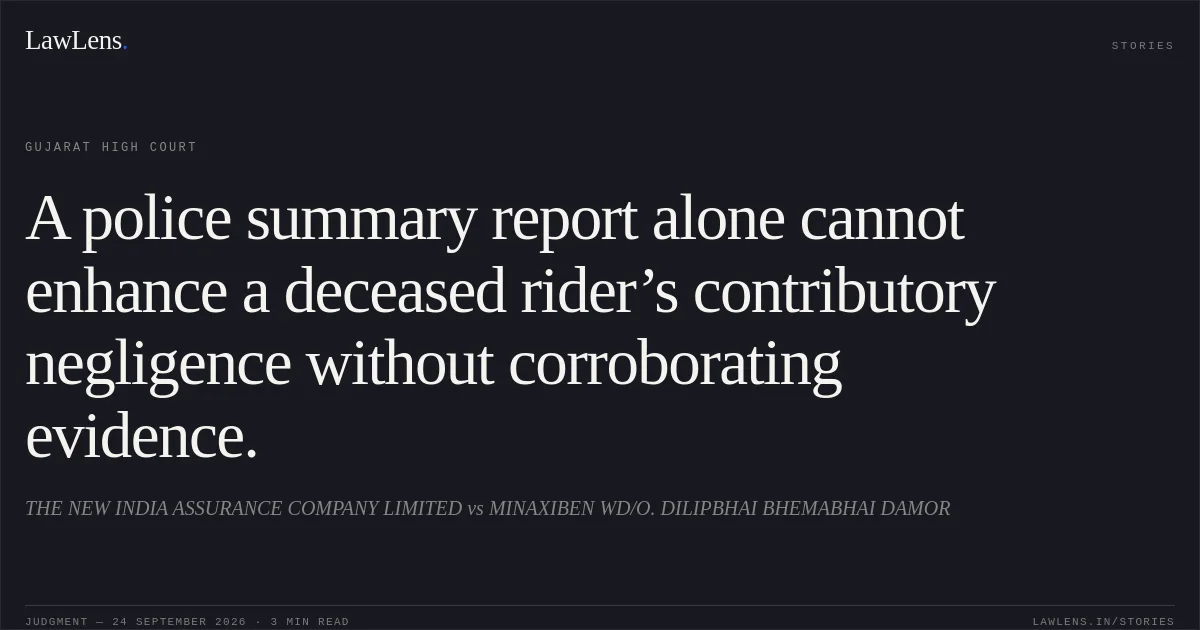
The Court applied the principles governing contributory negligence in motor accident claims, holding that a police report indicating possible negligence is not, by itself, sufficient to establish a higher degree of negligence in the absence of supporting evidence, particularly from the other driver involved in the accident.
Source reference: pp.3–4; paras. 5–6For computation of dependency compensation, the Court applied the multiplier method, deducted the deceased’s personal expenses with reference to the number of dependants, and added future prospects based on the deceased’s age and government employment.
Source reference: p.4; paras. 7–10It further relied on National Insurance Co. Ltd. v. Pranay Sethi & Ors. for awarding compensation under loss of consortium, loss of estate and funeral expenses.
Source reference: pp.5–6; paras. 11–12Reasoning
The Court accepted that the “B” summary report prima facie indicated negligence by the deceased, but held that it did not justify increasing his contribution to 50% because the car driver—the best witness on the issue—was not examined to prove the deceased’s alleged greater negligence.
Source reference: pp.3–4; paras. 5–6The Tribunal’s finding of 10% contributory negligence was therefore maintained.
Source reference: pp.3–4; paras. 5–6On quantum, the Court upheld the monthly income of ₹47,400 because it was supported by documentary evidence and the deceased was a government-employed primary-school teacher.
Source reference: p.4; para. 7Since the deceased’s mother died during the proceedings, the Court applied a one-fourth deduction rather than one-third for personal expenses, added 30% towards future prospects, and applied a multiplier of 14.
Source reference: p.4; paras. 8–9The resulting loss of dependency was assessed at ₹77,64,120 and, after deducting 10% for contributory negligence, reduced to ₹69,87,708.
Source reference: p.5; para. 10Applying Pranay Sethi, the Court further awarded ₹18,150 towards loss of estate, ₹1,93,600 towards loss of consortium, and ₹18,150 towards funeral expenses.
Source reference: pp.5–6; paras. 11–12Holding
The insurer’s challenge to the 10% finding of contributory negligence was rejected, and the claimants’ cross-objection was allowed.
The total compensation was enhanced from ₹62,81,296 to ₹72,17,608, resulting in an enhanced amount of ₹9,36,312.
Source reference: p.6; para. 12The Tribunal’s award of interest at 9% per annum was affirmed.
Source reference: p.6; para. 13The insurer was directed to deposit the enhanced compensation with interest within eight weeks, after which the Tribunal was directed to disburse the entire amount to the claimants through RTGS/NEFT upon due verification.
Source reference: p.7; para. 14Original Court PDF
THE NEW INDIA ASSURANCE COMPANY LIMITEDvsMINAXIBEN WD/O. DILIPBHAI BHEMABHAI DAMOR
Click to open original judgment
Original judgment, available to read, download and summarize on LawLens.in