Facts
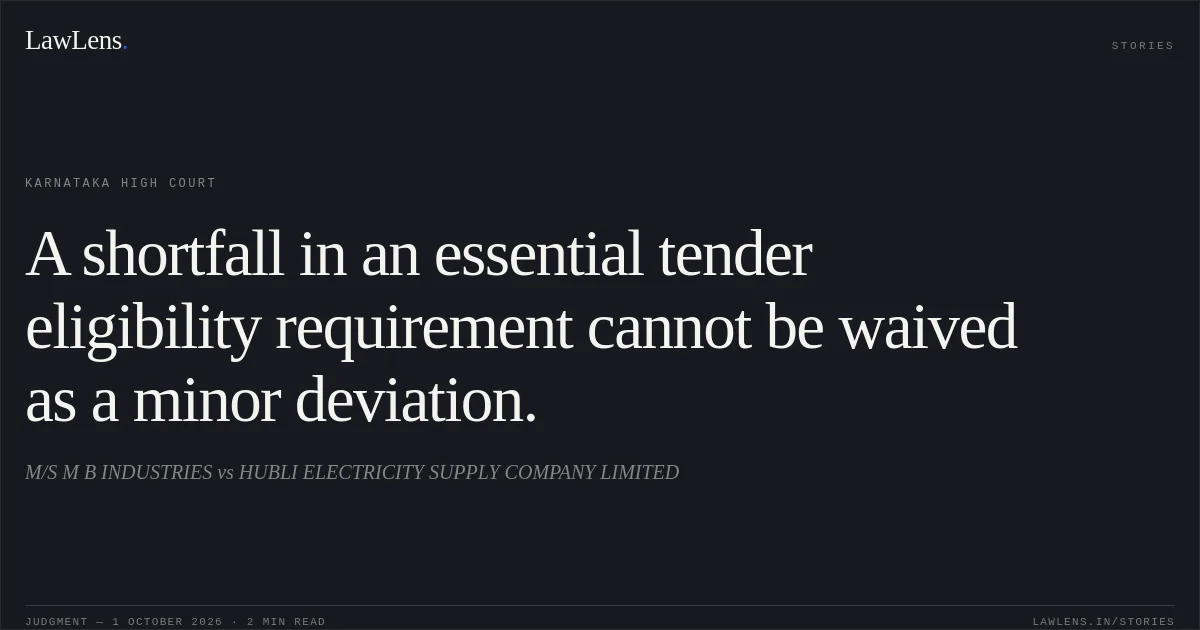
HESCOM invited bids for supplying 2,620 sets of LT Wiring Kits. Under QR-2, an MSME bidder had to establish prior supply of at least 40% of the tender quantity—1,048 sets—in a qualifying financial year. M.B. Industries’ uploaded Purchase Orders evidenced supply of 1,045 sets.
Source reference: paras. 2–3, 7–10; pp. 3–6HESCOM rejected the technical bid, and the firm’s appeal under Section 16 of the Karnataka Transparency in Public Procurements Act, 1999 (KTPP Act) was rejected on 18 February 2026. A Letter of Intent and Purchase Order were subsequently issued to the successful bidder, which was not impleaded.
Source reference: paras. 4–6, 34, 39; pp. 4, 17–20Issues
1. Whether the petitioner established, through the documents required by QR-2, prior supply of at least 1,048 sets
Source reference: para. 12(i); p. 72. Whether HESCOM was justified in treating the technical bid as non-responsive when the uploaded Purchase Orders evidenced supply of only 1,045 sets
Source reference: para. 12(ii); p. 73. Whether the three-set shortfall could be waived as a minor deviation under Clause 22.4 of the tender conditions
Source reference: para. 12(iii); p. 74. Whether rejection of the petitioner’s appeal under Section 16 of the KTPP Act warranted interference under Articles 226 and 227 of the Constitution
Source reference: para. 12(iv); p. 7Law Applied
Section 16 of the KTPP Act provides the statutory appeal mechanism invoked by the petitioner; Articles 226 and 227 empower the High Court to review the challenged procurement decision. Under the tender, QR-2 required an MSME bidder to establish the specified minimum prior supply through the prescribed documents, while Clause 22.4 permitted waiver only of a minor informality, non-conformity or irregularity that did not constitute a material deviation or affect relative ranking.
Source reference: paras. 9–10, 25–27; pp. 5–6, 13–14In *Jagdish Mandal v. State of Orissa*, (2007) 14 SCC 517, the Supreme Court held that tender evaluation is primarily a commercial function and judicial review is confined to legality of the decision-making process, including whether it is mala fide, arbitrary or irrational. *Silppi Constructions Contractors v. Union of India*, (2020) 16 SCC 489, likewise cautions courts against substituting their assessment for that of the competent technical authority.
Source reference: paras. 20–21, 40–41; pp. 11–12, 12, 21Reasoning
The tender required proof of 1,048 sets, but the Purchase Orders uploaded with the bid evidenced only 1,045; the petitioner itself acknowledged the three-set shortfall in its pleadings.
Source reference: paras. 13–16, 28–29; pp. 8–9, 15The claimed aggregate supply of 1,537 sets did not establish compliance through the documents stipulated in QR-2, and the Court would not reconstruct the bid after the submission deadline. Because the shortfall concerned an essential eligibility threshold, Clause 22.4 could not be used to waive or dilute that requirement.
Source reference: paras. 18–19, 32–33; pp. 10, 16–17The appellate portal recorded the required quantity, the quantity evidenced and the shortfall, providing an intelligible reason for rejection. Applying the limited standard of judicial review in tender matters, the Court found no demonstrated mala fides, favouritism, arbitrariness or irrationality.
Source reference: paras. 26–31, 34–36, 38, 40–42; pp. 14–18, 19–22Holding
The Court answered the first and third issues in the negative and the second in the affirmative; it also held that the appeal rejection did not warrant writ interference.
It dismissed the writ petition, upheld rejection of the technical bid and the Section 16 appeal, and refused to direct HESCOM to consider the bid. Pending interlocutory applications were disposed of, with no order as to costs.
Source reference: para. 43; p. 25Acts & Sections Cited
1 provisions across 1 statute referred to in this judgment. Each provision opens on LawLens.
KARNATAKA TRANSPARENCY IN PUBLIC PROCUREMENTS ACT, 19991
Original Court PDF
M/S M B INDUSTRIESvsHUBLI ELECTRICITY SUPPLY COMPANY LIMITED
Click to open original judgment
Original judgment, available to read, download and summarize on LawLens.in