Facts
The complainant, M/s Himalayan Plastics Ltd., alleged that the accused had purchased HDPE pipes and allied products on credit and issued a cheque for ₹14,79,374 towards the outstanding liability. The cheque was dishonoured for “insufficient funds”; despite service of the statutory demand notice, the accused did not make payment, leading to a complaint under Section 138 of the Negotiable Instruments Act, 1881 (NI Act).
Source reference: paras. 2–3The accused admitted his signatures on the cheque and receipt of the notice, but claimed that the cheque was blank, issued as security, and that he was merely a commission agent whose customers paid the complainant directly.
Source reference: para. 5The trial Court accepted the defence, held that the complainant had not proved the underlying business transactions, and acquitted the accused.
Source reference: para. 6The complainant challenged the acquittal in appeal.
Source reference: para. 7Issues
Whether the successor Magistrate could rely upon the evidence recorded by his predecessor, particularly where the case under Section 138 of the NI Act was allegedly tried summarily.
Source reference: paras. 16–21Whether the accused’s admission of his signatures and issuance of the cheque attracted the presumptions under Sections 118(a) and 139 of the NI Act.
Source reference: paras. 22–25Whether the accused rebutted, on a preponderance of probabilities, the presumption that the cheque was issued towards a legally enforceable debt or liability.
Source reference: paras. 26–47Whether the complainant proved the ingredients of the offence under Section 138 of the NI Act and whether the acquittal required appellate interference.
Source reference: paras. 48–55Law Applied
Section 138 of the NI Act applies where a cheque is drawn towards a legally enforceable debt or liability, presented within its validity period, dishonoured, followed by a valid demand notice, and the drawer fails to pay within fifteen days.
Source reference: para. 14Sections 118(a) and 139 raise rebuttable presumptions that the cheque was issued for consideration and in discharge of a debt or liability; once execution and signature are admitted, the burden shifts to the accused to establish a probable defence on a preponderance of probabilities (APS Forex Services (P) Ltd. v. Shakti International Fashion Linkers; Rangappa v. Sri Mohan; Sanjabij Tari v. Kishore S. Borcar).
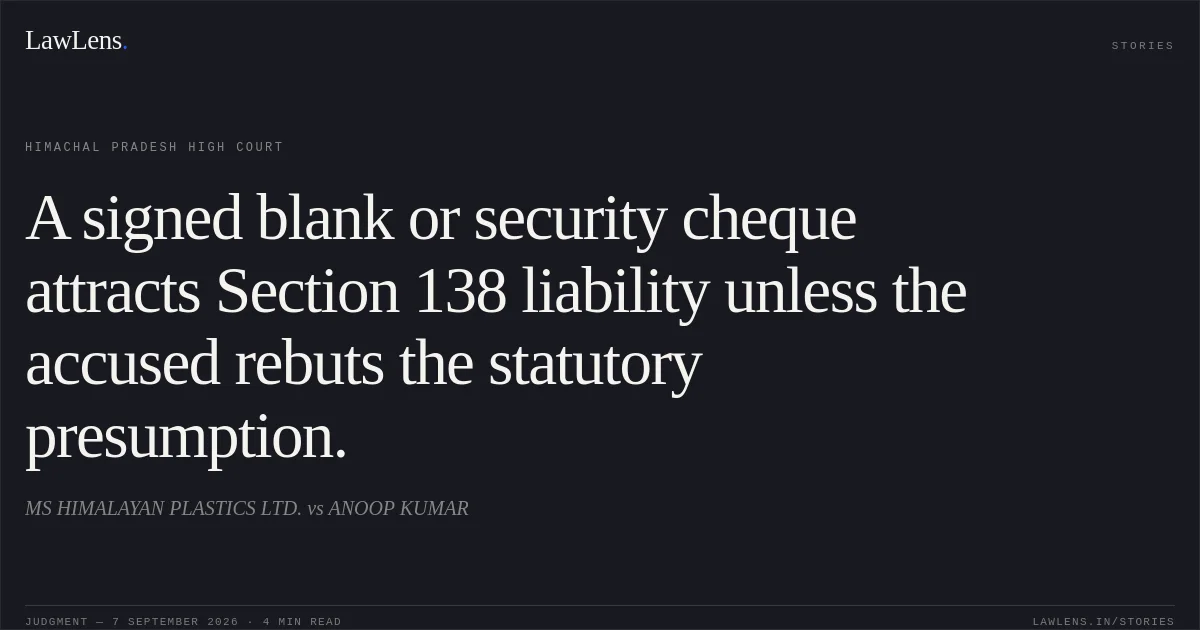
Source reference: paras. 22–25A signed blank cheque may attract Section 138 if the accused fails to rebut the statutory presumption (Bir Singh v. Mukesh Kumar).
Source reference: paras. 42–44A cheque described as “security” is actionable when an existing and legally enforceable liability has matured (Sampelly Satyanarayana Rao v. Indian Renewable Energy Development Agency Ltd.; Sripati Singh v. State of Jharkhand).
Source reference: paras. 38–41In an appeal against acquittal, interference is justified where the trial Court’s view is perverse, wholly unsustainable, or manifestly illegal; however, in Section 138 cases, the appellate Court may examine whether the accused has rebutted the statutory presumption (Sanjay Kumar v. State of Bihar; Rohitbhai Jivanlal Patel v. State of Gujarat).
Source reference: paras. 12–13Where the evidence has been recorded in full rather than merely summarised, Section 326(3) of the Code of Criminal Procedure does not prevent the successor Magistrate from relying on it.
Source reference: paras. 16–21Reasoning
The Court held that the evidence had been recorded in full and the case had effectively proceeded as a summons trial; consequently, the successor Magistrate was competent to rely on the evidence recorded by his predecessor.
Source reference: paras. 16–21Since the accused admitted the cheque and his signatures, the presumptions under Sections 118(a) and 139 arose, and the complainant was not required to prove the underlying debt in the manner required in an ordinary civil recovery suit.
Source reference: paras. 22–25, 35–37The accused’s reply to the statutory notice itself admitted receipt of goods worth ₹23,78,128 and claimed repayment through another cheque, but no such repayment cheque was produced. His unsupported assertion that he was a commission agent, the unsigned account statements, and the evidence concerning payments made by farmers did not establish that his liability had been discharged or that no debt was due.
Source reference: paras. 26–34, 45–47The plea that the cheque was blank or issued as security was legally insufficient, particularly because the accused admitted receipt of goods and failed to prove repayment; the cheque therefore represented an existing liability.
Source reference: paras. 38–44Dishonour for insufficient funds, service of notice, and non-payment were proved, satisfying the statutory ingredients of Section 138.
Source reference: paras. 48–53The trial Court had consequently erred in treating the complainant’s non-production of detailed sale records as fatal and in holding that the statutory presumption had been rebutted.
Source reference: paras. 35–37, 46Holding
The High Court allowed the appeal, set aside the judgment of acquittal, and convicted the accused under Section 138 of the NI Act, holding that the cheque had been issued towards a legally enforceable debt, was dishonoured for insufficient funds, and remained unpaid despite valid notice.
The accused was directed to be produced on 23 September 2026 for hearing on the question of sentence.
Source reference: para. 56Original Court PDF
MS HIMALAYAN PLASTICS LTD.vsANOOP KUMAR
Click to open original judgment
Original judgment, available to read, download and summarize on LawLens.in