Facts
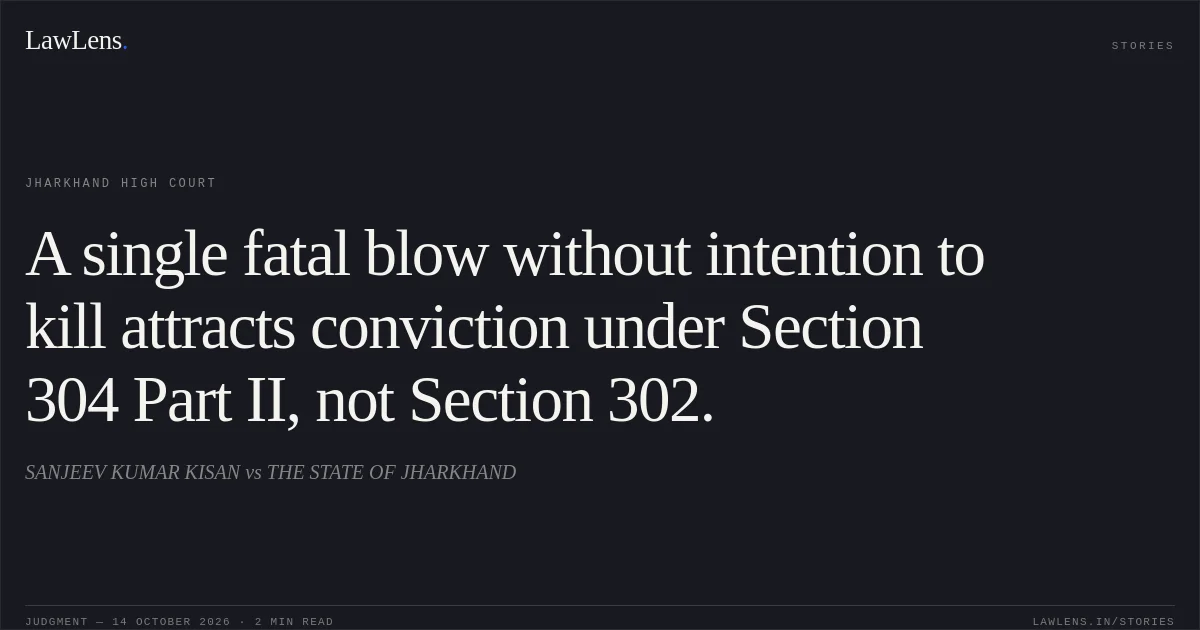
The appellant was convicted under Section 302 IPC and sentenced to life imprisonment with a fine for killing Surajati Nagesiya.
Source reference: pp. 2–4, paras. 5, 8–9The informant, her husband, testified that the appellant—Surajati’s cousin and the father of her daughter—was carrying the child and an axe when he encountered them; he then assaulted Surajati with the axe.
Source reference: pp. 2–4, paras. 5, 8–9The post-mortem attributed her death to haemorrhage and shock from the injuries caused by a heavy, sharp weapon.
Source reference: pp. 2–4, paras. 5, 8–9The informant was the sole eyewitness; the prosecution also relied on medical and forensic evidence.
Source reference: pp. 2–4, paras. 5, 8–9The appeal challenged the conviction under Section 302 IPC, with the appellant arguing that the case fell, at most, under Section 304 Part II IPC.
Source reference: p. 1, para. 3Issues
Whether the appellant’s act amounted to murder under Section 302 IPC or culpable homicide not amounting to murder under Section 304 Part II IPC.
Source reference: pp. 5–6, paras. 11–15Whether the sentence should be reduced to the period already undergone.
Source reference: p. 6, para. 16Law Applied
Sections 299 and 300 IPC distinguish culpable homicide from murder.
Source reference: pp. 5–6, paras. 13–15Under Section 304 Part II IPC, culpable homicide not amounting to murder is punishable where the accused had knowledge that the act was likely to cause death but lacked an intention to cause death or such bodily injury as was likely to cause death.
Source reference: pp. 5–6, paras. 13–15The Court set out the text of Section 304 and applied this distinction in assessing the appellant’s intention and knowledge.
Source reference: pp. 5–6, paras. 13–15Reasoning
The Court considered the circumstances in which the assault occurred: the appellant had come to take back his daughter, whom the informant had brought to his home the previous day, and assaulted the deceased after encountering her with the informant.
Source reference: pp. 5–6, paras. 11–15The medical evidence showed a fatal head injury, but the Court found no repetition of blows and no evidence establishing an intention to kill.
Source reference: pp. 5–6, paras. 11–15It therefore held that the circumstances supported culpable homicide with knowledge of the likelihood of death, but without the requisite intention for murder, bringing the case within Section 304 Part II IPC.
Source reference: pp. 5–6, paras. 11–15Holding
The appeal was partly allowed.
The Court converted the conviction from Section 302 IPC to Section 304 Part II IPC and modified the sentence to the period already undergone, noting the State’s submission that the appellant had served more than ten years with remission.
Source reference: p. 6, paras. 16–20It directed his release forthwith unless required in another case.
Source reference: p. 6, paras. 16–20Acts & Sections Cited
5 provisions across 2 statutes referred to in this judgment. Each provision opens on LawLens.
Indian Penal Code, 18604
Code of Criminal Procedure, 19731
Original Court PDF
SANJEEV KUMAR KISANvsTHE STATE OF JHARKHAND
Click to open original judgment
Original judgment, available to read, download and summarize on LawLens.in