Facts
On 10.08.2025, Pankaj was travelling on his scooty towards village Paju Kalan when car No. HR-20-AS-7396, allegedly driven rashly and negligently by Amit Kumar, struck him from behind near Milan Hotel. Pankaj sustained fatal injuries and was declared dead at General Hospital, Assandh.
Source reference: pp.1–2, paras 2.1–2.2FIR No. 444 dated 10.08.2025 was registered under Sections 106 and 281 of the Bharatiya Nyaya Sanhita against the driver.
Source reference: pp.1–2, paras 2.1–2.2His wife, children and father filed a claim petition under Section 166 of the Motor Vehicles Act, 1988, seeking compensation of ₹2 crore, asserting that he was 30 years old and earned ₹5,55,300 per annum from his proprietorship business, “Maan Sports Wear”.
Source reference: p.2, para 2.2The Motor Accident Claims Tribunal, Hisar relied upon the FIR, challan, eyewitness statement and the failure of the driver and owner to enter the witness box to hold that the accident resulted from the rash and negligent driving of Amit Kumar.
Source reference: pp.3–4, para 6On the basis of the deceased’s Income Tax Return for assessment year 2025–26, the Tribunal assessed his monthly income at ₹46,275, added 40% towards future prospects, deducted one-fourth towards personal expenses, applied a multiplier of 17 and awarded ₹1,01,42,000 with interest at 9% per annum.
Source reference: pp.4–5, paras 6.1–6.2The insurer appealed, principally contending that the Tribunal ought to have considered an average of at least three ITRs.
Source reference: p.5, para 8Issues
1. Whether the Tribunal erred in assessing the deceased’s income on the basis of a single Income Tax Return instead of averaging three years’ ITRs.
Source reference: p.5, para 82. Whether the compensation of ₹1,01,42,000, together with interest at 9% per annum, was justified on the evidence and applicable principles of motor accident compensation.
Source reference: pp.4–5, paras 6.1–6.3; p.8, para 12Law Applied
The Court applied Section 166 of the Motor Vehicles Act, 1988, governing claims for compensation arising from motor accidents.
Source reference: p.2, para 2It relied on National Insurance Company Limited v. Pranay Sethi, 2017 (4) R.C.R. (Civil) 1009, for the principles concerning future prospects, deduction towards personal expenses and application of the appropriate multiplier.
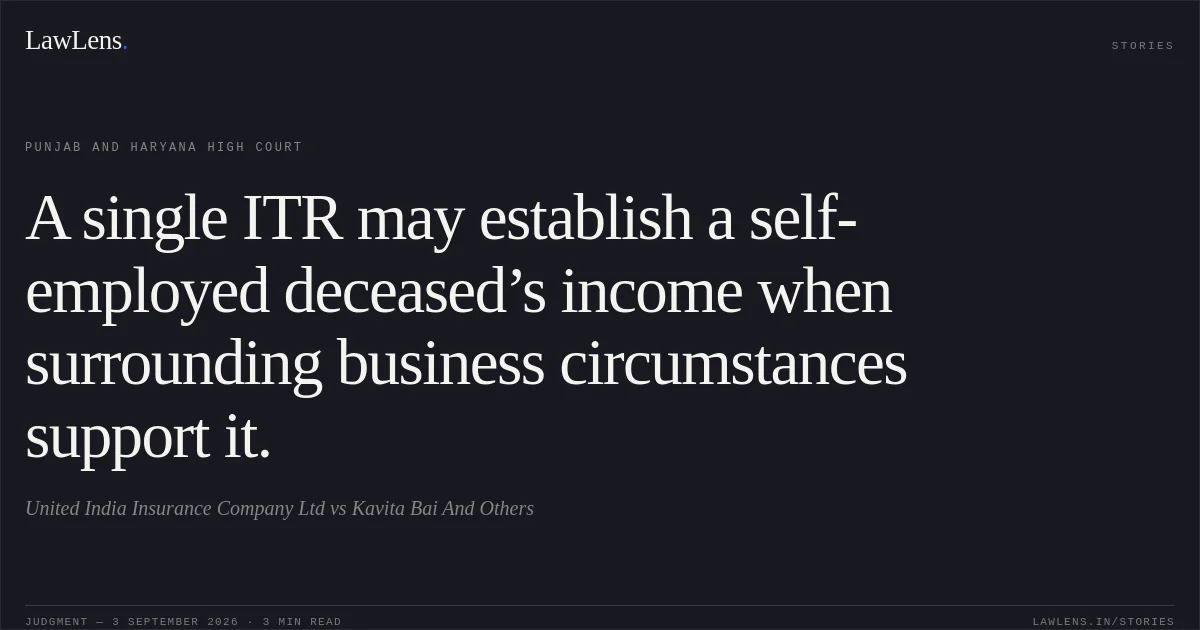
Source reference: p.4, para 6.2It further applied Rashmirekha Tripathy v. The Branch Manager (Legal Claims), Shriram General Insurance Company Limited and Others, SLP (C) No. 27220 of 2024, decided on 01.07.2026, which held that ITRs are an important reference point for assessing income; for self-employed persons, the average income reflected in up to three preceding years’ ITRs is ordinarily relevant, but one or two ITRs may be considered after examining surrounding circumstances, including the nature, growth pattern and potential growth of the business and other relevant factors.
Source reference: pp.6–7, para 10The burden remained on the insurer to rebut the claimants’ evidence regarding income, and compensation had to be assessed on the evidence available on record.
Source reference: p.8, paras 11–12Reasoning
The Court held that Rashmirekha Tripathy did not impose an inflexible requirement that three ITRs must invariably be produced or averaged.
Source reference: pp.6–8, paras 10–10.1Although the deceased was self-employed and operated “Maan Sports Wear,” his ITR for 2025–26 had been duly proved by an official from the Income Tax Office, establishing an annual income of ₹5,55,300.
Source reference: pp.4, 7–8, paras 6.1, 10.1–11The Court also considered the nature of the sportswear business and found it to be flourishing, with reasonable potential for growth.
Source reference: p.8, para 11The insurer had led no oral or documentary evidence to discredit the ITR or establish that the income was inflated or unreliable.
Source reference: p.8, para 11Accordingly, the Tribunal was justified in accepting the single proved ITR, applying 40% future prospects, deducting one-fourth for personal expenses, applying multiplier 17 and awarding the resultant compensation.
Source reference: pp.4–5, paras 6.2, 11–12Holding
The Court answered the issues against the insurer.
It held that the Tribunal had correctly assessed the deceased’s income on the basis of the proved ITR after considering the surrounding circumstances of his business, and that the award of ₹1,01,42,000 with interest at 9% per annum from the date of filing of the claim petition until realization was justified.
Source reference: p.8, para 12The appeal was dismissed, and all pending applications, if any, were closed.
Source reference: p.8, paras 13–14Acts & Sections Cited
4 provisions across 2 statutes referred to in this judgment. Each provision opens on LawLens.
Motor Vehicles Act, 19882
Bharatiya Nyaya Sanhita, 20232
Original Court PDF
United India Insurance Company LtdvsKavita Bai And Others
Click to open original judgment
Original judgment, available to read, download and summarize on LawLens.in