Facts
The appellant-husband challenged the Kerala High Court’s refusal to quash proceedings initiated by respondent No. 1-wife and respondent No. 2-daughter under the Protection of Women from Domestic Violence Act, 2005 (“DV Act”)
Source reference: para. 1; p. 1Before the proceedings, the appellant and respondent No. 1 executed a Settlement Agreement dated 23 July 2016, under which they agreed that neither would make future monetary claims against the other and that the wife would not claim maintenance.
Source reference: paras. 2, 9; pp. 1, 3–4They subsequently filed a joint petition under Section 10A of the Divorce Act, 1869 and obtained a mutual-consent divorce decree on 30 January 2017.
Source reference: paras. 2, 9; pp. 1, 3–4The wife also filed an affidavit before the Family Court affirming that she had relinquished her maintenance claim and that the divorce petition was filed voluntarily, without coercion or undue influence.
Source reference: paras. 2, 9; pp. 1, 3–4The respondents alleged that the settlement had been executed under duress, but the wife had not initiated proceedings to set aside either the settlement or the divorce decree.
Source reference: paras. 5–7, 11–12; pp. 2–3, 4The Supreme Court was also required to consider that respondent No. 2, who was a major when the settlement was executed, was not a party to it.
Source reference: para. 14; p. 6Issues
Whether proceedings under the DV Act relating to claims that had been voluntarily relinquished by the wife under a settlement agreement and affirmed in the mutual-consent divorce proceedings constituted an abuse of process
Source reference: paras. 8–13; pp. 3–5Whether mere allegations that the settlement agreement was executed under coercion or duress could invalidate its effect in the absence of proceedings challenging the settlement or the divorce decree
Source reference: paras. 5–6, 11–12; pp. 2–3, 4Whether the settlement agreement executed only between the appellant and respondent No. 1 extinguished respondent No. 2-daughter’s independent monetary claims
Source reference: para. 14; p. 6Law Applied
The Court applied the principle that a voluntary and valid settlement agreement binds the parties to its terms, and that a party who has relinquished monetary or maintenance claims cannot ordinarily revive the same pre-settlement claims through subsequent proceedings.
Source reference: paras. 8–12; pp. 3–4It further relied on Dhananjay Rathi v. Ruchika Rathi, 2026 SCC OnLine SC 587, and Gimpex Private Limited v. Manoj Goel, (2022) 11 SCC 705, for the rule that a settlement subsumes the original dispute or complaint, and that subsequent proceedings cannot be used to reverse the effect of a settlement; any non-compliance gives rise to appropriate fresh civil or criminal remedies.
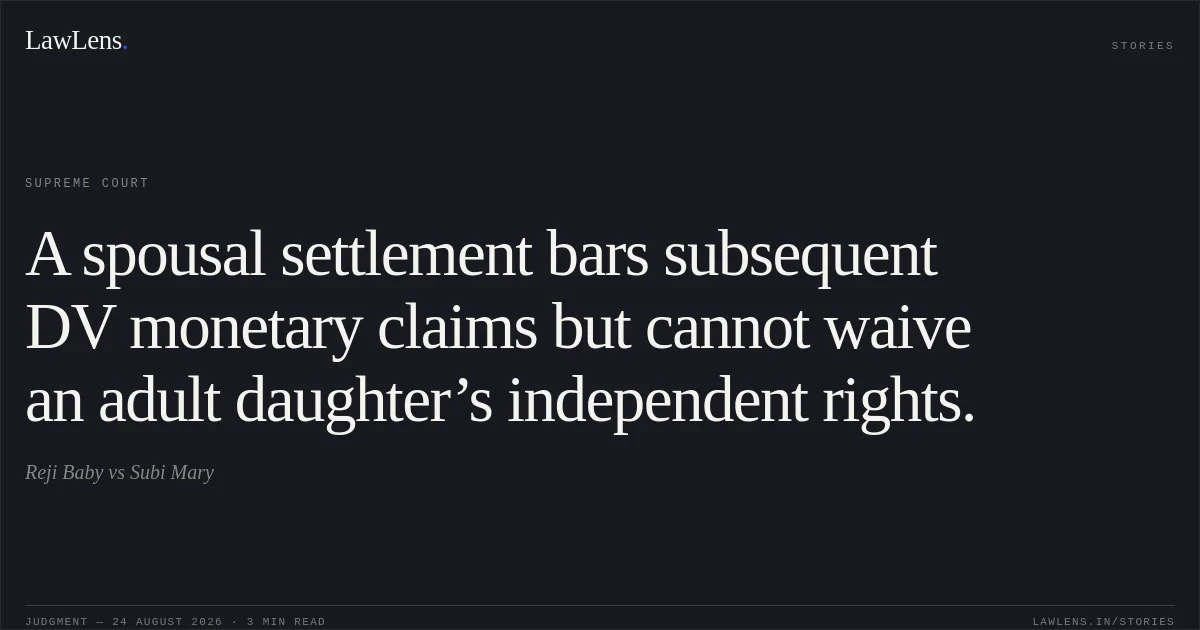
Source reference: para. 13; pp. 4–5However, a settlement binds only its parties and cannot waive or extinguish the independent rights of a person who was not a party to it.
Source reference: para. 14; p. 6Reasoning
The Court found that respondent No. 1 had expressly waived all future monetary and maintenance claims in the Settlement Agreement and had reiterated that waiver in her affidavit before the Family Court.
Source reference: para. 9; pp. 3–4The absence of any pleaded post-divorce cause of action meant that the DV proceedings concerned alleged acts predating the settlement and sought to revive claims already relinquished.
Source reference: para. 10; p. 4The wife’s allegation of duress was insufficient because she had not legally challenged the Settlement Agreement or sought to set aside the divorce decree; her status as an educated person, coupled with the express declaration of free consent in the affidavit, supported the conclusion that the settlement was voluntary.
Source reference: paras. 11–12; p. 4Accordingly, continuation of the proceedings against the appellant in respect of the wife’s extinguished claims constituted an abuse of process.
Source reference: paras. 8–13; pp. 3–5Nevertheless, because respondent No. 2-daughter was a major but had not executed or joined the Settlement Agreement, the Court held that her independent monetary rights had not been waived.
Source reference: para. 14; p. 6Holding
The Supreme Court allowed the appeal and set aside the Kerala High Court’s order dated 26 October 2018.
It quashed the proceedings in M.C. No. 23 of 2017 pending before the Judicial First Class Magistrate Court, Kalamassery, insofar as they were founded on claims extinguished by the settlement.
Source reference: para. 15; p. 6The Court clarified that respondent No. 2-daughter remained at liberty to initiate fresh proceedings seeking monetary relief against the appellant in accordance with law, which would have to be decided on their merits.
Source reference: para. 15; p. 6Acts & Sections Cited
1 provisions across 1 statute referred to in this judgment. Each provision opens on LawLens.
Negotiable Instruments Act, 18811
Original Court PDF
Reji BabyvsSubi Mary
Click to open original judgment
Original judgment, available to read, download and summarize on LawLens.in