Facts
The parties married on 5 May 2009 and began living together at Bilaspur. On 23 July 2009, the husband took the wife to her parental home for Raksha Bandhan. They thereafter lived separately.
Source reference: para. 1–2, 10–14The husband alleged that the wife refused to return unless he arranged separate accommodation, and sought divorce under Sections 13(1)(ia) and 13(1)(ib) of the Hindu Marriage Act, 1955 (“HMA”), on grounds of cruelty and desertion. The Family Court dismissed his petition in Original Suit No. 584 of 2019. The wife, maintaining that she remained willing to resume cohabitation and that the husband had refused to take her back, obtained a decree for restitution of conjugal rights under Section 9 HMA in Original Suit No. 313 of 2019. The husband appealed both decisions under Section 19(1) of the Family Courts Act, 1984.
Source reference: para. 1–2, 10–14, 113–124Issues
Whether the wife’s conduct, including her alleged refusal to return unless provided separate accommodation, established cruelty warranting divorce under Section 13(1)(ia) HMA
Source reference: para. 20, 60–76Whether the wife deserted the husband, without reasonable cause and with the intention permanently to end cohabitation, as required by Section 13(1)(ib) HMA
Source reference: para. 77–88Whether the wife had withdrawn from the husband’s society without reasonable excuse, entitling her to restitution of conjugal rights under Section 9 HMA
Source reference: para. 122, 142–48Law Applied
Under Section 19(1) of the Family Courts Act, an appeal lies to the High Court on facts and law, and the appellate court may reappraise the evidence.
Source reference: para. 47–50Section 13(1)(ia) HMA requires proof of cruelty assessed contextually; the conduct must be sufficiently grave and weighty, and ordinary marital disagreements do not suffice, relying on Dastane v. Dastane, (1975) 2 SCC 326, and Joydeep Majumdar v. Bharti Jaiswal Majumdar, (2021) 3 SCC 742.
Source reference: para. 62–76Desertion under Section 13(1)(ib) requires factum of separation and animus deserendi, without the deserted spouse’s consent and without reasonable cause attributable to that spouse, relying on Lachman Utamchand Kirpalani v. Meena, AIR 1964 SC 40, and Debananda Tamuli v. Kakumoni Kataky, (2022) 5 SCC 459.
Source reference: para. 78–88Under Section 9 HMA, the withdrawing spouse bears the burden of proving reasonable excuse for withdrawal; restitution may be ordered where withdrawal is without reasonable excuse and no legal ground bars relief.
Source reference: para. 142–50A finding is perverse only where it is unsupported by evidence, ignores or misapprehends material evidence, or is one no reasonable court could reach; a different view of the evidence is insufficient, relying on Arulvelu v. State, (2009) 10 SCC 206, and Damodar Lal v. Sohan Devi, (2016) 14 SCC 197.
Source reference: para. 54–59Reasoning
The husband did not establish cruelty by specific or cogent evidence. His allegation that the wife insisted on separate accommodation was denied, and even if established, the request alone did not amount to cruelty. The evidence also showed that he did not pursue sustained efforts to resume cohabitation and had stated that he would not keep his wife; meanwhile, she consistently expressed willingness to return and had sought restitution.
Source reference: para. 92–101The husband therefore failed to prove that the wife had the necessary intention permanently to end cohabitation. The evidence instead supported the Family Court’s finding that he had left her at her parental home and later refused to resume marital life.
Source reference: para. 104–109For the Section 9 petition, the wife’s repeated requests and legal notice supported her willingness to resume cohabitation, while the husband’s evidence established his refusal to take her back. He did not prove a reasonable excuse for his withdrawal from her society.
Source reference: para. 151–160Holding
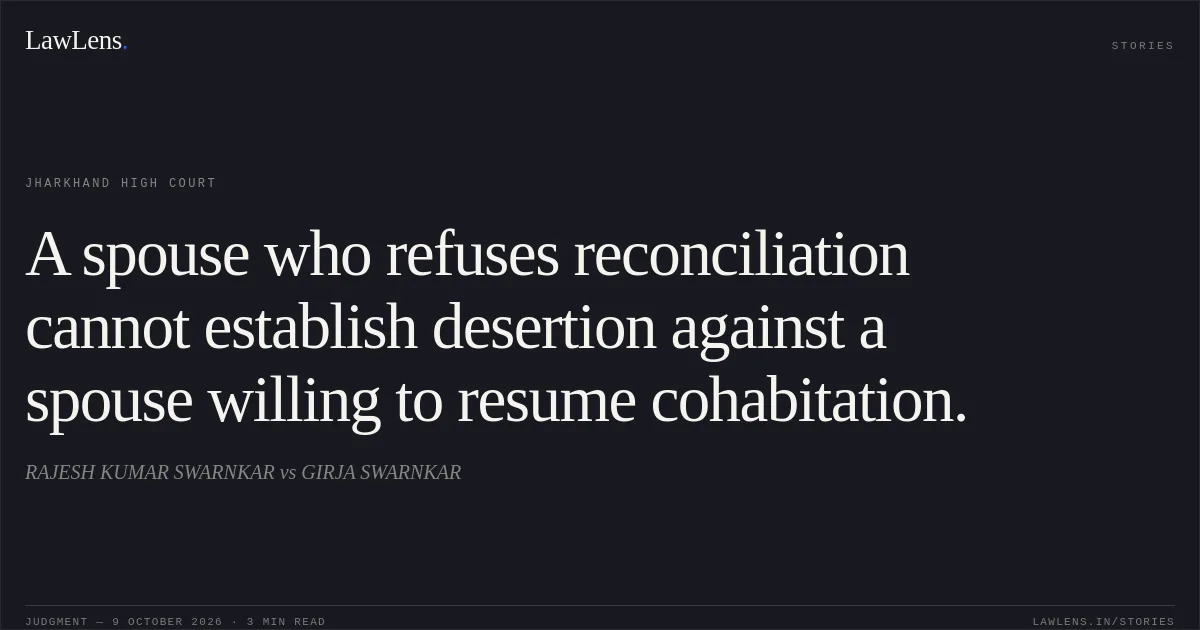
The High Court held that the husband failed to prove cruelty or desertion under Section 13(1)(ia) and (ib) HMA, and that the Family Court’s dismissal of his divorce petition was not perverse. It also upheld the decree for restitution of conjugal rights, finding that the husband had withdrawn from the wife’s society without reasonable excuse.
Both appeals—First Appeal Nos. 177 and 178 of 2024—were dismissed; the decree refusing divorce and the decree directing restitution of conjugal rights were left undisturbed.
Source reference: para. 111–112, 161–164Acts & Sections Cited
6 provisions across 4 statutes referred to in this judgment. Each provision opens on LawLens.
Code of Criminal Procedure, 19731
Family Courts Act, 19842
Hindu Marriage Act, 19552
Code of Civil Procedure, 19081
Original Court PDF
RAJESH KUMAR SWARNKARvsGIRJA SWARNKAR
Click to open original judgment
Original judgment, available to read, download and summarize on LawLens.in