Facts
Respondent No. 2 alleged that her sister, Paramjit Kaur, obtained title to Kothi No. 205, Nabha, on the basis of a forged Will executed by Ujagar Singh and thereafter transferred the property through a chain of transactions.
Source reference: paras. 2–5, 14, 19The petitioner, Tejinder Kaur, purchased the property from Kulwinder Singh through a registered sale deed dated 11 January 2012 for ₹20 lakhs, partly financed through a bank loan, and subsequently sold it to Baljinder Kaur through a registered sale deed dated 18 July 2014 for ₹23 lakhs.
Source reference: paras. 2–5, 14, 19An FIR was registered under Sections 420, 465, 467, 468, 471 and 120-B IPC. After investigation, the police presented a report under Section 173 Cr.P.C. The petitioner sought quashing of the FIR and consequential proceedings under Section 482 Cr.P.C.
Source reference: paras. 1, 4Her case was that she was a bona fide subsequent purchaser, had neither forged the Will nor participated in any conspiracy, and had no knowledge of the alleged defect in title.
Source reference: paras. 5–6Issues
Whether criminal proceedings for cheating, forgery, use of a forged document and criminal conspiracy could continue against the petitioner merely because she purchased the property through a registered sale deed from a vendor whose title was allegedly derived from a forged Will.
Source reference: paras. 14–19Whether the allegations and material collected during investigation disclosed the essential ingredients of Sections 420, 465, 467, 468, 471 and 120-B IPC against the petitioner so as to justify continuation of the proceedings.
Source reference: paras. 19–22Whether the pendency or availability of an application for discharge before the trial Court barred the High Court from exercising jurisdiction under Section 482 Cr.P.C.
Source reference: para. 21Law Applied
The Court applied Section 482 Cr.P.C., which empowers the High Court to prevent abuse of the process of any Court and secure the ends of justice; the provision was noted to be pari materia with Section 528 of the BNSS, 2023.
Source reference: para. 10Applying the categories formulated in State of Haryana v. Bhajan Lal, 1992 Supp (1) SCC 335, the Court held that proceedings may be quashed where the allegations, even if accepted in their entirety, do not constitute an offence, or where continuation of the prosecution would amount to abuse of process.
Source reference: para. 10Relying on Paramjeet Batra v. State of Uttarakhand, (2013) 11 SCC 673, and Mahendra K.C. v. State of Karnataka, (2022) 2 SCC 129, the Court reiterated that the allegations must prima facie satisfy the ingredients of the alleged offence, without conducting a mini-trial.
Source reference: para. 11Under Sections 415 and 420 IPC, cheating requires fraudulent or dishonest inducement, deception, resulting delivery or retention of property, and the requisite mens rea at the time of inducement.
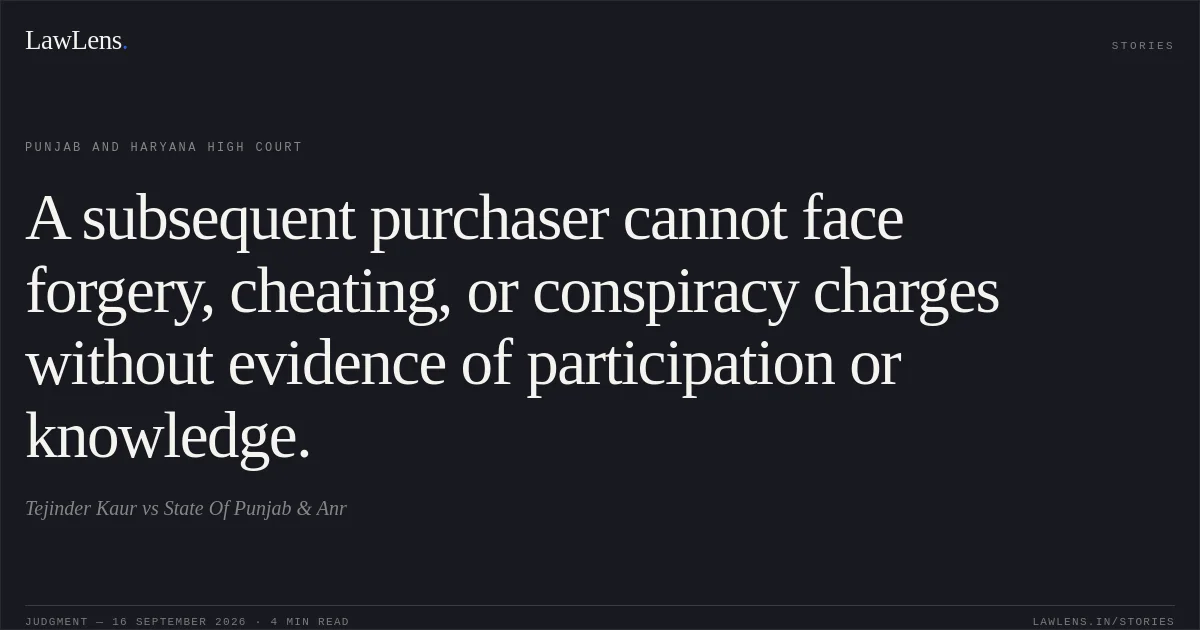
Source reference: paras. 15–17Relying on Gian Singh v. State of Punjab, (2012) 10 SCC 303, Mohammed Ibrahim v. State of Bihar, (2009) 8 SCC 751, and S. Anand v. State of Tamil Nadu and another, 2026 SCC OnLine SC 702, the Court held that a subsequent purchaser cannot ordinarily be prosecuted for cheating or forgery merely because the vendor’s title allegedly originated from a forged document, absent material showing participation in the forgery, knowledge of its falsity, or conspiracy.
Source reference: paras. 12, 17–18The Court further held, on the basis of Pepsi Foods Ltd. v. Special Judicial Magistrate, (1998) 5 SCC 749, and Ashok Chaturvedi v. Shitul H. Chanchani, (1998) 7 SCC 698, that the availability or pendency of a discharge application does not bar exercise of jurisdiction under Section 482 Cr.P.C.
Source reference: para. 21Reasoning
The Court found that the petitioner’s alleged involvement was based principally on her status as a subsequent purchaser and her later sale of the property.
Source reference: paras. 14, 19–20There was no specific allegation or tangible material showing that she prepared or fabricated the Will, participated in its creation, knew that it was forged when she purchased the property, or knowingly used it as genuine.
Source reference: paras. 14, 19–20The petitioner had purchased the property through a registered sale deed for valuable consideration, with a substantial payment made through demand draft and financing obtained from Axis Bank, although the Court clarified that these circumstances did not by themselves conclusively establish her bona fides.
Source reference: paras. 19–20Nevertheless, the allegations did not show that she had fraudulently induced the complainant to deliver property or valuable security, nor that she had the requisite mens rea for cheating under Section 420 IPC.
Source reference: paras. 15–18In the absence of material connecting her with the alleged forged Will or conspiracy, the ingredients of Sections 465, 467, 468 and 471 IPC were also not prima facie established.
Source reference: para. 19The Court therefore held that permitting the prosecution to continue solely because the petitioner had purchased and later sold the disputed property would constitute an abuse of the process of law.
Source reference: para. 22Holding
The High Court allowed the petition and quashed FIR No. 13 dated 10 February 2016, registered under Sections 420, 465, 467, 468, 471 and 120-B IPC at Police Station Kotwali Nabha, District Patiala, together with all consequential proceedings, insofar as they related to Tejinder Kaur.
The Court expressly clarified that the order would not affect the criminal proceedings against the remaining accused.
Source reference: para. 24Acts & Sections Cited
12 provisions across 3 statutes referred to in this judgment. Each provision opens on LawLens.
Code of Criminal Procedure, 19735
Indian Penal Code, 18606
Bharatiya Nagarik Suraksha Sanhita, 20231
Original Court PDF
Tejinder KaurvsState Of Punjab & Anr
Click to open original judgment
Original judgment, available to read, download and summarize on LawLens.in