Facts
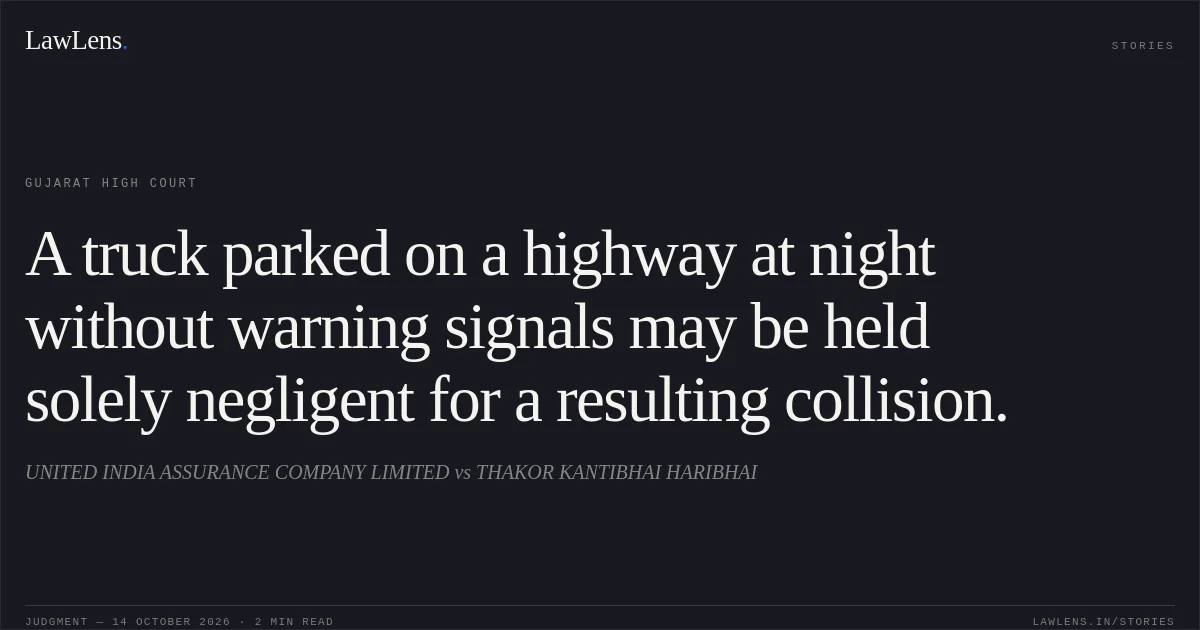
The deceased was riding an Activa scooter on a National Highway when it collided with a stationary trailer-truck at about 8:30 p.m.; he later died from his injuries. The claimants, his parents, sought compensation under Section 166 of the Motor Vehicles Act, 1988. The Tribunal awarded ₹14,58,800 with 9% annual interest, holding the trailer’s driver solely negligent and exonerating the other opponents. The insurer appealed, arguing that the deceased’s negligence should also have been assessed
Source reference: pp. 2–3, paras. 2–6The Tribunal’s findings included that the truck was stationary and that the evidence did not show it had warning lights, reflectors, or barriers in place
Source reference: pp. 5–7Issues
1. Whether the Tribunal erred in finding the trailer-truck’s driver solely negligent and declining to attribute contributory negligence to the deceased
Source reference: pp. 3, 9–10; paras. 6, 10–112. Whether the insurer’s appeal disclosed grounds warranting interference with the award
Source reference: p. 10; paras. 12–13Law Applied
Under Section 166 of the Motor Vehicles Act, negligence in a motor-accident claim is assessed on the balance of probabilities, not beyond reasonable doubt; the Court referred to Bimla Devi v. H.R.T.C., Parmeshwari Devi v. Amir Chand, and Dulcina Fernandes v. Joaquim Xavier Cruz
Source reference: pp. 4–5It also cited Mathew Alexander v. Mohammed Shafi for the principle that the Tribunal must consider the evidence holistically and that claimants need not prove the precise manner of the accident beyond reasonable doubt.
Source reference: p. 5Sections 122 and 126 of the Act were invoked in relation to leaving or keeping a vehicle in a dangerous position in a public place.
Source reference: pp. 8–9Relying on Jumani Begam v. Ram Narayan, the Court noted that contributory negligence cannot be based on conjecture where the evidence establishes that a truck-trailer was parked on a road at night without reflectors.
Source reference: pp. 6–7Reasoning
The Court found that the trailer-truck was stationary on a National Highway at night and that the record showed no blinkers, indicators, reflectors, or rear warning barrier. The truck’s driver did not testify to explain why it had been left there or what precautions had been taken; the Tribunal was therefore justified in drawing an adverse inference.
Source reference: pp. 6–10, paras. 8–11The insurer’s reliance on the FIR and the deceased’s alleged speed did not establish that he could have avoided the collision, and the Court rejected attributing contributory negligence on that basis as speculative. The circumstances supported the Tribunal’s finding of sole negligence on the part of the trailer-truck’s driver.
Source reference: pp. 6–10, paras. 8–11Holding
The Court held that the Tribunal had committed no error in finding the trailer-truck’s driver solely negligent and dismissed the appeal summarily at the admission stage.
It directed that, upon deposit of the decretal amount, the Tribunal disburse the compensation to the claimants after verification, and expected the insurer to deposit the amount within eight weeks. The connected stay application was disposed of as not surviving.
Source reference: p. 10, paras. 11–14Acts & Sections Cited
4 provisions across 1 statute referred to in this judgment. Each provision opens on LawLens.
Motor Vehicles Act, 19884
Original Court PDF
UNITED INDIA ASSURANCE COMPANY LIMITEDvsTHAKOR KANTIBHAI HARIBHAI
Click to open original judgment
Original judgment, available to read, download and summarize on LawLens.in