Facts
The appellant, a college teacher appointed as Principal, challenged the Vice-Chancellor’s decision revising the seniority determination in favour of respondent No. 4, together with consequential action by the college authorities.
Source reference: para. 4–18The Single Judge dismissed the writ petition at the threshold, without calling for counter-affidavits, on the ground that an alternative remedy was available under Section 68 of the Uttar Pradesh State Universities Act, 1973.
Source reference: para. 19In the special appeal, the appellant alleged, among other things, that the committee had been reconstituted without notice and that he had not been afforded an opportunity to address the material and reasoning relied upon in the seniority decision.
Source reference: para. 21–23, 34Issues
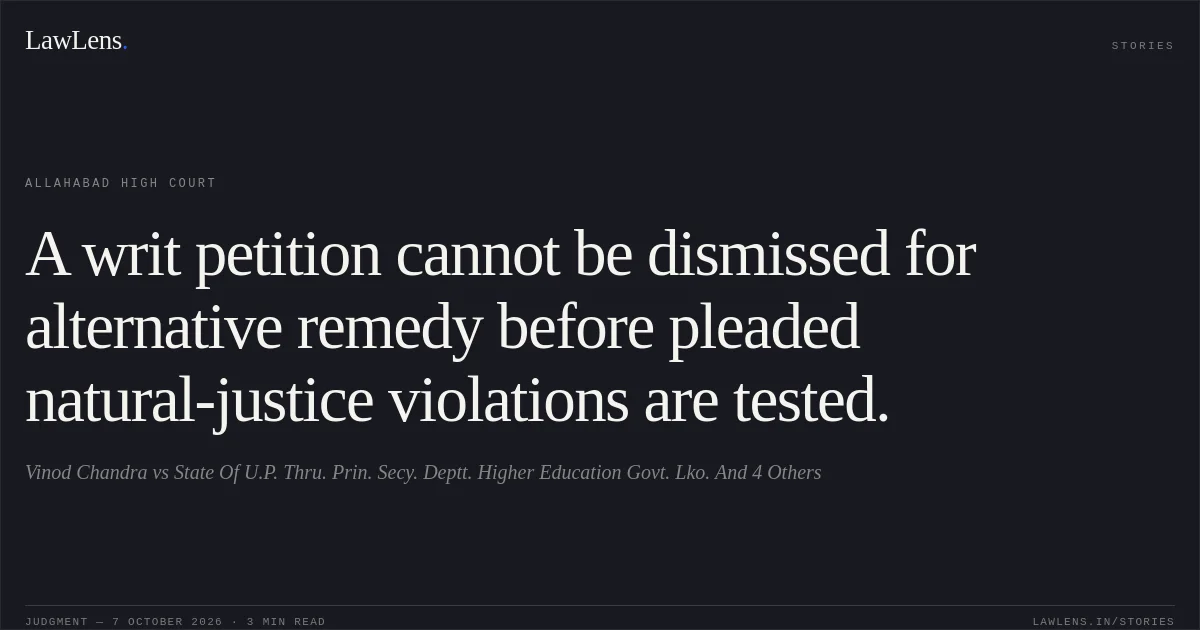
Whether the Single Judge could dismiss the writ petition at the threshold on the basis of an alternative statutory remedy without first testing the appellant’s specific allegations of breach of natural justice on the parties’ pleadings.
Source reference: para. 29, 34–37Whether the special appeal should be entertained where the Single Judge’s decision rested on the alternative-remedy rule and was made without a counter-affidavit or examination of the disputed allegations.
Source reference: para. 29–30Law Applied
Article 226 confers plenary jurisdiction, and the existence of an alternative remedy is ordinarily a rule of policy, convenience and judicial discretion—not a bar to the maintainability of a writ petition; recognised exceptions include breach of natural justice, want or excess of jurisdiction, enforcement of fundamental rights, and a challenge to vires (Whirlpool Corporation v. Registrar of Trade Marks; Radha Krishan Industries v. State of Himachal Pradesh).
Source reference: para. 31–33Assistant Commissioner of State Tax v. Commercial Steel Ltd. likewise recognises that a writ may be entertained in exceptional circumstances, including breach of natural justice.
Source reference: para. 33M/s Godrej Sara Lee Ltd. v. Excise and Taxation Officer distinguishes maintainability from entertainability: a petition may be maintainable but not entertained as a matter of discretion; dismissal solely for non-exhaustion of an alternative remedy, without considering whether an exception warrants entertainment, is improper.
Source reference: para. 35The Court distinguished Bihar Industrial Area Development Authority v. SCOPE Sales Ltd., observing that restraint in an intra-court appeal against discretionary orders presupposes that the writ court considered the matter on an adequate record.
Source reference: para. 30Section 68 of the Uttar Pradesh State Universities Act, 1973 provided the alternative remedy relied upon by the Single Judge.
Source reference: para. 19Reasoning
The appellant’s natural-justice objections were specific and disputed: he alleged that the committee was reconstituted without notice and that he lacked an opportunity to respond to the basis on which his service was assessed.
Source reference: para. 34Because the Single Judge had called for no counter-affidavit, those allegations had not been tested against the respondents’ account. The Division Bench held that the court should first obtain the opposing pleadings and assess whether the alleged procedural breach occurred; only then should it decide whether to entertain the writ petition or relegate the appellant to the statutory remedy.
Source reference: para. 34, 36–37The dismissal therefore prematurely treated a discretionary alternative-remedy question as one of maintainability. The Bench left the truth and merits of the allegations open.
Source reference: para. 37, 40Holding
The appeal was allowed. The Single Judge’s order dated 17 December 2025 was quashed, and the writ petition was restored and remitted for fresh consideration on merits, uninfluenced by the Division Bench’s observations on the underlying dispute.
The respondents were directed to file counter-affidavits within ten days and the appellant was permitted to file a rejoinder within three days thereafter; no order as to costs was made.
Source reference: para. 39, 42Acts & Sections Cited
2 provisions across 1 statute referred to in this judgment. Linked provisions open on LawLens.
Uttar Pradesh State Universities Act, 19732
Original Court PDF
Vinod ChandravsState Of U.P. Thru. Prin. Secy. Deptt. Higher Education Govt. Lko. And 4 Others
Click to open original judgment
Original judgment, available to read, download and summarize on LawLens.in