Facts
Respondent No. 1 filed O.S. No. 102/2016 claiming ownership and possession of 3 acres 1 gunta in Sy. No. 90/6 (old Sy. No. 90/1).
Source reference: p. 3–5The parties filed a compromise petition under Order XXIII Rule 3 CPC, which the Trial Court accepted and on which it drew a compromise decree.
Source reference: p. 3–5The petitioner later challenged the compromise order and decree, contending that the Government had acquired the 3 acres 1 gunta and that the Government was not a party to the suit. Respondents 2 and 3 supported the petitioner’s challenge.
Source reference: p. 3–5The High Court noted that the parties had appeared through counsel and that the Trial Court had recorded that the compromise petition was read over and explained to them, and that they admitted its contents.
Source reference: p. 6Issues
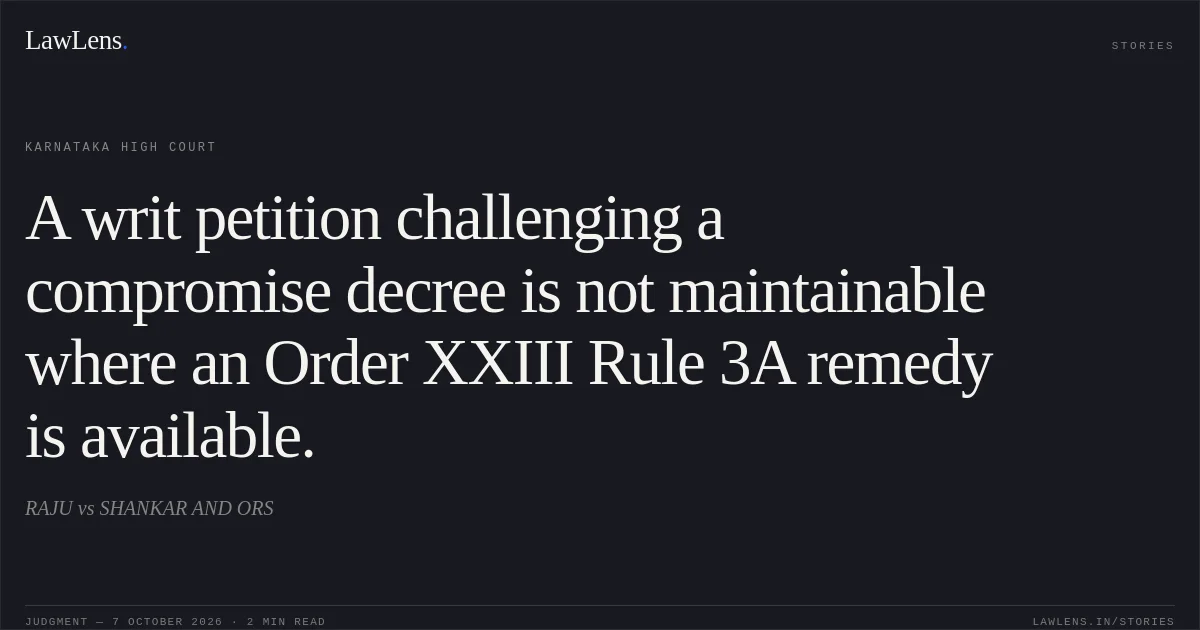
Whether the petitioner could challenge the compromise order and decree by a writ petition under Article 227, rather than by pursuing the remedy identified by the Court under Order XXIII Rule 3A CPC.
Source reference: p. 7Whether the writ petition was maintainable in the circumstances, given that the compromise decree had been passed by the Civil Court and not by a Lok Adalat.
Source reference: p. 7Law Applied
Order XXIII Rule 3 CPC concerns the recording of a lawful compromise by the court and the passing of a decree in accordance with it.
Source reference: p. 7The Court treated Order XXIII Rule 3A CPC as providing the petitioner with an efficacious alternative remedy to challenge the compromise decree, and held that the petitioner should pursue the appropriate proceedings before the appropriate forum rather than invoke writ jurisdiction.
Source reference: p. 7The Court distinguished the case from one involving a Lok Adalat award, observing that the impugned decree was a Civil Court decree, not a Lok Adalat award.
Source reference: p. 7Reasoning
Although the petitioner alleged that the suit property had been acquired by the Government and that the compromise was therefore erroneous, the High Court did not determine those merits.
Source reference: p. 6It relied on the Trial Court record showing that the parties had appeared, acknowledged the compromise petition’s contents, and obtained a decree on that basis.
Source reference: p. 6The Court concluded that the petitioner had an efficacious remedy under Order XXIII Rule 3A CPC and had not shown a basis to pursue the challenge by writ petition. It also found the Lok Adalat distinction inapplicable because the decree was passed by the Trial Court.
Source reference: p. 7Holding
The High Court dismissed the writ petition as not maintainable.
while reserving liberty to the petitioner to approach the appropriate authority and initiate appropriate proceedings.
Source reference: p. 7Any pending interlocutory applications were also disposed of.
Source reference: p. 7Acts & Sections Cited
1 provisions across 1 statute referred to in this judgment. Each provision opens on LawLens.
Code of Civil Procedure, 19081
Original Court PDF
RAJUvsSHANKAR AND ORS
Click to open original judgment
Original judgment, available to read, download and summarize on LawLens.in