Facts
Two occupants of a car were injured in a collision with a truck.
Source reference: pp. 1–3, paras. 1–3The Tribunal attributed 50% negligence to each driver and awarded compensation of ₹9,42,000 to Nafisa Rajubhai Barot and ₹8,41,400 to Dipti Gagan Shethi.
Source reference: pp. 1–3, paras. 1–3It assessed Nafisa’s disability at 40%, her monthly income at ₹10,000, and Dipti’s disability at 35%.
Source reference: pp. 1–3, paras. 1–3The insurer appealed on negligence and quantum; Nafisa cross-objected, seeking enhanced compensation.
Source reference: p. 3, para. 4Issues
1. Whether the Tribunal correctly apportioned negligence equally between the truck driver and the car driver?
Source reference: pp. 3–4, paras. 5–62. Whether the Tribunal correctly assessed Nafisa’s disability and compensation, including her future loss of income and medical and attendant expenses?
Source reference: pp. 4–8, paras. 7–153. Whether the compensation awarded to Dipti required reconsideration in the absence of an appeal by her?
Source reference: p. 8, para. 16Law Applied
The judgment cites no specific statute or precedent.
Source reference: no citationnegligence may be apportioned between drivers based on the evidence, including the physical damage recorded in the panchnama
Source reference: no citationdisability for compensation purposes must be assessed in light of the injury’s effect on the claimant’s mobility and earning capacity
Source reference: no citationfuture loss of income may be calculated by applying an appropriate disability percentage, future prospects, and multiplier to the claimant’s income.
Source reference: no citationReasoning
The Court upheld equal apportionment of negligence because the panchnama recorded damage to the right side of both vehicles, supporting the Tribunal’s conclusion that both drivers were responsible; the insurer had not produced the truck driver’s chargesheet.
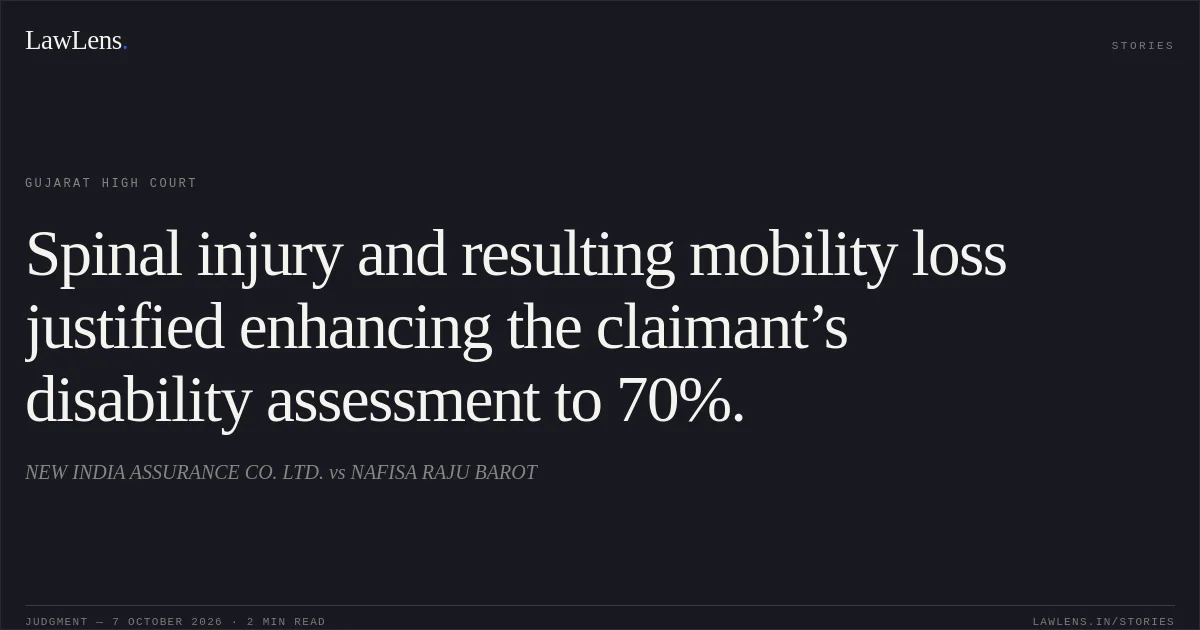
Source reference: p. 4, para. 6For Nafisa, the hospital records documented post-accident spinal disc herniation and stenosis, which the Court considered inconsistent with the Tribunal’s reliance on unrelated prior kidney and ovarian conditions to limit disability.
Source reference: pp. 5–7, paras. 10–12It assessed her disability at 70%, while maintaining her monthly income at ₹10,000; adding 25% future prospects and applying a multiplier of 13, it calculated future loss of income at ₹13,65,000.
Source reference: pp. 5–7, paras. 10–12It also increased medical expenses to ₹1,50,000, food, nutrition and attendant charges to ₹75,000, and loss of amenities to ₹1,00,000.
Source reference: pp. 7–8, paras. 13–15As Dipti had not appealed, the Court declined to revisit her award.
Source reference: p. 8, para. 16Holding
The Court affirmed the 50:50 apportionment of negligence and enhanced Nafisa’s total compensation to ₹18,60,000, an increase of ₹9,18,000 over the Tribunal’s award.
The enhanced amount was ordered to carry interest at 9% per annum from the date of the claim petition until payment, with eight weeks granted for deposit.
Source reference: p. 9, paras. 18–19The Court stated that the insurer’s appeals were dismissed and Nafisa’s cross-objection was partly allowed.
Source reference: p. 8, para. 16“the appeal is allowed in part”
Source reference: p. 9, para. 20Original Court PDF
NEW INDIA ASSURANCE CO. LTD.vsNAFISA RAJU BAROT
Click to open original judgment
Original judgment, available to read, download and summarize on LawLens.in