Facts
The applicant, named as Accused No. 5, sought quashing under Section 482 Cr.P.C. of two FIRs registered at Mansa Police Station under Sections 406, 420 and 114 IPC.
Source reference: paras. 5–13The complainants alleged that their firms supplied maize to Anil Limited on credit in 2016, received post-dated cheques, and were induced not to present them; the cheques later expired without valid revalidation
Source reference: paras. 5–13The applicant contended that he had resigned as a director on 6 November 2015, before the transactions, and that the FIRs alleged no specific act by him
Source reference: paras. 15–18The complainants disputed the resignation date and relied on other pending proceedings against him
Source reference: paras. 21–24The applications were heard together
Source reference: para. 4Issues
1. Whether the High Court could rely under Section 482 Cr.P.C. on Form DIR-12, a statutory public document recording the applicant’s resignation, despite the complainants’ contrary assertion
Source reference: para. 25(I); paras. 26–312. Whether the allegations disclosed the ingredients of Sections 406 and 420 IPC, including the relevance of the asserted mutual exclusivity of those offences
Source reference: para. 25(II); paras. 32–383. Whether the applicant’s alleged criminal antecedents and pending proceedings precluded quashing of these FIRs
Source reference: para. 25(III); paras. 39–434. Whether the FIRs disclosed criminal offences or amounted to use of the criminal process to pursue recovery of a commercial debt
Source reference: para. 25(IV); paras. 44–48Law Applied
Section 482 Cr.P.C. empowers the High Court to quash proceedings to prevent abuse of process and secure the ends of justice; under State of Haryana v. Bhajan Lal, quashing may be warranted, among other circumstances, where allegations do not disclose an offence, are inherently improbable, or proceedings are manifestly mala fide
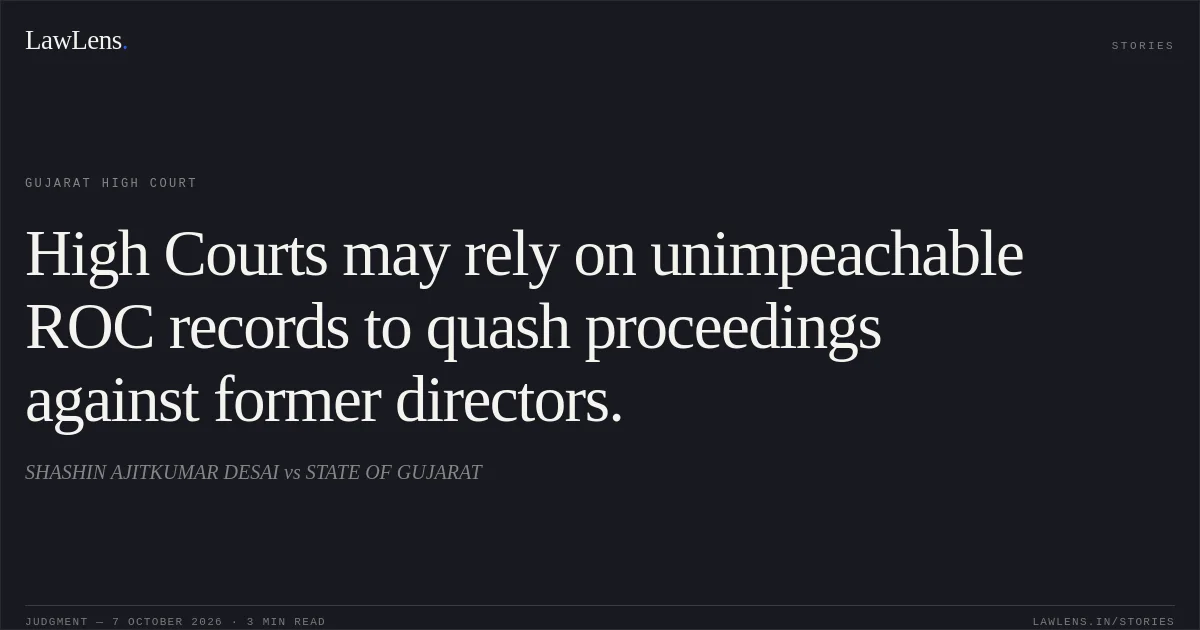
Source reference: para. 48Under Harshendra Kumar D. v. Rebatilata Koley and Anita Malhotra v. Apparel Export Promotion Council, the Court may consider unimpeachable statutory records, including Registrar of Companies filings, when exercising that jurisdiction
Source reference: paras. 28–30Section 406 IPC requires entrustment and dishonest misappropriation; Section 420 requires dishonest or fraudulent intention at the time of inducement, and subsequent non-performance alone does not establish that intention (Hridaya Ranjan Prasad Verma v. State of Bihar)
Source reference: paras. 33, 37The Court relied on Delhi Race Club (1940) Ltd. v. State of Uttar Pradesh for the rule that an ordinary sale of goods transfers ownership and creates a debtor-creditor relationship, not entrustment, and that non-payment alone does not constitute criminal breach of trust
Source reference: para. 36Although civil and criminal remedies may coexist, criminal process should not be used merely to recover a civil debt (Indian Oil Corpn. v. NEPC India Ltd.)
Source reference: paras. 45, 47The Court also held that IPC offences of cheating and criminal breach of trust do not impose vicarious liability on a director merely by virtue of office
Source reference: para. 38Reasoning
The Court treated the certified Form DIR-12 as an unimpeachable statutory record establishing that the applicant ceased to be a director on 6 November 2015, before the 2016 transactions; it found the complainants’ unsupported contrary assertion insufficient to create a triable factual dispute
Source reference: paras. 30–31The FIRs described sales of maize on credit, which did not involve entrustment, and did not allege facts showing that the applicant personally induced the complainants or possessed dishonest intent at the inception of the transactions
Source reference: paras. 35–38The applicant’s other pending cases could not supply missing allegations or establish liability in these FIRs
Source reference: paras. 40–43Given the absence of a specific act attributed to him and the commercial nature of the claims, the Court found the proceedings against him to fall within the Bhajan Lal categories warranting quashing
Source reference: paras. 46–48Holding
The Court answered the issues in the applicant’s favour and allowed both applications.
It quashed FIR Nos. C.R. I-54 of 2018 and C.R. I-57 of 2018, and all consequential proceedings, qua the applicant, Shashin Ajitkumar Desai
Source reference: paras. 50–53Acts & Sections Cited
7 provisions across 3 statutes referred to in this judgment. Each provision opens on LawLens.
Code of Criminal Procedure, 19732
Indian Penal Code, 18603
Negotiable Instruments Act, 18812
Original Court PDF
SHASHIN AJITKUMAR DESAIvsSTATE OF GUJARAT
Click to open original judgment
Original judgment, available to read, download and summarize on LawLens.in