Facts
Two FIRs were registered at Mansa Police Station in April 2018 under Sections 406, 420 and 114 IPC.
Source reference: paras. 1–4They arose from maize supplied on credit to Anil Limited: one complainant alleged outstanding dues of ₹1,33,83,350 and the other ₹30,78,437.
Source reference: paras. 1–4The complainants alleged that company representatives asked them not to present post-dated cheques, which later expired after their dates were altered without validation.
Source reference: paras. 1–4The FIRs named the applicants as participants in a conspiracy to obtain goods dishonestly.
Source reference: paras. 1–4The applicants sought quashing under Section 482 CrPC, contending that the dispute was commercial, the FIRs attributed no specific acts to them, and the alleged offences were not made out.
Source reference: paras. 1–4The complainants opposed, relying on the alleged fraudulent scheme and other proceedings involving the applicants.
Source reference: paras. 1–4The High Court heard the connected applications together.
Source reference: paras. 1–4Issues
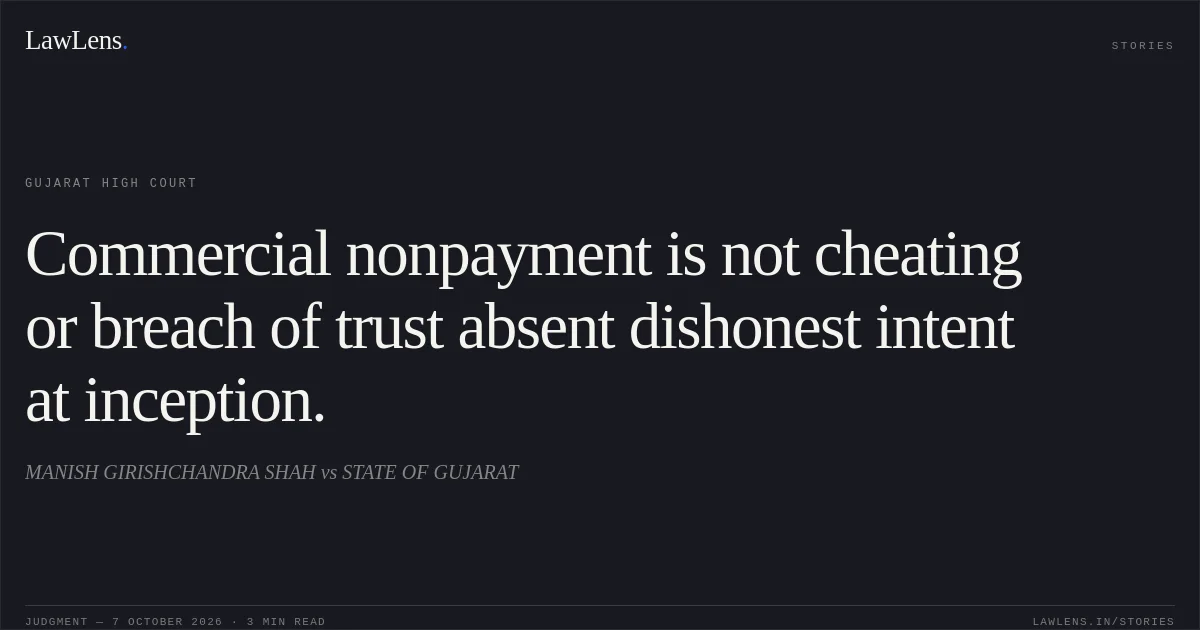
1. Whether the FIRs disclosed the essential ingredients of criminal breach of trust under Section 406 IPC or cheating under Section 420 IPC, including the relevance of the asserted mutual exclusivity of those offences.
Source reference: para. 25(I); paras. 26–322. Whether the applicants’ alleged antecedent proceedings and “habitual offender” status could defeat their applications to quash these FIRs.
Source reference: para. 25(II); paras. 33–373. Whether the FIRs disclosed criminal conduct or instead sought to use criminal proceedings to recover a commercial debt.
Source reference: para. 25(III); paras. 38–42Law Applied
Section 482 CrPC empowers the High Court to quash proceedings to prevent abuse of process and secure the ends of justice.
Source reference: no citationUnder Sections 406 and 420 IPC, criminal breach of trust requires entrustment and subsequent dishonest misappropriation, while cheating requires dishonest or fraudulent intention at the time of inducement; a sale of goods ordinarily transfers ownership and creates a debtor–creditor relationship, not an entrustment (Delhi Race Club (1940) Ltd. v. State of Uttar Pradesh, (2024) 10 SCC 690).
Source reference: paras. 27–31A later failure to perform a promise, without dishonest intention at inception, does not by itself constitute cheating (Hridaya Ranjan Prasad Verma v. State of Bihar, (2000) 4 SCC 168).
Source reference: para. 31The existence of a civil remedy does not automatically bar criminal proceedings, but criminal process should not be used to exert pressure for recovery of a civil debt (Indian Oil Corpn. v. NEPC India Ltd., (2006) 6 SCC 736).
Source reference: paras. 39–41Under State of Haryana v. Bhajan Lal, 1992 Supp (1) SCC 335, quashing may be justified, among other circumstances, where allegations do not disclose an offence, are inherently improbable, or proceedings are manifestly mala fide.
Source reference: para. 42The Court also relied on Section 54 of the Indian Evidence Act, 1872, observing that bad character is generally irrelevant in criminal proceedings.
Source reference: para. 36Reasoning
The Court treated the transactions as ordinary sales of maize against invoices.
Source reference: paras. 29–32Because the goods were sold rather than entrusted, it held that the allegations did not support Section 406 IPC.
Source reference: paras. 29–32It also found that the FIRs described an established business relationship and non-payment of invoices, but did not disclose dishonest intention at the inception of the transactions sufficient to make out cheating.
Source reference: paras. 29–32, 40The alleged requests to defer presentation of cheques were viewed as consistent with commercial financial distress, not by themselves proof of an original fraudulent design; moreover, the FIRs did not attribute specific acts of inducement to the applicants, and the IPC imposes no general vicarious liability on directors for these offences.
Source reference: paras. 29–32, 40The Court held that other pending cases and allegations of bad character could not substitute for proof of the elements of the offences in these particular FIRs.
Source reference: paras. 34–37Applying Bhajan Lal, it concluded that the proceedings, insofar as they concerned the applicants, lacked a sufficient criminal foundation and risked using criminal process to recover corporate dues.
Source reference: paras. 41–45Holding
The High Court answered the issues in the applicants’ favour and allowed all connected applications.
It quashed FIR C.R. I-54 of 2018 and FIR C.R. I-57 of 2018, together with consequential proceedings, including any charge-sheet or process, qua the present applicants.
Source reference: paras. 45–47Rule was made absolute accordingly.
Source reference: paras. 45–47Acts & Sections Cited
7 provisions across 3 statutes referred to in this judgment. Each provision opens on LawLens.
Code of Criminal Procedure, 19732
Indian Penal Code, 18603
Negotiable Instruments Act, 18812
Original Court PDF
MANISH GIRISHCHANDRA SHAHvsSTATE OF GUJARAT
Click to open original judgment
Original judgment, available to read, download and summarize on LawLens.in