Facts
The plaintiffs, farmers whose land was rendered barren by floods, received alternative agricultural land from the State.
Source reference: no citationThey challenged the Collector’s 1986 order setting aside the allotments and the Additional Chief Secretary’s 1989 order concerning recovery of land.
Source reference: no citationThe Trial Court granted declaratory and injunctive relief, and the first appellate court dismissed the State’s appeal.
Source reference: para. 5.2–7During the State’s second appeal, respondent No. 8 died. Her legal representatives were not brought on record; the State had obtained permission to delete her and its later application to recall that order was rejected.
Source reference: para. 8–13The State then sought to join her legal representatives and a proposed respondent claiming through respondent No. 7’s will.
Source reference: para. 8–13The respondents objected that the appeal had abated in its entirety because the decree was joint and inseparable.
Source reference: para. 4, 14–19Issues
1. Whether the second appeal abated in its entirety because respondent No. 8 died without her legal representatives being brought on record, where the decree was alleged to be joint and inseparable.
Source reference: para. 4, 14–192. Whether the State could rejoin respondent No. 8 and add her legal representatives after its application to recall the order deleting her had been rejected.
Source reference: para. 11–133. Whether the proposed respondent claiming under respondent No. 7’s will could be joined in the appeal.
Source reference: para. 10, 134. Whether the Collector’s revisional order and the condition imposing new tenure were legally valid—the substantial questions originally framed on admission, but not reached for decision because the appeal was dismissed as abated.
Source reference: para. 3, 19–20Law Applied
The Court relied on Suresh Chandra (Deceased) Thr. Lrs. and Ors. v. Parasram and Ors., 2025 SCC OnLine SC 1472, for the principles governing partial or whole abatement: the result depends on the facts, and an appeal cannot proceed where doing so may produce contradictory decrees, the relief cannot be pursued against the surviving parties alone, or a decree against them would be ineffective.
Source reference: para. 16A decree is joint and inseverable for this purpose where deciding the appeal against the surviving parties could result in mutually irreconcilable decrees; distinct and independent rights may, by contrast, support separate decrees.
Source reference: para. 16The Court also applied res judicata to the State’s renewed request concerning respondent No. 8, because the prior order refusing recall had not been challenged.
Source reference: para. 11–12Reasoning
The Court considered the plaintiffs’ common interest in the land allotments and the operative terms of the decree, which granted relief concerning the impugned revenue orders to the plaintiffs collectively.
Source reference: para. 10, 14–15It concluded that allowing the State’s appeal to proceed against the surviving plaintiffs could restore the revenue orders as to them while leaving the decree in force as to respondent No. 8, creating inconsistent outcomes.
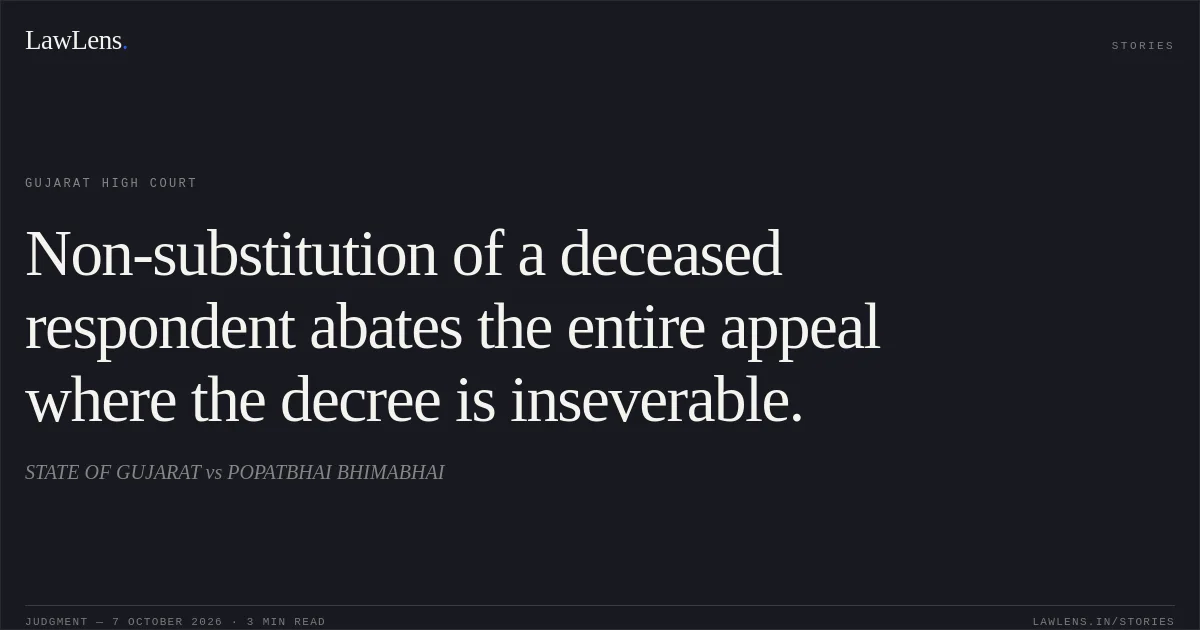
Source reference: para. 18–19The Court therefore treated the decree as inseparable and held that the appeal could not proceed.
Source reference: para. 18–19It rejected the request to rejoin respondent No. 8 or her legal representatives as barred by res judicata, but allowed the proposed respondent claiming through respondent No. 7 to be added as respondent No. 7.5.
Source reference: para. 12–13Holding
The Civil Application for joining a party was partly allowed to add Sarmanbhai Savdasbhai Sutreja as respondent No. 7.5; the request concerning respondent No. 8 and her legal representatives was rejected.
The second appeal was dismissed as abated in its entirety, and the judgments and decrees of the courts below were confirmed.
Source reference: para. 20The Court made no order as to costs and directed that the decree be drawn accordingly.
Source reference: para. 20The substantive questions concerning the Collector’s revisional powers and the new-tenure condition were not decided on their merits.
Source reference: para. 3, 19–20Acts & Sections Cited
1 provisions across 1 statute referred to in this judgment. Linked provisions open on LawLens.
Bombay Land Revenue Code, 18791
Original Court PDF
STATE OF GUJARATvsPOPATBHAI BHIMABHAI
Click to open original judgment
Original judgment, available to read, download and summarize on LawLens.in