01Facts
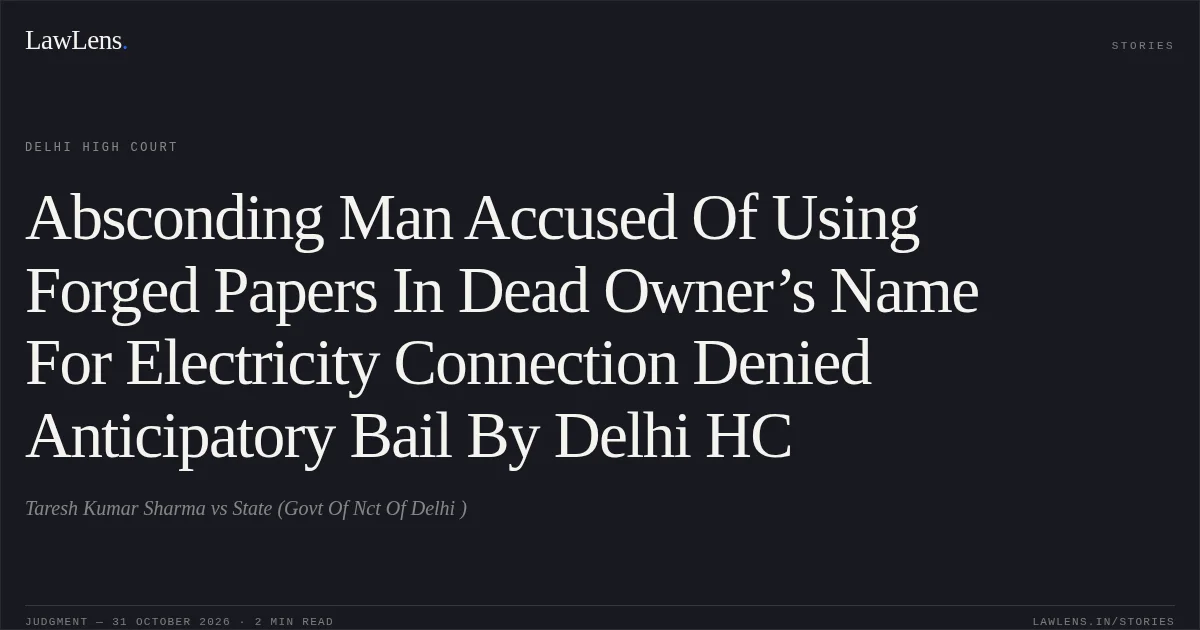
The petitioner sought anticipatory bail under Section 482 of the Bharatiya Nagarik Suraksha Sanhita, 2023, in FIR No. 217/2026, registered under Sections 420, 468, 471, 467, 120B and 34 IPC.
p. 1The FIR concerned electricity connections allegedly obtained using forged property documents in the name of a deceased former owner. During investigation, records from the electricity distributor showed that a connection had been obtained for the ground floor in the petitioner’s name.
pp. 1–2After notices were served, the petitioner did not join the investigation; non-bailable warrants were issued, and three bail applications before the Trial Court were dismissed.
pp. 2–3The petitioner argued that his signature on the connection application had not been established and that his role differed from that of the co-accused.
p. 3During the hearing, counsel accepted that the petitioner had obtained the connection; the original documents allegedly used to secure it had not been recovered.
p. 502Issues
i.1. Whether the petitioner had made out a case for anticipatory bail under Section 482 BNSS, given the allegations of using forged documents to obtain an electricity connection.
¶ 1, 13–15, 22ii.2. Whether the petitioner’s failure to join the investigation, the issuance of non-bailable warrants, and the outstanding recovery of original documents weighed against granting anticipatory bail.
¶ 17, 20–2203Law Applied
Section 482 BNSS empowers the court to grant anticipatory bail.
The Supreme Court in Srikant Upadhyay v. State of Bihar, (2024) 12 SCC 382, held that anticipatory bail is an extraordinary discretionary remedy, not a rule, and must be exercised cautiously; protection in serious cases may hamper investigation or enable tampering with or destruction of evidence.
¶ 21The judgment also observed that a person who continuously defies court orders and absconds is not ordinarily entitled to such relief, while preserving the court’s power to grant it in extreme and exceptional cases.
¶ 21Provisions in the judgment · 6 · Linked ones open on LawLens
Bharatiya Nagarik Suraksha Sanhita, 2023 Section 482
Indian Penal Code, 1860 Section 420Section 468Section 471Section 467Section 34
04Reasoning
The Court considered the allegations serious because the electricity connection was allegedly obtained using forged documents, including an NOC attributed to a person who had died in 2009.
¶ 9, 14–15The petitioner was named in the FIR and was the beneficiary of the ground-floor connection; his counsel also accepted that he had obtained it.
¶ 18–19The petitioner had not joined the investigation despite notices, his phone was switched off, non-bailable warrants had issued, and the original documents remained unrecovered.
¶ 17, 20Applying the caution required by Srikant Upadhyay, the Court concluded that these circumstances did not justify pre-arrest protection.
¶ 21–2205Holding
The Court held that no case for anticipatory bail was made out and dismissed the petition.
¶ 22–23It clarified that its observations were confined to the bail application and were not an expression of opinion on the merits; pending applications were also disposed of.
¶ 24–25Original Court PDF
Taresh Kumar SharmavsState (Govt Of Nct Of Delhi )
Click to open original judgment
Original judgment, available to read, download and summarize on LawLens.in