01Facts
The petitioners sought to quash FIR No. 164/2019, registered under Sections 498A, 406 and 34 IPC, and the proceedings arising from it, under Section 528 of the Bharatiya Nagarik Suraksha Sanhita, 2023.
p. 1 · ¶ 1The FIR alleged dowry demands, cruelty and misappropriation of the complainant’s stridhan and dowry articles.
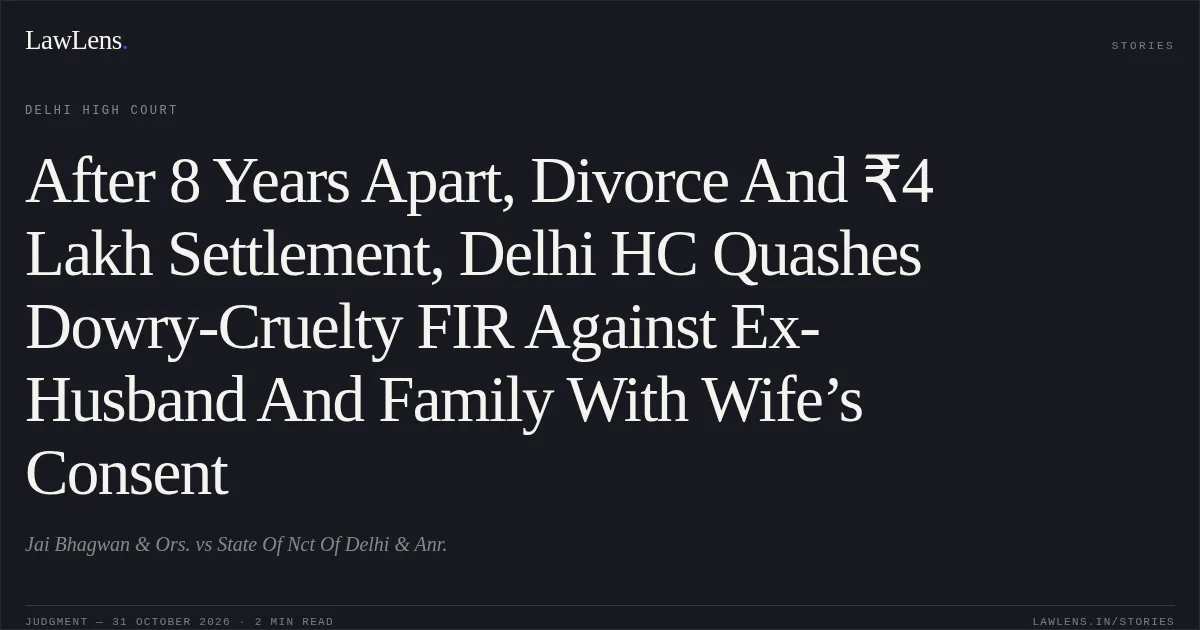
p. 2 · ¶ 2Petitioner no. 1 and respondent no. 2 had married in 2017, had no children, and had lived separately since 2 September 2018.
p. 2 · ¶ 2–3They later settled their disputes; the marriage was dissolved by mutual-consent divorce and the agreed settlement amount of ₹4,00,000 was paid.
p. 7 · ¶ 5 · p. 12 · ¶ 12Respondent no. 2 appeared before the Court, confirmed that the settlement was voluntary, and stated that she had no objection to quashing the FIR.
p. 8 · ¶ 602Issues
i.Whether the High Court could quash proceedings under Sections 498A, 406 and 34 IPC, although the alleged offences are non-compoundable, on the basis of a voluntary settlement in a matrimonial dispute.
pp. 8–12 · ¶ 9–13ii.Whether, in the circumstances, continuing the criminal proceedings would serve the ends of justice, given the complainant’s settlement and the prospect of conviction.
p. 12 · ¶ 12–1303Law Applied
Section 528 BNSS preserves the High Court’s inherent power to quash proceedings to secure the ends of justice or prevent abuse of the process of court.
p. 1 · ¶ 1Under Gian Singh v. State of Punjab, (2012) 10 SCC 303, and Narinder Singh v. State of Punjab, (2014) 6 SCC 466, that power may extend to non-compoundable offences where the dispute is predominantly private or matrimonial, the settlement is genuine, and quashing is justified by the ends of justice; it is not ordinarily available for heinous offences or offences with serious societal impact.
pp. 8–10 · ¶ 9–10Jitendra Raghuvanshi v. Babita Raghuvanshi, (2013) 4 SCC 58, further recognises that criminal proceedings arising from matrimonial disputes may be quashed following an amicable, voluntary settlement, notwithstanding that the offences are non-compoundable.
pp. 11–12 · ¶ 11Provisions in the judgment · 5 · Linked ones open on LawLens
Bharatiya Nagarik Suraksha Sanhita, 2023 Section 528
Code of Criminal Procedure, 1973 Section 482Section 320
Indian Penal Code, 1860 Section 406Section 34
04Reasoning
The Court treated the dispute as matrimonial and essentially private, rather than one involving heinous or seriously society-affecting offences.
p. 12 · ¶ 12It relied on the parties’ comprehensive settlement, the mutual-consent divorce, payment of the agreed amount, their long separation, and respondent no. 2’s in-court confirmation that the settlement was voluntary and that she did not wish to proceed.
pp. 7–8 · ¶ 5–6 · p. 12 · ¶ 12As the complainant was the principal prosecution witness, the Court considered the likelihood of conviction remote and bleak; continuing the proceedings would therefore not advance the ends of justice.
p. 12 · ¶ 1205Holding
The Court answered the issues in favour of quashing.
p. 12 · ¶ 13–14Allowing the petition, it quashed FIR No. 164/2019 under Sections 498A, 406 and 34 IPC, together with all proceedings arising from it, as against all petitioners.
p. 12 · ¶ 13–14The petition and any pending applications were disposed of accordingly.
p. 12 · ¶ 15Original Court PDF
Jai Bhagwan & Ors.vsState Of Nct Of Delhi & Anr.
Click to open original judgment
Original judgment, available to read, download and summarize on LawLens.in