01Facts
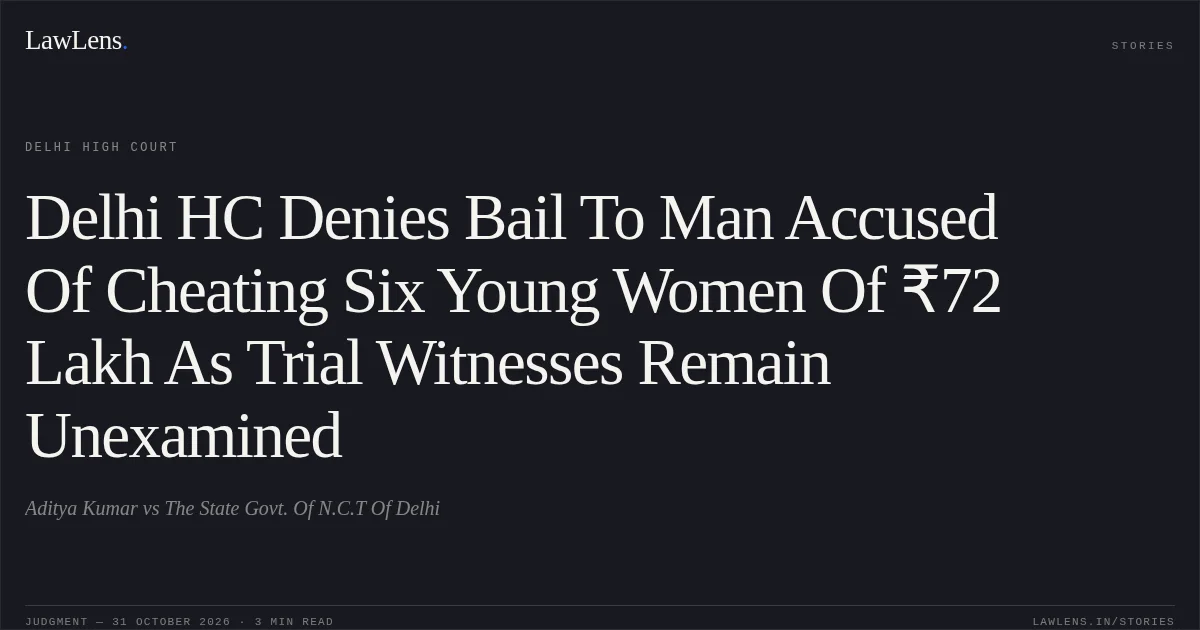
The petitioner sought regular bail under Section 483 of the Bharatiya Nagarik Suraksha Sanhita, 2023, in a case alleging that he induced the complainant’s daughter and other persons to invest money in a purported trading scheme by promising high returns and displaying fabricated account records.
pp. 2–5, 6The complainant’s daughter allegedly invested approximately ₹39 lakh; the State submitted that six young women were victims and that the total amount involved was ₹72 lakh.
pp. 2–5, 6The petitioner was arrested on 17 September 2025, the chargesheet was filed on 13 November 2025, and the trial was at the prosecution-evidence stage, with none of the 16 prosecution witnesses examined.
pp. 3–4, 6The petitioner relied on his custody, completion of investigation, academic studies, and alleged repayment of the complainant’s loan; he also submitted that only the cheating charge remained against him.
p. 5His earlier bail application before the High Court had been withdrawn, and eight applications before the Trial Court had been dismissed.
p. 302Issues
i.Whether the petitioner was entitled to regular bail under Section 483 BNSS, having regard to the nature and gravity of the alleged cheating, the number of victims, and the amount involved.
pp. 1, 6–9ii.Whether the petitioner’s custody, completion of investigation, asserted repayment, and the documentary nature of the evidence warranted bail while the trial remained at an early stage.
pp. 5, 8–903Law Applied
Section 483 BNSS empowers the High Court to grant regular bail.
pp. 6–8In assessing bail, the Court relied on the principles discussed in Rakesh Mittal v. Ajay Pal Gupta, 2026 SCC OnLine SC 211: liberty is important, but bail requires consideration of relevant circumstances, including the accused’s conduct, the risk of repeated offending, and the potential effect on victims and witnesses; an order must account for relevant factors rather than rest on irrelevant considerations.
pp. 6–8The Court also referred to Neeru Yadav v. State of Uttar Pradesh and Sudha Singh v. State of Uttar Pradesh on the need to weigh societal and victim interests alongside individual liberty, and to Dolat Ram v. State of Haryana concerning the principles governing cancellation of bail.
pp. 7–8It noted the Supreme Court’s observation that, in pecuniary offences involving alleged exploitation of victims’ trust and economic interests, those consequences are relevant to bail assessment.
p. 8Provisions in the judgment · 6 · Linked ones open on LawLens
Bharatiya Nagarik Suraksha Sanhita, 2023 Section 483
Bharatiya Nyaya Sanhita, 2023 Section 318Section 316Section 61Section 351Section 3
04Reasoning
The Court considered the allegations serious in light of the State’s submission that there were multiple victims and ₹72 lakh was involved, and noted the statements of the victims on the original case file.
p. 6, 9The trial was at a nascent stage, and none of the 16 prosecution witnesses—including the complainant—had been examined.
p. 6, 9The Court treated the petitioner’s contention that the evidence was documentary and already with the Investigating Officer as a matter for trial, declining to assess the merits at the bail stage.
p. 9In view of the allegations, the trial stage, and the cited principles requiring consideration of victims’ interests, it found the petitioner’s grounds insufficient to justify release.
pp. 8–905Holding
The Court answered the bail question in the negative and held that the case was not fit for regular bail, considering the nature and gravity of the allegations and the stage of trial.
p. 9The second bail application was dismissed.
p. 9Original Court PDF
Aditya KumarvsThe State Govt. Of N.C.T Of Delhi
Click to open original judgment
Original judgment, available to read, download and summarize on LawLens.in