Facts
The applicant, a State Police Service officer, was selected for promotion to the Indian Police Service (IPS) against 2014 vacancies.
Source reference: para 1On 24.10.2016, the State Government (Respondent No. 1) suspended him under Kerala Police Rules.
Source reference: para 1On 09.11.2016, the Union of India formally appointed him to the IPS.
Source reference: para 1Despite this, the State refused to grant him an IPS posting.
Source reference: para 1In OA 469/2017, the Tribunal quashed the suspension and the then-existing charge memo, directing the State to post him to the IPS cadre and mandating that any future disciplinary actions follow the All India Services (Discipline & Appeal) Rules, 1969.
Source reference: para 2This order was upheld by the Kerala High Court and the Supreme Court.
Source reference: para 3The applicant was finally posted on 26.08.2020.
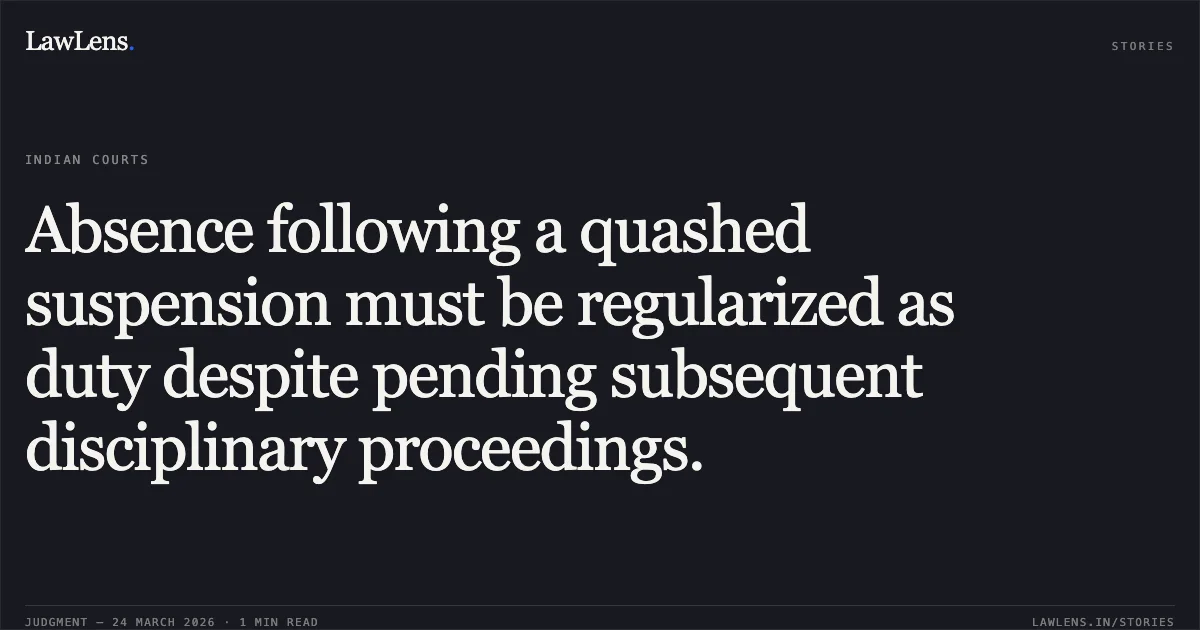
Source reference: para 3Prior to his retirement on 30.04.2021, the State issued fresh charge memos and passed an order (Annexure A-10) refusing to regularize his period of absence (24.10.2016 to 25.08.2020) until the conclusion of the new proceedings.
Source reference: para 5Issues
1. Whether the State Government is legally justified in withholding the regularization of a period during which an officer was kept out of service due to a suspension order that was subsequently quashed by a court of law?
Source reference: para 112. Whether the initiation of fresh disciplinary proceedings on the eve of retirement justifies the non-regularization of a prior period where no valid suspension order was in effect?
Source reference: para 11Law Applied
The court primarily applied the principles of the All India Services (Discipline & Appeal) Rules, 1969, which govern the conduct and disciplinary procedures for IPS officers.
Source reference: para 2It relied on the doctrine of judicial finality, noting that once a suspension order is quashed by a competent court and upheld by the Supreme Court, the order is "dead and buried" and cannot be revived by subsequent administrative actions.
Source reference: para 6The Tribunal also emphasized the principle that keeping an employee away from duty without the authority of law constitutes a violation of service rights.
Source reference: para 11, 12Reasoning
The Tribunal observed that the original suspension order (Annexure A-1) had been set aside by the judiciary and no subsequent suspension order was ever issued covering the period from 2016 to 2020.
Source reference: para 11Consequently, the applicant was kept away from duty without any legal authority and in contravention of the All India Service Rules.
Source reference: para 12The Tribunal noted a "deliberate delay" on the part of the State, highlighting that the fresh inquiry into 2016 allegations only commenced in 2025—nearly a decade later and five years after the initial court orders.
Source reference: para 10The Tribunal reasoned that the regularization of a period where the suspension was declared illegal cannot be made contingent upon the outcome of new disciplinary proceedings initiated years later.
Source reference: para 10By quashing the initial suspension, the legal basis for keeping the applicant out of service was removed, rendering the State's refusal to regularize that period arbitrary and irrational.
Source reference: para 12Holding
The Tribunal allowed the Original Application and quashed Annexure A-10.
The Tribunal directed Respondent No. 1 to regularize the period from 24.10.2016 to 25.08.2020 as "duty for all purposes" and grant all consequential benefits within one month.
Source reference: para 12It further ordered that in case of default, the State must pay simple interest @ 8% per annum from the date of the order until dispersal.
Source reference: para 12The Tribunal recorded its strong displeasure regarding the conduct of the State Government.
Source reference: para 12Original Court PDF
K Radhakrishnan IPSvsCHIEF SECRETARY STATE OF KERALA
Click to open original judgment
Original judgment, available to read, download and summarize on LawLens.in