Facts
On July 12, 2015, the complainants (Dilpa, Kalam, Rajmati, and Ishwari Sahu) were weeding paddy in their field in Village Reevapar
Source reference: para. 3The accused persons, armed with lathis, confronted them regarding a land boundary dispute, allegedly used obscene language, and assaulted the complainants, causing various injuries
Source reference: para. 3Dilpa and Kalam Sahu were referred to CIMS Bilaspur for treatment
Source reference: para. 3The prosecution charged the accused under Sections 294, 506-II, 323, 307, and 34 of the IPC
Source reference: para. 5The Trial Court convicted the accused under Sections 323 and 323/34 IPC for causing simple hurt but acquitted them of the graver charges, including Section 307 (Attempt to Murder) and Section 294 (Obscene Acts)
Source reference: para. 2, 7The victim and the State filed separate appeals against these acquittals
Source reference: para. 2Issues
1. Whether the Trial Court erred in acquitting the accused under Section 307/34 IPC (Attempt to Murder) despite evidence of head injuries and a bone fracture
Source reference: para. 92. Whether the ingredients of Section 294 IPC (Obscene Acts) were established through the verbal testimony of the injured witnesses
Source reference: para. 93. Whether the High Court is justified in reversing an order of acquittal where the Trial Court’s view is legally plausible
Source reference: para. 19Law Applied
The court primarily applied Sections 307 (Attempt to Murder), 323 (Voluntarily causing hurt), 294 (Obscene acts and songs), and 34 (Common intention) of the Indian Penal Code
Source reference: para. 5, 13It further relied on the principles governing appeals against acquittal as established in Mallappa v. State of Karnataka (2024) 3 SCC 544 and Babu Sahebagouda Rudragoudar v. State of Karnataka (2024) 8 SCC 149, which mandate that if two views are possible, the one favoring the accused must be followed unless the Trial Court’s finding is perverse or illegal
Source reference: para. 11, 19Reasoning
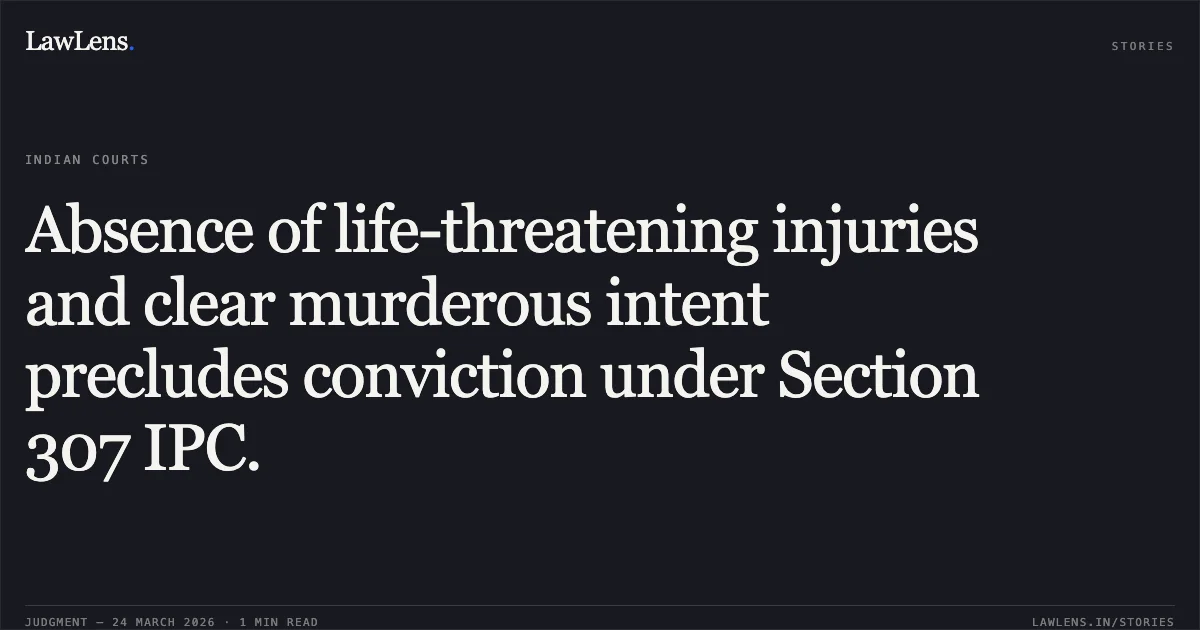
The High Court observed that medical evidence (PW-6 and PW-7) did not categorize the injuries as life-threatening or fatal
Source reference: para. 18Although Kalam Sahu suffered a fracture of the ulna, the court noted that he did not specifically testify to a blow on the arm, and the examining doctor admitted that such a fracture could result from a forceful fall
Source reference: para. 17, 18Regarding Section 307, the court found the prosecution failed to prove the requisite "intention or knowledge" to cause death, noting that the weapons used (lathis) and the nature of the assault did not necessarily imply an intent to murder
Source reference: para. 18On the charge of obscenity (Section 294), the court found the evidence insufficient to prove the acts occurred in a public place causing the specific annoyance required by law
Source reference: para. 18Applying the Mallappa precedent, the court determined that the Trial Court had taken a "legally plausible view" based on the selective corroboration of medical and oral evidence, and no perversity was found in discarding the testimonies regarding graver offences
Source reference: para. 18, 20Holding
The High Court dismissed both appeals and upheld the Trial Court’s judgment of acquittal for the graver charges
The Court held that the prosecution failed to prove the essential ingredients of Sections 307, 294, and 506-II IPC beyond a reasonable doubt
Source reference: para. 18It reaffirmed that in an appeal against acquittal, interference is only warranted if the finding is highly perverse; here, the Trial Court was justified in limiting the conviction to Sections 323 and 323/34 IPC based on a proper appreciation of evidence
Source reference: para. 20Acts & Sections Cited
5 provisions across 1 statute referred to in this judgment. Each provision opens on LawLens.
Indian Penal Code, 18605
Original Court PDF
KALAM SAHUvsSTATE OF CHHATTISGARH
Click to open original judgment
Original judgment, available to read, download and summarize on LawLens.in