Facts
The incident occurred on August 10, 2012, following a petty dispute over the accused (Vinod Kumar Ahuja) sprinkling water in front of his shop, which allegedly damaged articles in the adjacent shop of the complainants
Source reference: para 5When PW-2 (Jitender) narrated the incident to his father (PW-1), the accused allegedly emerged with a knife, stabbing PW-1 in the stomach and PW-2 in the neck and abdomen
Source reference: para 5The Trial Court convicted the accused under Section 325 of the IPC (voluntarily causing grievous hurt) rather than Section 307 (attempt to murder), sentencing him to three years of simple imprisonment
Source reference: para 1The accused appealed the conviction, while the State filed a cross-appeal seeking conviction under Section 307 IPC and enhancement of the sentence
Source reference: para 2During the pendency of these appeals, the accused and the surviving victim (PW-2) entered into an amicable settlement
Source reference: para 3, 20Issues
1. Whether the nature of injuries and the circumstances of the assault warranted a conviction under Section 307 IPC instead of Section 325 IPC
Source reference: para 15, 232. Whether the High Court, in exercise of its inherent powers, can modify the sentence or quash proceedings based on a compromise arrived at after the conviction of the accused
Source reference: para 35-36Law Applied
The Court applied Section 307 (Attempt to murder) and Section 325 (Grievous hurt) of the Indian Penal Code
Source reference: para 1It invoked Section 528 of the Bharatiya Nagarik Suraksha Sanhita, 2023 (formerly Section 482 of the CrPC) regarding inherent powers to secure the ends of justice
Source reference: para 3, 35The Court primarily relied on the precedent of Ramgopal & Anr. v. State of Madhya Pradesh (2022), which established that the High Court may annul criminal proceedings for non-heinous or private offences even post-conviction if the parties have settled and it serves the interest of justice
Source reference: para 36Reasoning
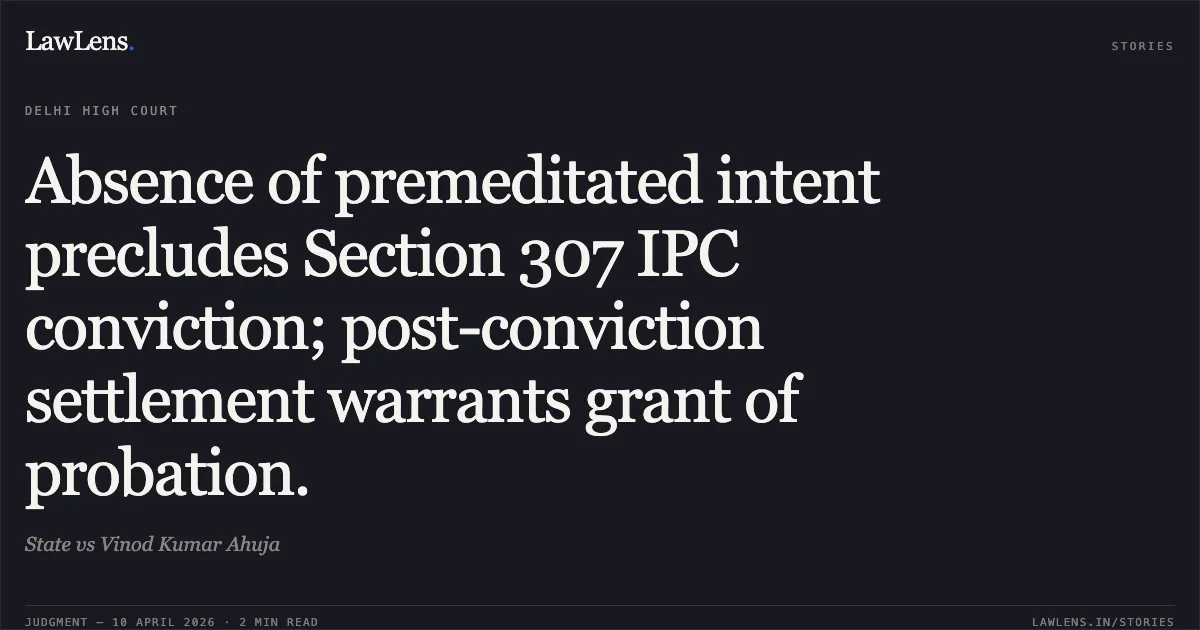
The Court affirmed the Trial Court’s decision to convict under Section 325 IPC rather than Section 307 IPC.
Source reference: no citationIt reasoned that the prosecution failed to prove "intention or knowledge" for murder because the assault was not premeditated but occurred in the heat of a sudden quarrel over a petty issue
Source reference: para 31-32Furthermore, the non-recovery of the weapon and the lack of medical evidence regarding the depth of the wounds prevented a definitive finding that the injuries were sufficient to cause death in the ordinary course of nature
Source reference: para 30Regarding the settlement, the Court observed that the parties were relatives, the accused was a first-time offender, and the victim (PW-2) had voluntarily entered into a compromise
Source reference: para 37-39Following the Ramgopal doctrine, the Court held that continuing incarceration after a private settlement in a non-heinous matter would be counterproductive and create further acrimony
Source reference: para 39-40Holding
The Court dismissed the State’s appeal for enhancement and upheld the conviction under Section 325 IPC
However, in light of the settlement, the Court modified the sentence: the order for three years' imprisonment was set aside, and the accused was released on probation of good conduct for one year
Source reference: para 41This was conditioned upon the accused furnishing a personal bond of Rs. 10,000 and depositing a cost of Rs. 50,000 with the Army Central Welfare Fund
Source reference: para 41The petitions were disposed of accordingly
Source reference: para 42Acts & Sections Cited
12 provisions across 3 statutes referred to in this judgment. Each provision opens on LawLens.
Indian Penal Code, 18608
Code of Criminal Procedure, 19733
Bharatiya Nagarik Suraksha Sanhita, 20231
Original Court PDF
StatevsVinod Kumar Ahuja
Click to open original judgment
Original judgment, available to read, download and summarize on LawLens.in