01Facts
The appellant was prosecuted in connection with an alleged incident dated 22 October 2000, in which he allegedly caught the victim, took her towards bushes, threatened her with a knife, removed or loosened her clothing, and attempted to rape her.
pp. 2–3 · ¶ 3–4The prosecution further alleged that, when the victim raised an alarm, her father, brother and brother-in-law arrived, whereupon the appellant fled after allegedly snatching her golden chain.
pp. 2–3 · ¶ 3–4An earlier incident dated 7 October 2000, involving the appellant allegedly putting vermillion on the victim’s head against her will, had also resulted in a separate case under Sections 341 and 354 IPC.
p. 3 · ¶ 9The appellant was charged under Sections 341, 376, 511 and 379 IPC; four prosecution witnesses, including the victim, her father and her brothers, were examined, while the defence examined one witness in support of alleged false implication arising from the appellant’s refusal to marry the victim.
pp. 3–4 · ¶ 5–11The trial court convicted the appellant under Sections 376/511 IPC and sentenced him to four years’ rigorous imprisonment on 9 December 2005.
p. 1 · ¶ 202Issues
i.Whether the trial court’s conviction of the appellant under Sections 376/511 IPC suffered from legal or evidentiary error warranting appellate interference.
p. 8 · ¶ 16ii.Whether, on the evidence proved by the prosecution, the appellant’s conduct constituted an attempt to commit rape under Sections 376/511 IPC or only an offence under Section 354 IPC.
pp. 7–8 · ¶ 13, 16 · p. 12 · ¶ 19iii.If the conviction were altered to Section 354 IPC, what sentence would meet the ends of justice considering the lapse of time and the period of custody already undergone.
p. 12 · ¶ 2003Law Applied
The court applied Section 376 read with Section 511 IPC, under which criminal liability for attempted rape requires proof of conduct constituting a sufficiently proximate act towards the commission of rape, and not merely an indecent or sexually improper assault.
Section 354 IPC applies where the accused assaults or uses criminal force against a woman with the intention of outraging, or knowledge that he is likely to outrage, her modesty.
The court also applied the principle that the testimony of the victim may form the basis of conviction if reliable, although material contradictions and improvements must be assessed in the overall evidentiary context.
Provisions in the judgment · 6 · Linked ones open on LawLens
Indian Penal Code, 1860 Section 341Section 354Section 376Section 379Section 511
Code of Criminal Procedure, 1973 Section 313
04Reasoning
The High Court found that the victim’s evidence established that the appellant caught hold of her, pushed or thrashed her, removed or loosened her clothing, threatened her with a knife and committed an indecent assault.
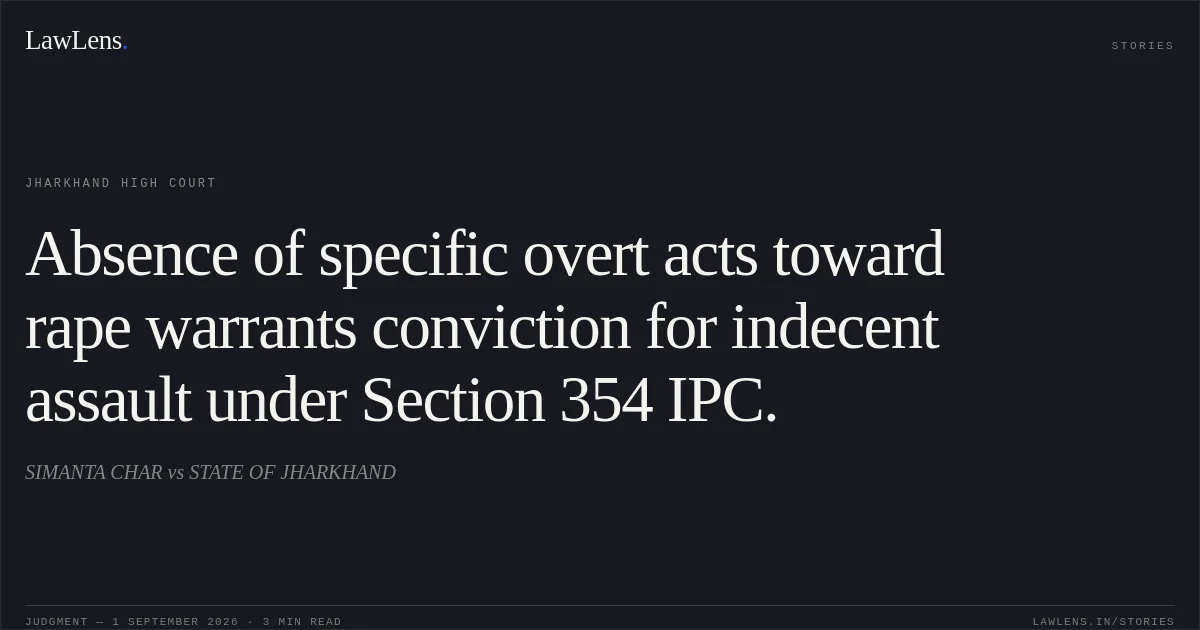
p. 12 · ¶ 19However, the court concluded that the prosecution had not proved any specific overt act sufficiently directed towards the actual commission of rape so as to satisfy Sections 376/511 IPC.
p. 12 · ¶ 19The victim’s testimony contained inconsistencies concerning the manner of assault, the use of the knife, the raising of an alarm and the arrival of the family members; there was also no medical examination or injury report, and the Investigating Officer was not examined.
pp. 5–7 · ¶ 13 · pp. 8–9 · ¶ 18Nevertheless, the court held that these inconsistencies did not justify rejecting her evidence in its entirety, particularly regarding the indecent assault.
p. 12 · ¶ 19On that basis, the ingredients of Section 354 IPC were held proved beyond reasonable doubt, while the more serious charge of attempted rape was not established.
p. 12 · ¶ 19For sentencing, the court considered that approximately 25 years had elapsed since the occurrence, that the appellant had no criminal antecedents, and that he had already undergone approximately one month and nine days’ imprisonment.
p. 12 · ¶ 2005Holding
The appeal was dismissed on merits, but the conviction under Sections 376/511 IPC was set aside and modified to a conviction under Section 354 IPC.
p. 12 · ¶ 19 · p. 13 · ¶ 21The appellant was sentenced under Section 354 IPC to the period of imprisonment already undergone, namely approximately one month and nine days.
p. 12 · ¶ 20As the appellant was on bail, he was discharged from the liability of his bail bond and the sureties were released.
p. 13 · ¶ 22Original Court PDF
SIMANTA CHARvsSTATE OF JHARKHAND
Click to open original judgment
Original judgment, available to read, download and summarize on LawLens.in