Facts
The complainant, Uttam Singh, alleged that on 28 October 2009, near Kalindi, while removing his stone blocks from a road undergoing RCC construction, his brother Mulayam alias Mulu abused and assaulted him with a luhangi. Co-accused Jandel Singh allegedly joined the assault by kicking and punching him. The complainant sustained injuries, including a fracture to his finger, and the incident was witnessed by Puran and other neighbours. The matter was reported to Police Station Pichhore, followed by medical examination, registration of the criminal case, and filing of the charge-sheet.
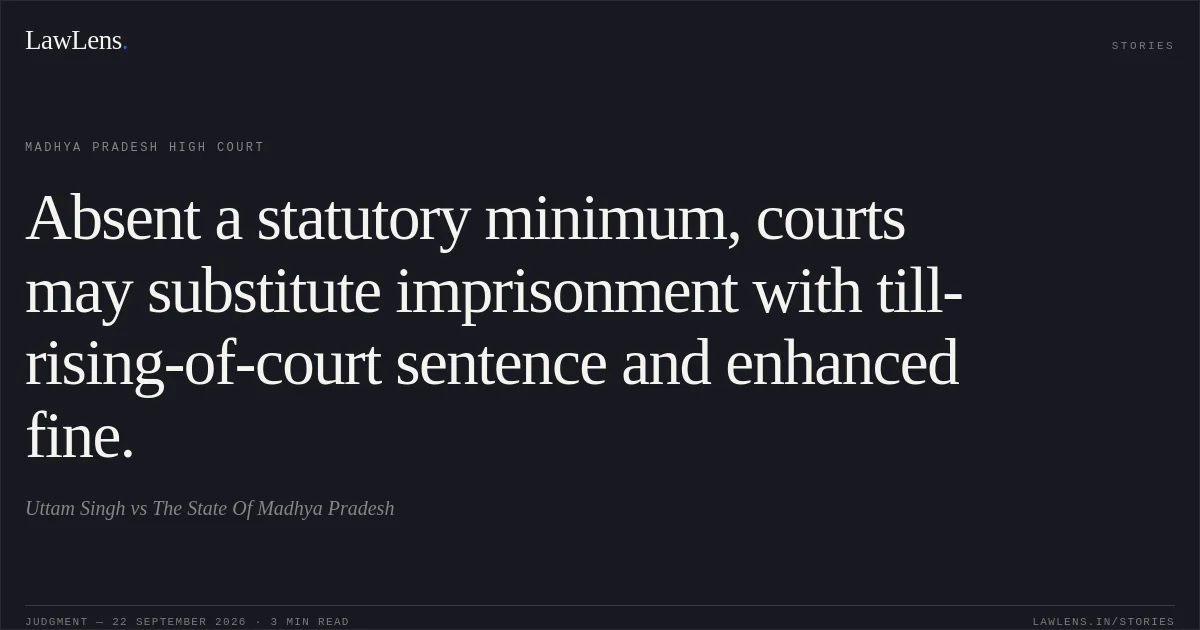
Source reference: para. 2The Judicial Magistrate First Class, Dabra, convicted the respondents under Sections 325, 325/34, 323 and 323/34 of the IPC and imposed imprisonment with fines. In appeal, the First Additional Sessions Judge reduced the custodial sentences to imprisonment till the rising of the Court while enhancing the fines from ₹500 to ₹3,000 each under Sections 325/325/34 and from ₹300 to ₹500 each under Sections 323/323/34. The complainant challenged that alteration in the present criminal revision.
Source reference: para. 1Issues
Whether the Appellate Court committed a patent illegality, jurisdictional error, or manifest perversity by reducing the substantive imprisonment imposed under Sections 325, 325/34, 323 and 323/34 of the IPC to imprisonment till the rising of the Court and enhancing the fines instead?
Source reference: paras. 3, 6–7Whether, in view of the familial relationship between the parties, the duration of the proceedings, the nature of the injury, and the absence of a statutory minimum sentence under the relevant provisions, the modified sentence was legally permissible?
Source reference: paras. 4, 6–7Law Applied
The Court applied Sections 397 read with 401 of the Code of Criminal Procedure, which confer limited revisional jurisdiction and permit interference only in cases of patent illegality, jurisdictional error, or manifest perversity in the subordinate court’s order.
Source reference: para. 6It considered Sections 325, 325/34, 323 and 323/34 of the Indian Penal Code, governing voluntarily causing grievous hurt, acts done in furtherance of common intention, voluntarily causing hurt, and the corresponding common-intention liability. The Court further held that no minimum sentence is prescribed under the relevant provisions, leaving sentencing discretion with the court, subject to the requirements of justice and legality.
Source reference: paras. 1, 6–7Reasoning
The High Court held that the Appellate Court had considered relevant mitigating circumstances: the respondents and the complainant were real brothers, the accused had faced the criminal proceedings for approximately five years from the filing of the charge-sheet, and the complainant had suffered a fracture to a finger.
Source reference: para. 6In that context, replacing the custodial sentence with imprisonment till the rising of the Court, while enhancing the fines and directing that the injured person receive compensation, was within the permissible sentencing discretion. Since the IPC provisions did not prescribe a mandatory minimum sentence, and the Appellate Court’s approach disclosed no patent illegality, jurisdictional error, or manifest perversity, the limited scope of revisional review did not justify interference.
Source reference: paras. 6–7Holding
The Court answered the issues against the petitioner. It found no illegality, perversity, or jurisdictional error in the Appellate Court’s reduction of the sentences to imprisonment till the rising of the Court and enhancement of the fines.
The criminal revision was accordingly dismissed, and a certified copy of the order was directed to be sent to the trial court for information and immediate compliance.
Source reference: paras. 8–9Acts & Sections Cited
5 provisions across 2 statutes referred to in this judgment. Each provision opens on LawLens.
Code of Criminal Procedure, 19732
Indian Penal Code, 18603
Original Court PDF
Uttam SinghvsThe State Of Madhya Pradesh
Click to open original judgment
Original judgment, available to read, download and summarize on LawLens.in