Facts
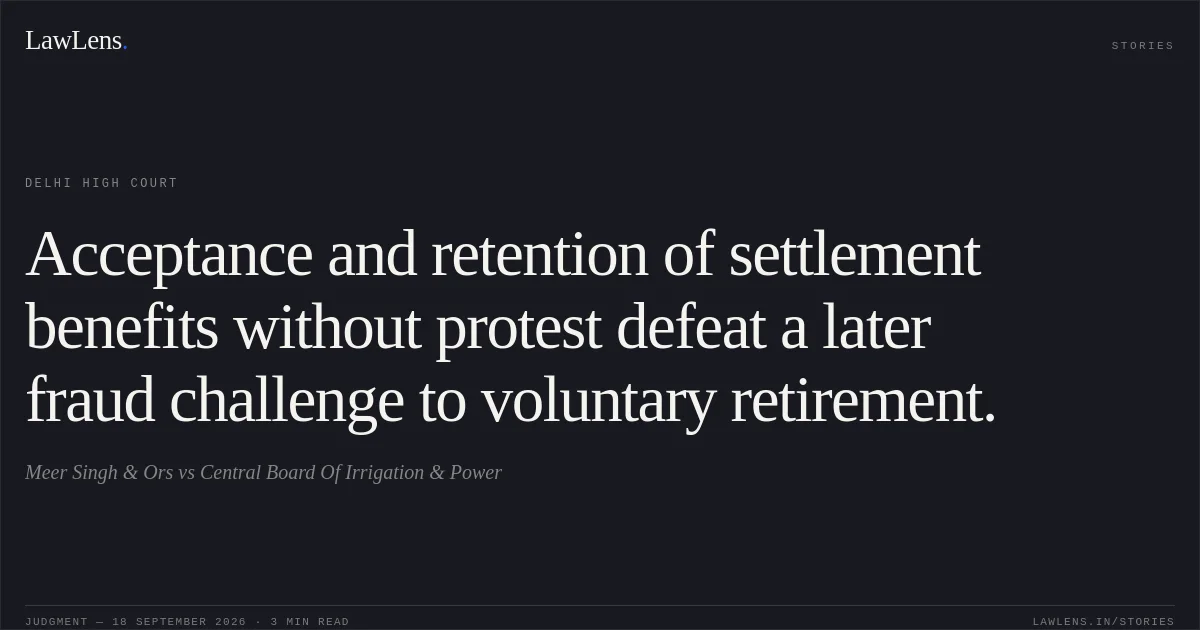
The petitioners, workmen of the respondent, formed a union in September 1998 and alleged that their relations with the management thereafter deteriorated.
Source reference: p.1–2, paras. 1–2They went on strike from 3 September 1998 to 15 September 1998, allegedly calling it off on the management’s assurance that their demands would be addressed.
Source reference: p.1–2, paras. 1–2On 16 September 1998, the petitioners signed an agreement recording their voluntary retirement and received their dues and retiral benefits.
Source reference: p.1–2, paras. 1–2They later alleged that their signatures had been procured by fraud and coercion on the representation that the establishment would close immediately, and sought reinstatement.
Source reference: p.1–2, paras. 1–2The Industrial Tribunal rejected the claim for reinstatement, finding that the petitioners had voluntarily entered into the settlement and had not alleged or proved that they were paid less than their entitlement or had accepted the amount under protest.
Source reference: p.2–3, para. 4The petitioners challenged that award under Article 226 of the Constitution.
Source reference: p.3, para. 5Issues
Whether the Industrial Tribunal’s finding that the petitioners voluntarily entered into the retirement settlement was perverse or otherwise warranted interference under Article 226 of the Constitution
Source reference: p.3–4, paras. 8–10Whether the petitioners were entitled to reinstatement on the ground that the voluntary retirement agreement dated 16 September 1998 had been obtained by fraud, coercion, or through an unauthorised person
Source reference: p.3, paras. 5–7; p.4–5, paras. 10–13Law Applied
The Court applied the principle that the High Court’s jurisdiction under Article 226 of the Constitution is supervisory and not appellate; it cannot substitute its own view for that of an Industrial Adjudicator unless the award is arbitrary, irrational, or perverse.
Source reference: p.3–4, paras. 8, 14The Court further applied the principle that a party who knowingly executes a settlement, accepts and retains the consideration without protest, and subsequently acts upon the settlement cannot ordinarily challenge it on the basis of fraud or coercion without a substantiated factual foundation.
Source reference: p.4–5, paras. 10–13The Court also considered the evidentiary significance of the petitioners’ failure to plead or prove that the settlement amount was deficient or accepted under protest.
Source reference: p.2–3, para. 4; p.4, para. 12Reasoning
The Court found no basis to disturb the Tribunal’s factual conclusion.
Source reference: no citationThe agreement was signed individually by the workmen as well as by the union President and General Secretary, and it recorded that the settlement followed negotiations on 16 September 1998.
Source reference: p.4–5, paras. 10, 13The petitioners did not dispute execution of the agreement, receipt of their full dues, or retention of the money without protest.
Source reference: p.4, para. 10Their subsequent conduct also undermined the allegation of fraud: the General Secretary applied on 17 September 1998 for experience or character certificates for the workmen, an application whose issuance was admitted.
Source reference: p.4, para. 12The management’s evidence further established that the agreement had been executed by a competent representative.
Source reference: p.4, para. 11The substantial delay in raising the industrial dispute— from 1998 until 2003—also weakened the petitioners’ claim of immediate coercion or fraud.
Source reference: p.5, para. 13Since the Tribunal’s findings were neither arbitrary nor perverse, the limited scope of Article 226 review did not permit interference.
Source reference: p.5–6, paras. 14–15Holding
The Court held that the petitioners had voluntarily entered into and acted upon the settlement dated 16 September 1998, and had failed to establish that it was procured by fraud, coercion, or an unauthorised representative.
The Industrial Tribunal’s refusal to grant reinstatement was neither arbitrary nor perverse.
Source reference: p.6, para. 16The writ petition was accordingly dismissed.
Source reference: p.6, para. 16Acts & Sections Cited
1 provisions across 1 statute referred to in this judgment. Each provision opens on LawLens.
Indian Penal Code, 18601
Original Court PDF
Meer Singh & OrsvsCentral Board Of Irrigation & Power
Click to open original judgment
Original judgment, available to read, download and summarize on LawLens.in