Facts
The appellant imported twelve consignments of polyester knitted fabrics of mixed lots from China and declared the transaction value at USD 0.95 per kg, supported by the foreign supplier’s invoices.
Source reference: no citationExamination confirmed the description, quantity and nature of the goods. The Customs authorities nevertheless enhanced the assessable value, allegedly relying on contemporaneous import data.
Source reference: no citationThe appellant made written requests for provisional or final clearance on payment of enhanced duty under protest, but ultimately submitted letters accepting the enhanced value and stating that it did not require a show-cause notice or speaking order.
Source reference: paras. 2–5, 13–15The appellant thereafter challenged the reassessment before the Commissioner (Appeals), contending that the acceptance letters were obtained under coercive circumstances and that the mandatory valuation procedure had not been followed.
Source reference: paras. 2–5, 13–15The appeals were rejected on the ground that written acceptance eliminated the requirement of a speaking order under Section 17(5) of the Customs Act, 1962.
Source reference: paras. 2–5, 13–15Issues
Whether the appellant’s written acceptance of the enhanced assessable value barred it from challenging the reassessment in an appeal under Section 128 of the Customs Act, 1962.
Source reference: paras. 16–17Whether the Customs authorities could reject the declared transaction value and enhance it without complying with Section 14 of the Customs Act and Rule 12(2) of the Customs Valuation (Determination of Value of Imported Goods) Rules, 2007, including communicating the grounds for doubting the declared value.
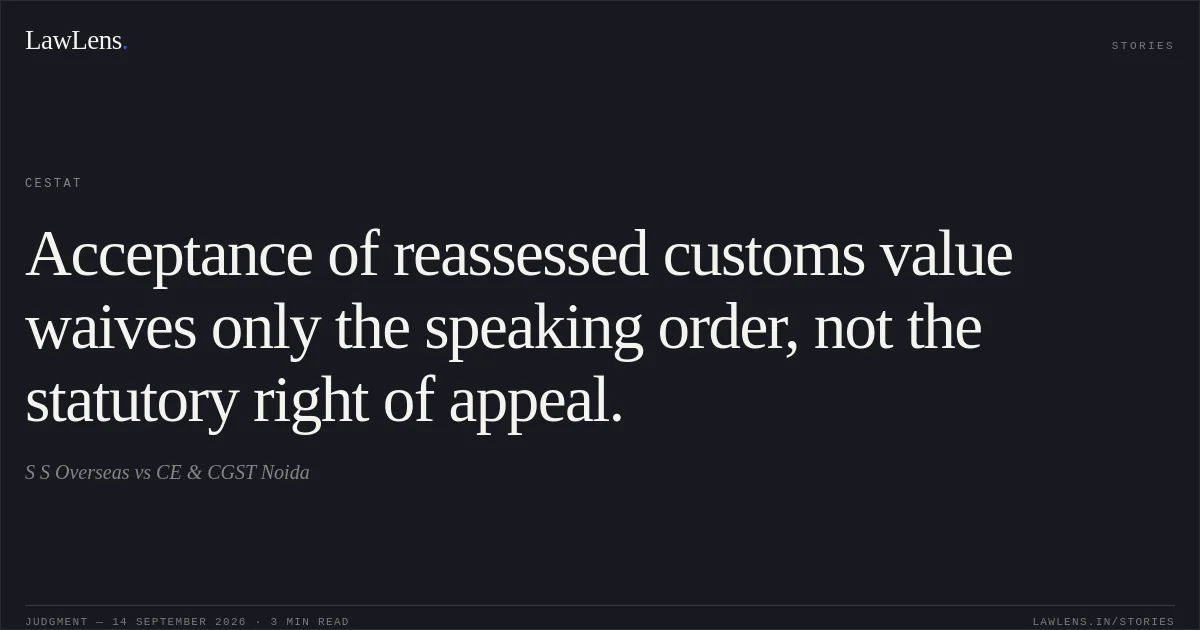
Source reference: paras. 14–15Whether the appellant’s acceptance of the reassessment merely waived the requirement of a speaking order under Section 17(5), or also constituted a waiver of its substantive right to contest the reassessment.
Source reference: paras. 16–19Law Applied
The Tribunal applied Section 14 of the Customs Act, 1962, which governs valuation of imported goods; Sections 17(4) and 17(5), under which reassessment must ordinarily be followed by a speaking order unless the importer accepts the reassessment in writing; and Section 128, which confers a statutory right of appeal against an assessment or reassessment.
Source reference: paras. 14, 17Rule 12(2) of the Customs Valuation Rules, 2007 requires the proper officer, where necessary, to communicate in writing the grounds for doubting the truth or accuracy of the declared value; the declared value may then be rejected and redetermined only by applying the valuation rules sequentially.
Source reference: para. 14Relying on Century Metal Recycling Pvt. Ltd. v. Union of India, 2019 (367) E.L.T. 3 (S.C.), the Tribunal held that the Rule 12(2) requirement is mandatory and cannot be waived through procedural subterfuge.
Source reference: para. 14Following Niraj Silk Mills v. Commissioner of Customs (ICD), Patparganj, CUSAA No. 26/2022 (Delhi High Court, 27 November 2024), it held that acceptance of reassessment may dispense with a speaking order but does not extinguish the importer’s statutory right to challenge the reassessment on merits.
Source reference: paras. 16–18The Tribunal also applied the principle that there can be no estoppel against a statutory right, including in taxation matters.
Source reference: paras. 20–21Reasoning
The Commissioner (Appeals) treated the appellant’s acceptance letters as conclusive proof that the enhanced value had been voluntarily accepted and that the appellant could not challenge it.
Source reference: paras. 16–17The Tribunal held that this approach conflated two distinct matters: waiver of the procedural requirement to issue a speaking order and abandonment of the substantive statutory right of appeal.
Source reference: paras. 16–17The appellant’s prior written requests for clearance on enhanced value under protest demonstrated that the acceptance was not a simple, unconditional acceptance of the valuation.
Source reference: para. 13Further, the acceptance letters merely stated that contemporaneous import data had been shown and understood; they did not disclose the relevant comparable transactions or particulars such as quantity, quality, GSM, commercial level or contemporaneity.
Source reference: paras. 14–15The authorities therefore failed to establish compliance with Rule 12(2) or the sequential valuation methodology under the Customs Valuation Rules.
Source reference: paras. 14–15In light of Niraj Silk Mills, the appellant’s consent could at most relieve the officer from issuing a speaking order under Section 17(5); it could not prevent the appellant from questioning the legality or merits of the reassessment under Section 128.
Source reference: paras. 16–19Holding
The Tribunal held that the appellant’s acceptance letters did not bar the appeals or constitute a waiver of the right to challenge the enhanced valuation.
The Customs authorities had not demonstrated compliance with the mandatory requirements of Rule 12(2) of the Customs Valuation Rules, 2007 and the applicable valuation procedure.
Source reference: paras. 15–17Accordingly, the impugned Orders-in-Appeal were set aside, and consequential relief, if any, was directed to follow in accordance with law.
Source reference: para. 26Acts & Sections Cited
3 provisions across 1 statute referred to in this judgment. Each provision opens on LawLens.
Customs Act,19623
Original Court PDF
S S OverseasvsCE & CGST Noida
Click to open original judgment
Original judgment, available to read, download and summarize on LawLens.in