Facts
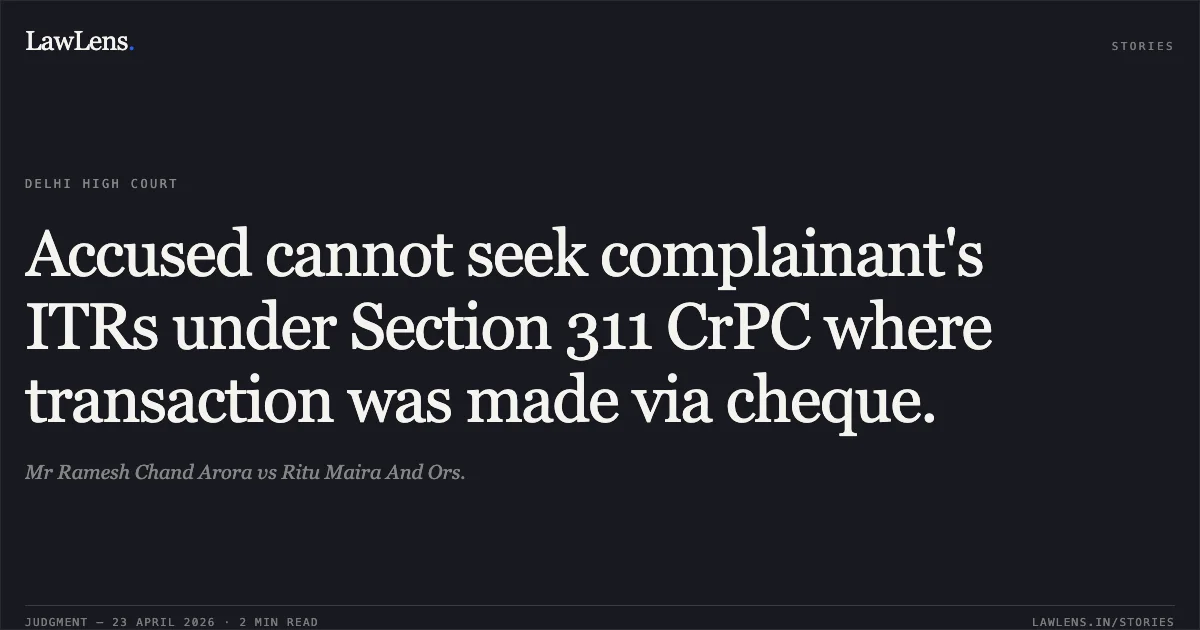
The Respondent filed a complaint under Section 138 of the Negotiable Instruments Act, 1881, in 2019, alleging that a loan of ₹25,00,000 advanced to the Petitioner via cheque—pursuant to an MoU dated 22.02.2018—remained unpaid after the repayment cheque was dishonored for "funds insufficient".
Source reference: para 1-2At the stage of final arguments, the Petitioner (accused) filed an application under Section 311 Cr.P.C. to summon the Income Tax Assessment Officer to produce the Respondent’s ITRs, contending the amount was an "investment" subject to market risk rather than a loan.
Source reference: para 4-5The Trial Court dismissed the application, noting the transaction was non-cash and the dispute concerned the "purpose" rather than the "fact" of the transaction.
Source reference: para 6This dismissal was upheld by the Revisional Court on 02.04.2026. The Petitioner subsequently moved the High Court under Section 528 of the Bharatiya Nagarik Suraksha Sanhita (BNSS).
Source reference: para 7Issues
1. Whether the production of the Complainant’s Income Tax Returns is necessary under Section 311 Cr.P.C. to determine the nature of a transaction conducted via cheque.
Source reference: para 11-122. Whether a petition under Section 528 of the BNSS (inherent powers) is maintainable when it effectively functions as a second revision petition barred by law.
Source reference: para 14Law Applied
The Court applied Section 311 of the Cr.P.C. regarding the power to summon material witnesses and Section 528 of the BNSS (corresponding to Section 482 Cr.P.C.) regarding inherent powers of the High Court.
Source reference: para 14Inherent powers cannot be utilized to circumvent express statutory bars, such as the prohibition against a second revision petition, citing Dharampal v. Ramshri and Deepti alias Arati Rai v. Akhil Rai.
Source reference: para 14In Negotiable Instruments Act cases, the financial capacity of a complainant is not automatically relevant if the transaction was made through banking channels.
Source reference: para 11Reasoning
The Court reasoned that since the ₹25,00,000 was admittedly transferred via cheque (not cash), the financial capacity of the Respondent was not a triable issue of doubt that necessitated peeping into her ITRs.
Source reference: para 10-12The Court observed that the Petitioner's defense—that the payment was an investment rather than a loan—could be established independently without recourse to tax records.
Source reference: para 12Procedurally, the Court found the petition to be an attempt to bypass the legal bar on second revisions. It determined that the inherent powers under BNSS could only be invoked in cases of serious miscarriage of justice or abuse of process, neither of which were present here, as the lower courts' findings were well-reasoned.
Source reference: para 14Holding
The High Court dismissed the petition, holding that there was no merit in seeking the complainant's ITRs when the transaction was documented via banking channels and the financial capacity was not genuinely in question.
The Court further held that the petition was an impermissible second revision under the guise of invoking inherent powers. The Trial Court and Revisional Court orders were upheld.
Source reference: para 14, 15Acts & Sections Cited
3 provisions across 3 statutes referred to in this judgment. Each provision opens on LawLens.
Negotiable Instruments Act, 18811
Code of Criminal Procedure, 19731
Bharatiya Nagarik Suraksha Sanhita, 20231
Original Court PDF
Mr Ramesh Chand AroravsRitu Maira And Ors.
Click to open original judgment
Original judgment, available to read, download and summarize on LawLens.in