01Facts
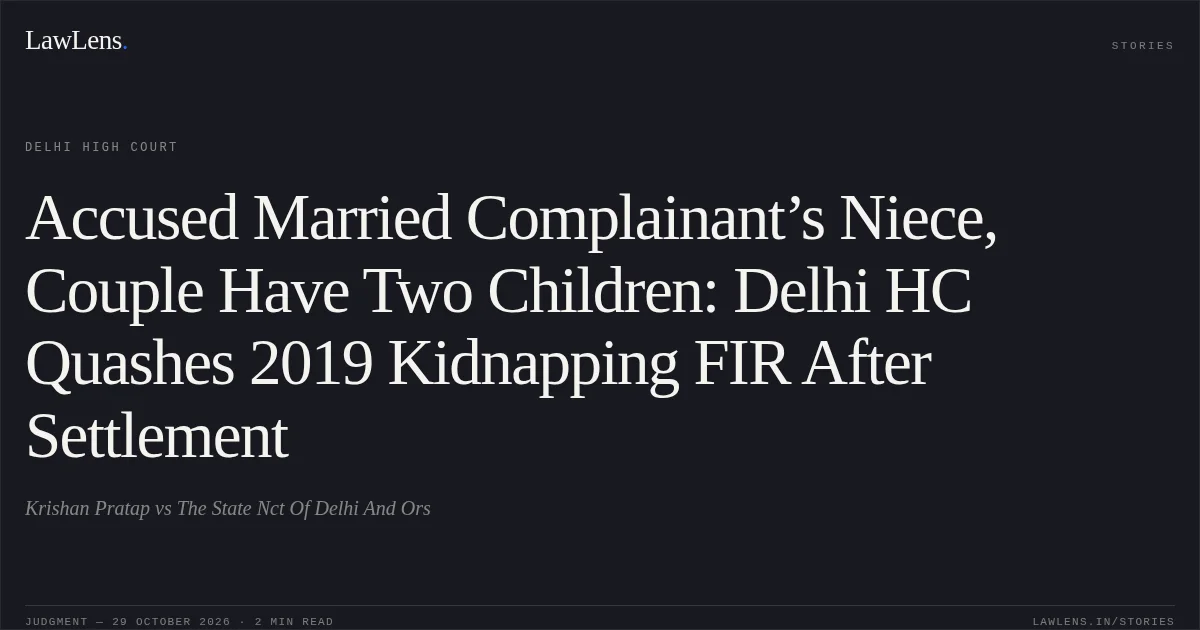
The petitioner sought to quash FIR No. 69/2019, registered under Section 363 of the Indian Penal Code, 1860 (IPC), alleging that he had lured away respondent no. 2, the complainant’s niece
p. 1The petitioner and respondent no. 2 married on 10 April 2019, have since lived together, and have two children
p. 2Under a settlement deed dated 28 February 2026, respondent nos. 2 and 3 agreed to the FIR being quashed
p. 2The petitioner and both respondents confirmed that the settlement was voluntary, and the Investigating Officer identified them before the Court
p. 7The petition was brought under Section 528 of the Bharatiya Nagarik Suraksha Sanhita, 2023 (BNSS)
p. 102Issues
i.1. Whether the High Court could quash a non-compoundable FIR under Section 363 IPC under its inherent jurisdiction on the basis of a settlement between the parties
pp. 4–6ii.2. Whether, in the circumstances of this case, quashing the FIR would serve the ends of justice and prevent abuse of the process of the court
p. 4, 703Law Applied
Section 528 BNSS, corresponding to Section 482 of the Code of Criminal Procedure, 1973, preserves the High Court’s inherent power to quash criminal proceedings to secure the ends of justice or prevent abuse of process; that power is distinct from the statutory power to compound offences and may extend to non-compoundable offences
pp. 4–5Under Gian Singh v. State of Punjab, (2012) 10 SCC 303, and Narinder Singh v. State of Punjab, (2014) 6 SCC 466, the Court must consider the nature and gravity of the offence, whether it is essentially private in character, the likelihood of conviction, and whether continuing the proceedings would cause injustice despite the settlement
pp. 5–6Serious offences with substantial societal impact are generally unsuitable for settlement-based quashing
p. 5Provisions in the judgment · 5 · Linked ones open on LawLens
Bharatiya Nagarik Suraksha Sanhita, 2023 Section 528
Indian Penal Code, 1860 Section 363Section 307
Code of Criminal Procedure, 1973 Section 482Section 320
04Reasoning
The FIR alleged only an offence under Section 363 IPC, with no other offence alleged
p. 4The Court considered that respondent no. 2 had married the petitioner shortly after the FIR was registered, the couple had lived together since, they had two children, and more than seven years had elapsed
p. 4In light of the parties’ voluntary settlement, the private and familial nature of the dispute, and the remote and bleak possibility of conviction, the Court concluded that continuing the proceedings would serve no meaningful purpose
p. 4, 7It also relied on a coordinate Bench decision involving a comparable Section 363 IPC FIR
p. 605Holding
The Court held that there was no impediment to quashing the FIR on the basis of the settlement
p. 7It allowed the petition and quashed FIR No. 69/2019, registered at PS Khajuri Khas under Section 363 IPC, together with all consequential proceedings; a copy of the order was directed to be sent to the trial court
pp. 7–8Original Court PDF
Krishan PratapvsThe State Nct Of Delhi And Ors
Click to open original judgment
Original judgment, available to read, download and summarize on LawLens.in