Facts
The applicant was provisionally selected for the post of Constable (Executive) in the Delhi Police.
Source reference: p. 2During the recruitment process, he disclosed his involvement in two criminal cases: FIR No. 50/2021 (attempt to murder/rioting) and FIR No. 138/2022 (robbery/assault).
Source reference: p. 7-8In the first case, he was acquitted after witnesses turned hostile.
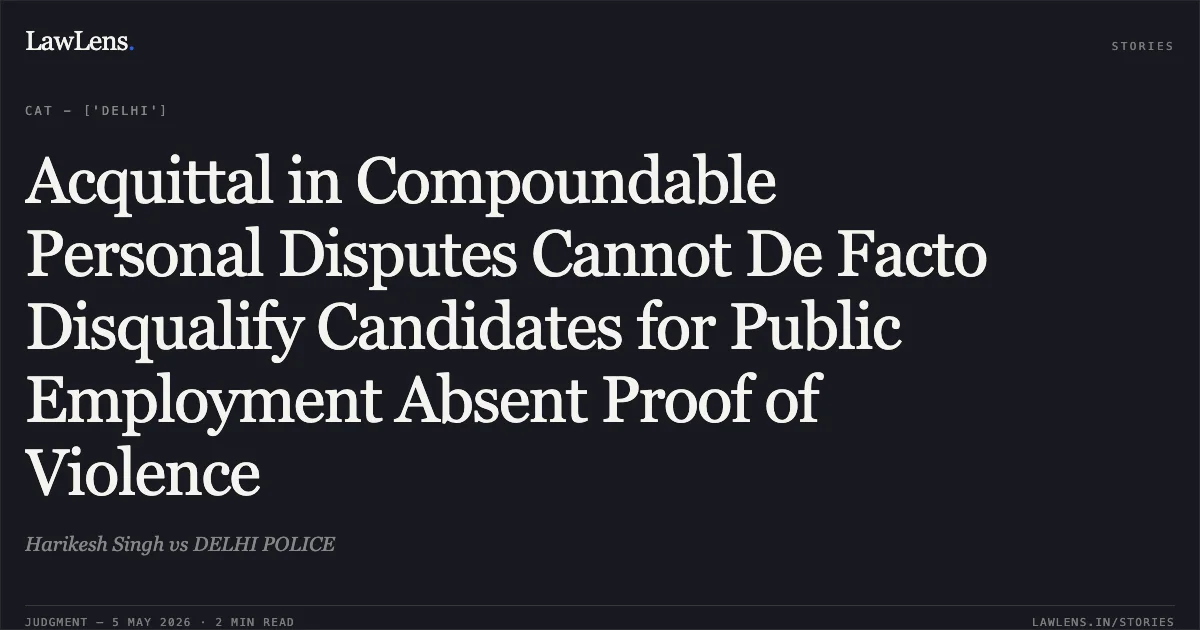
Source reference: p. 4-5In the second case, the charges were diluted to simple hurt and criminal intimidation, and he was acquitted following a lawful compromise/compounding of offences.
Source reference: p. 5-6Despite these acquittals, the Delhi Police Screening Committee rejected his candidature via order dated 16.12.2024, citing the "serious nature" of the original charges and a "propensity for violence".
Source reference: p. 2, 14-15The applicant challenged this rejection as arbitrary.
Source reference: p. 3Issues
1. Whether the mere involvement in a criminal case or an acquittal based on a compromise/hostile witnesses is sufficient ground to denigrate a candidate's suitability for a disciplined force.
Source reference: p. 9-102. Whether the Screening Committee exercised its discretion reasonably and in accordance with Standing Order No. HRD-12/2022.
Source reference: p. 13-14Law Applied
Delhi Police Standing Order No. HRD-12/2022, which mandates a "nuanced, case-specific assessment" of a candidate’s antecedents, including the nature of involvement and circumstances of acquittal.
Source reference: p. 9-12Supreme Court precedent of Avtar Singh v. Union of India (2016) regarding the disclosure of criminal antecedents.
Source reference: p. 10Supreme Court precedent of Commissioner of Police v. Mehar Singh, which established that while an employer has the right to assess suitability, the decision must not be arbitrary.
Source reference: p. 8-9Delhi High Court's ruling in Vikram Ruhal v. Delhi Police, emphasizing that acquittals in personal/village disputes should not mechanically lead to unfitness.
Source reference: p. 16-17Reasoning
The Tribunal found that the Screening Committee failed to conduct a balanced evaluation as required by the Standing Order.
Source reference: p. 14-15Specifically, the Committee focused on the initial serious sections mentioned in the FIRs (e.g., Section 395/307 IPC) rather than the final outcome, where the applicant was only charge-sheeted for compoundable offences or acquitted due to lack of evidence.
Source reference: p. 14-15The Tribunal noted that the Committee’s conclusion—that the applicant had a "violent tendency"—was based on surmises and "conjectural" assumptions such as "witnesses being won over," rather than objective material or subsequent bad conduct.
Source reference: p. 15-16The Court reasoned that since the offences arose from local/village disputes and were lawfully settled or resulted in acquittal, they should not be used as an absolute bar to employment without balancing them against mitigating factors.
Source reference: p. 6-7, 16Holding
The Tribunal held that while acquittal does not grant an automatic right to appointment, the assessment of suitability must be fair and judicious.
The Tribunal allowed the O.A. in part and set aside the impugned rejection order, directing respondents to place the applicant's case before a fresh Screening Committee within 8 weeks to reconsider his suitability objectively; if found suitable, he is to be granted notional seniority.
Source reference: p. 17-18Acts & Sections Cited
140 provisions across 4 statutes referred to in this judgment. Each provision opens on LawLens.
Indian Penal Code, 1860
Code of Criminal Procedure, 19733
Arms Act, 19592
Public Gambling Act, 18671
Original Court PDF
Harikesh SinghvsDELHI POLICE
Click to open original judgment
Original judgment, available to read, download and summarize on LawLens.in