Facts
On April 11, 1998, the complainant and his family were working on an encroached agricultural field near Vallabhgam
Source reference: p. 2The prosecution alleged that the respondents formed an unlawful assembly, armed with sticks, axes, and spears, and assaulted the complainant while using caste-based slurs
Source reference: p. 2The complainant was treated at a government hospital for minor injuries.
Source reference: no citationthe trial court acquitted the accused on August 16, 2010, noting discrepancies in medical evidence and the failure to prove the presence of a five-member unlawful assembly
Source reference: p. 1, 8The State of Gujarat filed this appeal against the acquittal
Source reference: p. 3Issues
1. Whether the trial Court was justified in passing the judgment and order of acquittal based on the available evidence
Source reference: p. 62. Whether there is any manifest illegality, irregularity, or perversity in the impugned judgment of acquittal warranting interference
Source reference: p. 6Law Applied
The court applied Section 378 of the Code of Criminal Procedure (CrPC) regarding appeals against acquittal
Source reference: p. 1It invoked the evidentiary requirements of Section 3(1)(x) of the Atrocity Act, which requires proof of intent to insult in a "public view"
Source reference: p. 9The "double presumption of innocence" principle was applied, emphasizing that an acquittal reinforces the initial presumption of innocence
Source reference: p. 10The court relied on precedents including Chandrappa v. State of Karnataka (2007), Rajesh Prasad v. State of Bihar (2022), and Ramesh v. State of Karnataka (2024) to define the limited scope of appellate interference in acquittals.
Source reference: p. 11, 12Reasoning
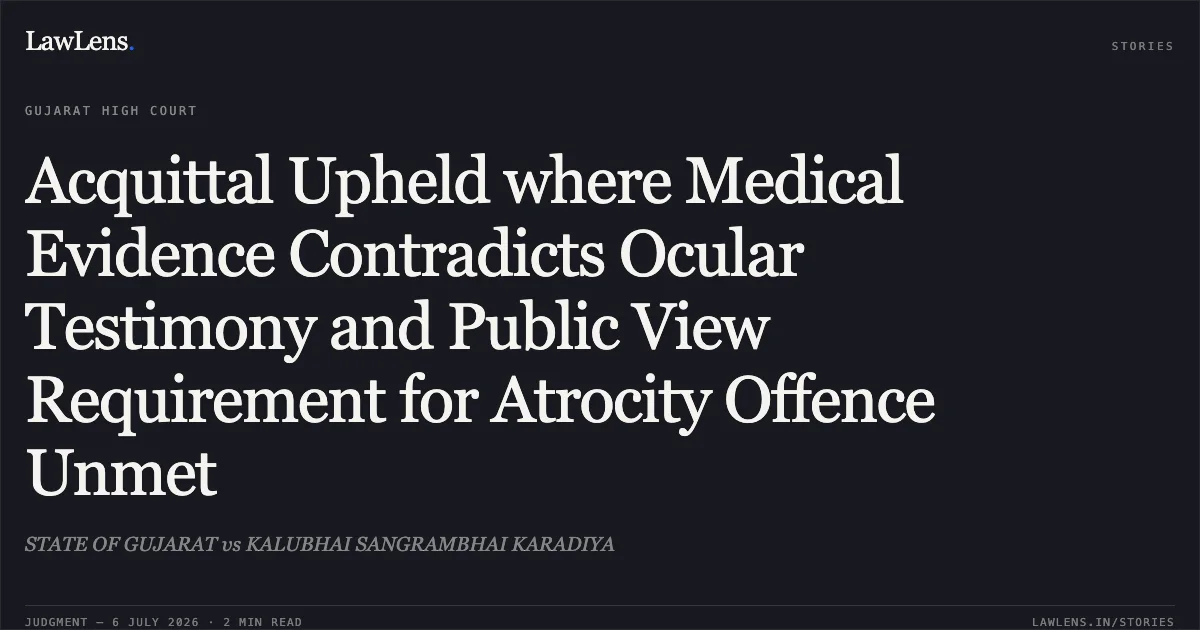
The Court observed that the medical evidence provided by P.W.1 (Doctor) contradicted the ocular testimony; while the complainant alleged a brutal assault with sharp weapons and sticks, the medical report showed only simple skin lesions likely caused by a fall
Source reference: p. 7-8Regarding the Atrocity Act, the prosecution failed to produce a valid caste certificate and could not prove the incident occurred in "public view," as it took place in a private agricultural field
Source reference: p. 9Furthermore, since the fifth accused was never joined or identified, the charge of "unlawful assembly" under Section 141-149 of the IPC could not be sustained
Source reference: p. 8The Court found that the trial court's view was a "reasonable conclusion" and noted that the State failed to demonstrate any perversity or misreading of evidence
Source reference: p. 13-14Holding
The High Court dismissed the appeal and confirmed the trial court's order of acquittal
It held that the prosecution miserably failed to prove the charges beyond a reasonable doubt and that the appellate court should not disturb an acquittal merely because a second view is possible
Source reference: p. 13-14The bail bonds were cancelled, and the record was ordered back to the Trial Court
Source reference: p. 14Acts & Sections Cited
10 provisions across 3 statutes referred to in this judgment. Each provision opens on LawLens.
Code of Criminal Procedure, 19732
Indian Penal Code, 18607
Scheduled Castes and the Scheduled Tribes (Prevention of Atrocities) Act, 19891
Original Court PDF
STATE OF GUJARATvsKALUBHAI SANGRAMBHAI KARADIYA
Click to open original judgment
Original judgment, available to read, download and summarize on LawLens.in