Facts
The petitioner-complainant’s son, Gurjant Singh, was allegedly murdered on 12.10.2014 by a group of armed persons, resulting in registration of FIR No. 151 under Sections 302, 201, 120-B, 148 and 149 IPC at Police Station Sarhali, District Tarn Taran.
Source reference: para. 2Respondents Nos. 2 to 4—Stalinjit Singh, Gurdev Singh and Gurcharan Singh—were prosecuted in the case; Gurcharan Singh was subsequently summoned under Section 319 Cr.P.C.
Source reference: para. 3After trial, all three were acquitted by the Additional Sessions Judge, Tarn Taran, on 04.08.2018.
Source reference: paras. 7–8The High Court had earlier directed re-investigation of the entire case on 06.12.2019, following concerns regarding the investigation, prosecution and conduct of the earlier trial.
Source reference: para. 8A supplementary report under Section 173(8) Cr.P.C. was thereafter submitted, again naming respondents Nos. 2 to 4 as accused. Since they had already been acquitted, they were not summoned when the case was committed against the remaining accused.
Source reference: para. 8The petitioner’s application seeking their summoning was dismissed by the trial Court on 25.03.2021 on the ground that the prior acquittal remained operative and Section 300 Cr.P.C. barred a second trial. The petitioner challenged that order under Section 482 Cr.P.C.
Source reference: para. 8Issues
Whether persons who had already faced trial and been acquitted could be summoned afresh, for the same occurrence and offences, solely on the basis of a subsequent re-investigation and supplementary report under Section 173(8) Cr.P.C.?
Source reference: paras. 15, 19–21Whether the earlier acquittal could be treated as a nullity or ignored because it was pronounced despite the High Court’s order staying pronouncement of the final judgment?
Source reference: paras. 16–18Whether the trial Court committed jurisdictional error by considering the effect of Section 300 Cr.P.C. while deciding the application for summoning?
Source reference: para. 22Law Applied
Section 482 Cr.P.C. preserves the High Court’s inherent jurisdiction but cannot be used as a substitute for a specific appellate or revisional remedy, or to indirectly nullify a subsisting judgment of acquittal.
Source reference: para. 15Section 300 Cr.P.C. embodies the rule against double jeopardy and bars a second prosecution for the same offence after a competent Court has tried and acquitted or convicted the accused; the protection applies where the earlier prosecution was valid, the acquittal remains in force, and the subsequent proceeding concerns the same offence and facts, as explained in T.P. Gopalakrishnan v. State of Kerala, (2022) 14 SCC 323.
Source reference: para. 17Article 20(2) of the Constitution similarly protects against prosecution and punishment for the same offence, with the identity of offences determined by their ingredients, as stated in State of Bombay v. S.L. Apte, AIR 1961 SC 578.
Source reference: para. 21A distinction exists between retrial and re-investigation; re-investigation after acquittal cannot, by itself, authorise a fresh prosecution for the same offence, as held in P. Manikandan v. CBI, 2024 INSC 1007.
Source reference: para. 17Further, an order alleged to be void or passed in breach of a superior Court’s direction cannot simply be ignored without being set aside in appropriate proceedings; it remains operative until judicially invalidated, consistent with Tayabbhai M. Bagasarwalla v. Hind Rubber Industries (P) Ltd., (1997) 3 SCC 443, Shiv Chander Kapoor v. Amar Bose, (1990) 1 SCC 234, and State of Punjab v. Gurdev Singh, (1991) 4 SCC 1.
Source reference: paras. 16–17Reasoning
The Court held that respondents Nos. 2 to 4 had been tried by a competent Court in the same FIR, had participated in a complete trial, had their statements recorded under Section 313 Cr.P.C., and had been acquitted on 04.08.2018.
Source reference: para. 21That acquittal had never been challenged successfully or set aside and therefore continued to operate. The subsequent re-investigation and supplementary report did not disclose any distinct offence or specific fresh evidence capable of overcoming the statutory protection under Section 300 Cr.P.C.; merely naming the respondents again in the report could not revive a concluded prosecution.
Source reference: para. 20Although the earlier judgment was pronounced despite the High Court’s order staying pronouncement, that breach did not automatically render the acquittal non-existent. Its validity had to be determined in appropriate appellate, revisional or other legally maintainable proceedings, rather than collaterally under Section 482 Cr.P.C.
Source reference: paras. 16–18, 24The trial Court therefore rightly examined Section 300 Cr.P.C. as a threshold bar to summoning and did not exceed the scope of the petitioner’s application.
Source reference: para. 22Holding
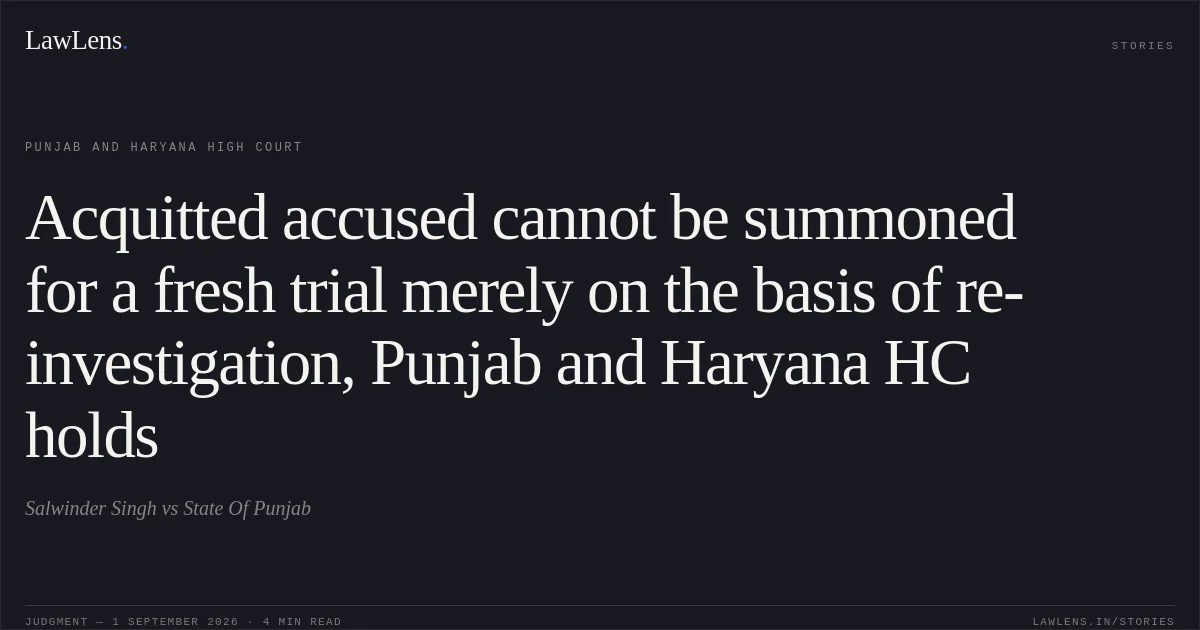
The High Court answered the issues against the petitioner. It held that respondents Nos. 2 to 4 could not be summoned for a second trial on the basis of the supplementary report while their prior acquittal remained in force, and that the alleged breach of the stay order did not automatically obliterate that acquittal.
Finding no illegality, perversity or jurisdictional error in the order dated 25.03.2021, the Court dismissed the petition under Section 482 Cr.P.C.
Source reference: para. 24The petitioner was, however, left free to pursue any legally available remedy against the judgment of acquittal dated 04.08.2018, subject to objections regarding maintainability, limitation, delay, condonation and jurisdiction.
Source reference: para. 25Acts & Sections Cited
15 provisions across 3 statutes referred to in this judgment. Each provision opens on LawLens.
Code of Criminal Procedure, 19737
Indian Penal Code, 18606
Arms Act, 19592
Original Court PDF
Salwinder SinghvsState Of Punjab
Click to open original judgment
Original judgment, available to read, download and summarize on LawLens.in