Facts
The petitioner-firm challenged the classification and reporting of its bank account as “fraud” on the RBI Central Fraud Registry and sought deletion of the fraud flag, restoration of banking facilities, and consequential reliefs under Article 226 of the Constitution.
Source reference: p.1The petitioner alleged that the Bank had failed to follow the applicable Standard Operating Procedure, had not conducted a forensic audit or identified the petitioner’s individual role, and had not properly considered its reply to the show-cause notices.
Source reference: p.2The Bank contended that the petitioner had been served two show-cause notices, after which it waited for approximately five months before classifying the account as fraudulent on 22 February 2026.
Source reference: p.3According to the Bank, loan proceeds had been credited against invoices issued by the petitioner for machinery, but neither the borrower nor the petitioner could substantiate that the machinery transaction had actually taken place.
Source reference: pp.3–4The petitioner’s complaint before the Ombudsman was also closed, and the Bank’s action was endorsed.
Source reference: p.3Issues
1. Whether the Bank’s classification of the petitioner’s account as “fraud” was invalid for non-compliance with the principles of natural justice and the applicable procedure, including the alleged failure to provide a personal hearing and pass a reasoned order.
Source reference: pp.1–2, 4–52. Whether the factual disputes concerning the underlying machinery transaction, return of funds, alleged procedural violations, and the petitioner’s role could be adjudicated in a writ petition under Article 226 of the Constitution.
Source reference: pp.2–3, 53. Whether the petitioner was entitled to deletion of the fraud classification, restoration of banking operations, and other consequential reliefs.
Source reference: pp.1, 5Law Applied
The Court exercised its jurisdiction under Article 226 of the Constitution but reiterated that disputed and evidence-dependent factual matters ordinarily cannot be conclusively determined in writ proceedings.
Source reference: pp.1, 5It considered the natural-justice principles recognised in State Bank of India v. Rajesh Agarwal, (2023) 6 SCC 1, including the requirement of procedural fairness before fraud classification; the decisions in State Bank of India v. Jah Developers Pvt. Ltd., (2019) 6 SCC 787, and Erusian Equipment & Chemicals Ltd. v. State of West Bengal, (1975) 1 SCC 70, relied upon by the petitioner regarding the serious civil consequences of adverse classification; and the subsequent decision in State Bank of India v. Amit Iron Private Limited & Others, Civil Appeal Nos. 4243–4244 of 2026, which, as understood by the Court, clarified that a personal hearing was not mandatory in such matters.
Source reference: pp.2–3, 5The Court applied the principle that where the bank has issued notices, allowed time for response, and followed the prescribed procedure, judicial interference is not warranted merely because the affected party disputes the factual basis of the classification.
Source reference: pp.4–5Reasoning
The Court found that two notices had admittedly been served on the petitioner and that the Bank had waited five months before classifying the account as fraudulent.
Source reference: p.4On the material before it, the Court considered the Bank’s concern prima facie justified: funds were credited pursuant to invoices issued by the petitioner, but the petitioner failed to substantiate the actual supply of machinery, while the borrower also could not establish the underlying transaction.
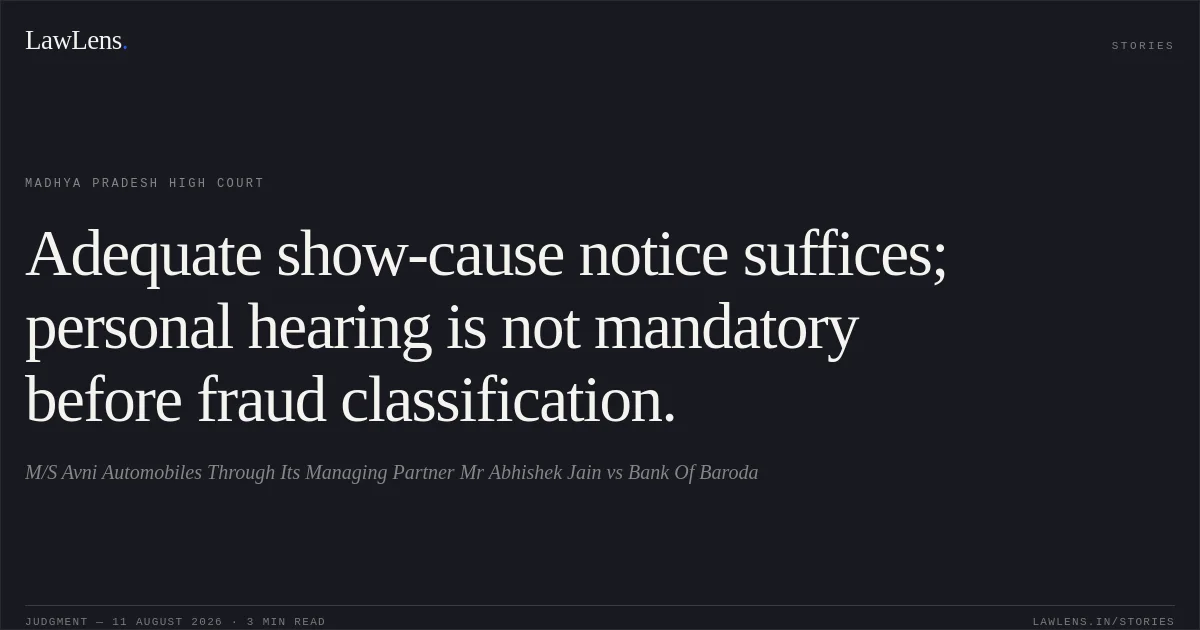
Source reference: pp.4–5Relying on Amit Iron, the Court held that a personal hearing was not required in the circumstances, and concluded that the Bank had sufficiently complied with natural-justice requirements.
Source reference: p.5The petitioner’s remaining allegations— including the alleged return of funds, procedural violations, absence of a forensic audit, and failure to identify individual responsibility—were treated as disputed factual issues requiring evidence and a full-fledged trial, which could not appropriately be undertaken under Article 226 or Article 227.
Source reference: pp.2, 5Holding
The Court held that, prima facie, the Bank had committed no error in classifying the petitioner’s account as “fraud” after following the requisite procedure and principles of natural justice.
It further held that the disputed factual issues could not be adjudicated in the writ jurisdiction and that the petitioner had no sufficient case on merits.
Source reference: p.5The writ petition was accordingly dismissed, with no relief granted regarding deletion of the fraud flag, restoration of banking facilities, independent inquiry, or costs.
Source reference: p.5Original Court PDF
M/S Avni Automobiles Through Its Managing Partner Mr Abhishek JainvsBank Of Baroda
Click to open original judgment
Original judgment, available to read, download and summarize on LawLens.in